
Question Number 901 by 123456 last updated on 17/Apr/15
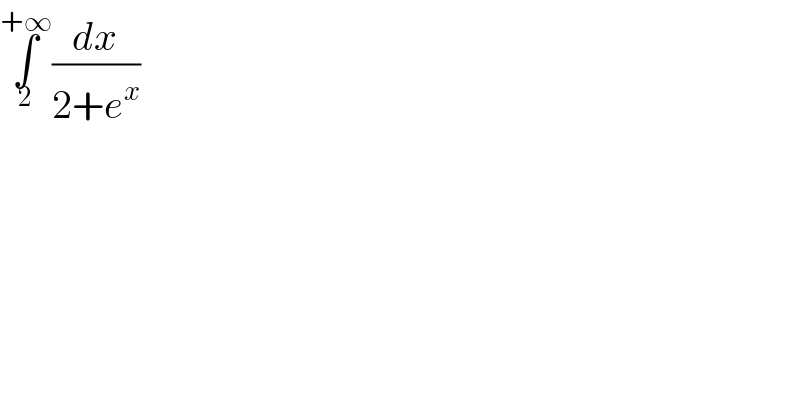
$$\underset{\mathrm{2}} {\overset{+\infty} {\int}}\frac{{dx}}{\mathrm{2}+{e}^{{x}} } \\ $$
Answered by prakash jain last updated on 17/Apr/15
![e^x =t e^x dx=dt⇒dx=(dt/t) ∫ (dt/(t(2+t)))=(1/2)[∫ (dt/t)−∫(dt/(2+t))]=(1/2)ln (t/(2+t))=(1/2)ln (e^x /(2+e^x )) caculating limits I=−(1/2) ∙ (e^2 /(1+e^2 ))](https://www.tinkutara.com/question/Q904.png)
$${e}^{{x}} ={t} \\ $$$${e}^{{x}} \:{dx}={dt}\Rightarrow{dx}=\frac{{dt}}{{t}} \\ $$$$\int\:\frac{{dt}}{{t}\left(\mathrm{2}+{t}\right)}=\frac{\mathrm{1}}{\mathrm{2}}\left[\int\:\frac{{dt}}{{t}}−\int\frac{{dt}}{\mathrm{2}+{t}}\right]=\frac{\mathrm{1}}{\mathrm{2}}\mathrm{ln}\:\frac{{t}}{\mathrm{2}+{t}}=\frac{\mathrm{1}}{\mathrm{2}}\mathrm{ln}\:\frac{{e}^{{x}} }{\mathrm{2}+{e}^{{x}} } \\ $$$${caculating}\:{limits} \\ $$$${I}=−\frac{\mathrm{1}}{\mathrm{2}}\:\centerdot\:\frac{{e}^{\mathrm{2}} }{\mathrm{1}+{e}^{\mathrm{2}} } \\ $$