
Question Number 8070 by FilupSmith last updated on 29/Sep/16
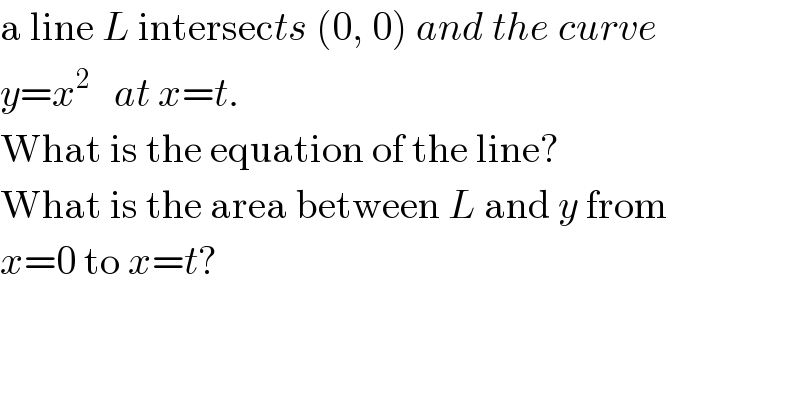
$$\mathrm{a}\:\mathrm{line}\:{L}\:\mathrm{intersec}{ts}\:\left(\mathrm{0},\:\mathrm{0}\right)\:{and}\:{the}\:{curve} \\ $$$${y}={x}^{\mathrm{2}} \:\:\:{at}\:{x}={t}. \\ $$$$\mathrm{What}\:\mathrm{is}\:\mathrm{the}\:\mathrm{equation}\:\mathrm{of}\:\mathrm{the}\:\mathrm{line}? \\ $$$$\mathrm{What}\:\mathrm{is}\:\mathrm{the}\:\mathrm{area}\:\mathrm{between}\:{L}\:\mathrm{and}\:{y}\:\mathrm{from} \\ $$$${x}=\mathrm{0}\:\mathrm{to}\:{x}={t}? \\ $$
Answered by sandy_suhendra last updated on 29/Sep/16
![so the line L intersects (0,0) and (t, t^2 ) the equation of L ⇒ ((x−x_1 )/(x_2 −x_1 )) = ((y−y_1 )/(y_2 −y_1 )) ((x−t)/(0−t)) = ((y−t^2 )/(0−t^2 )) tx−t^2 = y−t^2 y=tx the area between L and y = _0 ∫^( t) (tx−x^2 ) dx = [(1/2_ )tx^2 −(1/3)x^3 ]_( 0) ^( t) =(1/2)t^3 −(1/3)t^3 = (1/6)t^3](https://www.tinkutara.com/question/Q8079.png)
$${so}\:{the}\:{line}\:{L}\:{intersects}\:\left(\mathrm{0},\mathrm{0}\right)\:{and}\:\left({t},\:{t}^{\mathrm{2}} \right) \\ $$$${the}\:{equation}\:{of}\:{L}\:\Rightarrow\:\frac{{x}−{x}_{\mathrm{1}} }{{x}_{\mathrm{2}} −{x}_{\mathrm{1}} }\:=\:\frac{{y}−{y}_{\mathrm{1}} }{{y}_{\mathrm{2}} −{y}_{\mathrm{1}} } \\ $$$$\:\:\:\:\:\:\:\:\:\:\:\:\:\:\:\:\:\:\:\:\:\:\:\:\:\:\:\:\:\:\:\:\:\:\:\:\frac{{x}−{t}}{\mathrm{0}−{t}}\:=\:\frac{{y}−{t}^{\mathrm{2}} }{\mathrm{0}−{t}^{\mathrm{2}} } \\ $$$$\:\:\:\:\:\:\:\:\:\:\:\:\:\:\:\:\:\:\:\:\:\:\:\:\:\:\:\:\:\:\:\:\:\:\:\:\:{tx}−{t}^{\mathrm{2}} \:=\:{y}−{t}^{\mathrm{2}} \\ $$$$\:\:\:\:\:\:\:\:\:\:\:\:\:\:\:\:\:\:\:\:\:\:\:\:\:\:\:\:\:\:\:\:\:\:\:\:\:\:\:\:\:\:\:\:\:\:\boldsymbol{{y}}=\boldsymbol{{tx}} \\ $$$${the}\:{area}\:{between}\:{L}\:{and}\:{y} \\ $$$$=\:\:_{\mathrm{0}} \int^{\:\:{t}} \:\left({tx}−{x}^{\mathrm{2}} \right)\:{dx} \\ $$$$=\:\left[\frac{\mathrm{1}}{\mathrm{2}_{} }{tx}^{\mathrm{2}} −\frac{\mathrm{1}}{\mathrm{3}}{x}^{\mathrm{3}} \:\right]_{\:\mathrm{0}} ^{\:{t}} \\ $$$$=\frac{\mathrm{1}}{\mathrm{2}}{t}^{\mathrm{3}} −\frac{\mathrm{1}}{\mathrm{3}}{t}^{\mathrm{3}} \:=\:\frac{\mathrm{1}}{\mathrm{6}}\boldsymbol{{t}}^{\mathrm{3}} \\ $$