
Question Number 5712 by sanusihammed last updated on 24/May/16
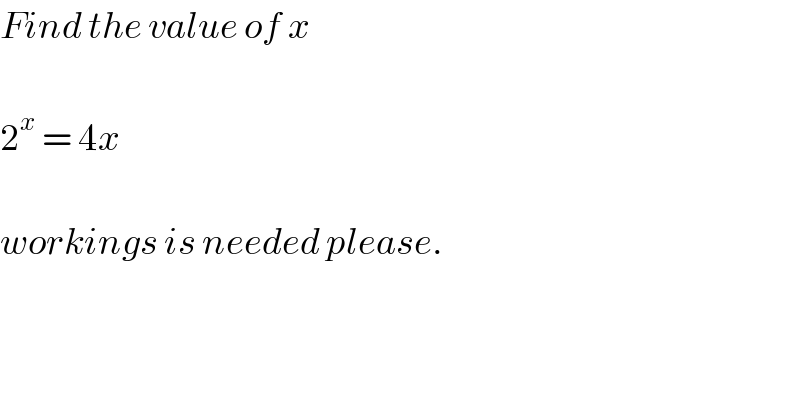
$${Find}\:{the}\:{value}\:{of}\:{x}\: \\ $$$$ \\ $$$$\mathrm{2}^{{x}} \:=\:\mathrm{4}{x} \\ $$$$ \\ $$$${workings}\:{is}\:{needed}\:{please}. \\ $$
Commented by Yozzii last updated on 24/May/16
![2^x =4x ⇒2^(x−2) =x Try x=4. ⇒2^(4−2) =4=2^2 2^2 =2^2 ∴ x=4 is one solution. 2^(x−2) >0 ∀x∈R⇒if 2^(x−2) =x⇒x>0 if real solutions are to exist. If x∈N⇒ x is even since x=2^(x−2) and 2^(x−2) is even for x−2≥1⇒x≥3. For x≥6 2^(x−2) ≥2^(6−2) =16 and 2^(x−2) diverges rapidly (note that (d/dx)(2^(x−2) )=2^(x−2) ln2) whereas x rises at a linear rate ((d/dx)(x)=1<2^(x−2) ln2 for x≥3). This indicates that no further integer solutions could possibly exist for 2^x =4x. Graphing the two functions y=4x and y=2^x (x∈R) shows that some other root lies in the interval [0,1]. Any method of determining the root approximately could be used : Interval bisection, Newton−Raphson method, Linear interpolation, etc...](https://www.tinkutara.com/question/Q5713.png)
$$\mathrm{2}^{{x}} =\mathrm{4}{x} \\ $$$$\Rightarrow\mathrm{2}^{{x}−\mathrm{2}} ={x} \\ $$$${Try}\:{x}=\mathrm{4}.\:\Rightarrow\mathrm{2}^{\mathrm{4}−\mathrm{2}} =\mathrm{4}=\mathrm{2}^{\mathrm{2}} \\ $$$$\mathrm{2}^{\mathrm{2}} =\mathrm{2}^{\mathrm{2}} \therefore\:{x}=\mathrm{4}\:{is}\:{one}\:{solution}. \\ $$$$\mathrm{2}^{{x}−\mathrm{2}} >\mathrm{0}\:\forall{x}\in\mathbb{R}\Rightarrow{if}\:\mathrm{2}^{{x}−\mathrm{2}} ={x}\Rightarrow{x}>\mathrm{0}\:{if} \\ $$$${real}\:{solutions}\:{are}\:{to}\:{exist}. \\ $$$${If}\:{x}\in\mathbb{N}\Rightarrow\:{x}\:{is}\:{even}\:{since}\:{x}=\mathrm{2}^{{x}−\mathrm{2}} \\ $$$${and}\:\mathrm{2}^{{x}−\mathrm{2}} \:{is}\:{even}\:{for}\:{x}−\mathrm{2}\geqslant\mathrm{1}\Rightarrow{x}\geqslant\mathrm{3}. \\ $$$${For}\:{x}\geqslant\mathrm{6}\:\mathrm{2}^{{x}−\mathrm{2}} \geqslant\mathrm{2}^{\mathrm{6}−\mathrm{2}} =\mathrm{16}\:{and}\:\mathrm{2}^{{x}−\mathrm{2}} \:{diverges} \\ $$$${rapidly}\:\left({note}\:{that}\:\frac{{d}}{{dx}}\left(\mathrm{2}^{{x}−\mathrm{2}} \right)=\mathrm{2}^{{x}−\mathrm{2}} {ln}\mathrm{2}\right)\:{whereas}\:{x}\:{rises}\:{at} \\ $$$${a}\:{linear}\:{rate}\:\left(\frac{{d}}{{dx}}\left({x}\right)=\mathrm{1}<\mathrm{2}^{{x}−\mathrm{2}} {ln}\mathrm{2}\:{for}\:{x}\geqslant\mathrm{3}\right). \\ $$$${This}\:{indicates}\:{that}\:{no}\:{further}\:{integer} \\ $$$${solutions}\:{could}\:{possibly}\:{exist}\:{for}\:\mathrm{2}^{{x}} =\mathrm{4}{x}. \\ $$$$ \\ $$$${Graphing}\:{the}\:{two}\:{functions}\:{y}=\mathrm{4}{x} \\ $$$${and}\:{y}=\mathrm{2}^{{x}} \:\:\:\left({x}\in\mathbb{R}\right)\:{shows}\:{that}\:{some}\:{other} \\ $$$${root}\:{lies}\:{in}\:{the}\:{interval}\:\left[\mathrm{0},\mathrm{1}\right]. \\ $$$${Any}\:{method}\:{of}\:{determining}\:{the}\:{root} \\ $$$${approximately}\:{could}\:{be}\:{used}\::\:{Interval} \\ $$$${bisection},\:{Newton}−{Raphson}\:{method},\:{Linear} \\ $$$${interpolation},\:{etc}… \\ $$
Commented by sanusihammed last updated on 24/May/16

$${Thaks}.\:{no}\:{algeraic}\:{solution}.? \\ $$
Commented by Yozzii last updated on 25/May/16
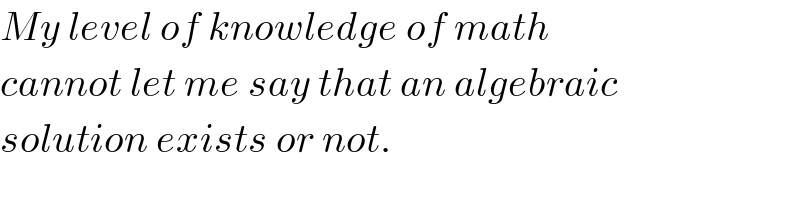
$${My}\:{level}\:{of}\:{knowledge}\:{of}\:{math} \\ $$$${cannot}\:{let}\:{me}\:{say}\:{that}\:{an}\:{algebraic} \\ $$$${solution}\:{exists}\:{or}\:{not}. \\ $$