
Question Number 1582 by 112358 last updated on 21/Aug/15
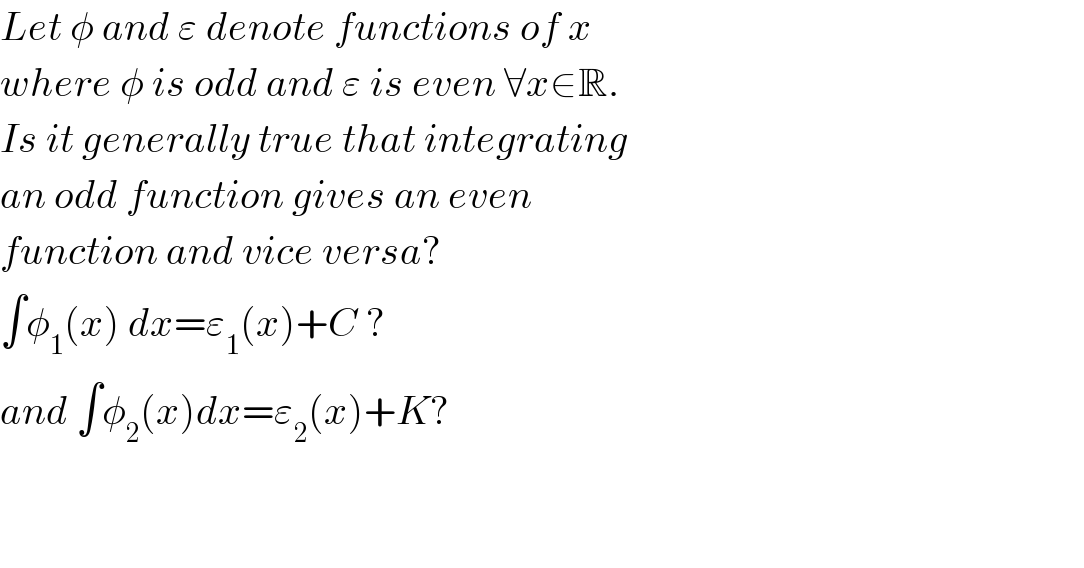
$${Let}\:\phi\:{and}\:\varepsilon\:{denote}\:{functions}\:{of}\:{x} \\ $$$${where}\:\phi\:{is}\:{odd}\:{and}\:\varepsilon\:{is}\:{even}\:\forall{x}\in\mathbb{R}. \\ $$$${Is}\:{it}\:{generally}\:{true}\:{that}\:{integrating} \\ $$$${an}\:{odd}\:{function}\:{gives}\:{an}\:{even} \\ $$$${function}\:{and}\:{vice}\:{versa}?\: \\ $$$$\int\phi_{\mathrm{1}} \left({x}\right)\:{dx}=\varepsilon_{\mathrm{1}} \left({x}\right)+{C}\:? \\ $$$${and}\:\int\phi_{\mathrm{2}} \left({x}\right){dx}=\varepsilon_{\mathrm{2}} \left({x}\right)+{K}? \\ $$$$ \\ $$$$ \\ $$
Answered by 123456 last updated on 23/Aug/15
![lets φ a odd function and ε a even function continuous and dirrentebiable into R, then φ(−x)=−φ(x) [φ(−x)]′=[−φ(x)]′ −φ′(−x)=−φ′(x) φ′(−x)=φ′(x) and ε(−x)=ε(x) [ε(−x)]′=[ε(x)]′ −ε′(−x)=ε′(x) ε′(−x)=ε′(x) then lets φ a odd function continuous and integable into R take ε(x):=∫_0 ^x φ(x)dx ε(−x)=∫_0 ^(−x) φ(t)dt+C u=−t⇒du=−dt t=0⇒u=0 t=−x⇒u=x ε(−x)=−∫_0 ^x φ(−u)du=∫_0 ^x φ(u)du=ε(x) then ε is a even function and you can write ∫φ(x)dx=∫_0 ^x φ(x)dx+C=ε(x)+C to finish lets ε(x) a even function contonuous and integrable on R take φ(x):=∫_0 ^x ε(t)dt φ(−x)=∫_0 ^(−x) ε(t)dt u=−t⇒du=−dt t=0⇒u=0 t=−x⇒u=xw φ(−x)=−∫_0 ^x ε(−u)du=−∫_0 ^x ε(u)du=−φ(x) then φ is a odd function and also ∫ε(x)dx=∫_0 ^x ε(t)dt+C=φ(x)+C](https://www.tinkutara.com/question/Q1584.png)
$$\mathrm{lets}\:\phi\:\mathrm{a}\:\mathrm{odd}\:\mathrm{function}\:\mathrm{and}\:\varepsilon\:\mathrm{a}\:\mathrm{even}\:\mathrm{function} \\ $$$$\mathrm{continuous}\:\mathrm{and}\:\mathrm{dirrentebiable}\:\mathrm{into}\:\mathbb{R},\:\mathrm{then} \\ $$$$\phi\left(−{x}\right)=−\phi\left({x}\right) \\ $$$$\left[\phi\left(−{x}\right)\right]'=\left[−\phi\left({x}\right)\right]' \\ $$$$−\phi'\left(−{x}\right)=−\phi'\left({x}\right) \\ $$$$\phi'\left(−{x}\right)=\phi'\left({x}\right) \\ $$$$\mathrm{and} \\ $$$$\varepsilon\left(−{x}\right)=\varepsilon\left({x}\right) \\ $$$$\left[\varepsilon\left(−{x}\right)\right]'=\left[\varepsilon\left({x}\right)\right]' \\ $$$$−\varepsilon'\left(−{x}\right)=\varepsilon'\left({x}\right) \\ $$$$\varepsilon'\left(−{x}\right)=\varepsilon'\left({x}\right) \\ $$$$\mathrm{then}\:\mathrm{lets}\:\phi\:\mathrm{a}\:\mathrm{odd}\:\mathrm{function}\:\mathrm{continuous}\:\mathrm{and}\:\mathrm{integable}\:\mathrm{into}\:\mathbb{R} \\ $$$$\mathrm{take}\:\varepsilon\left({x}\right):=\underset{\mathrm{0}} {\overset{{x}} {\int}}\phi\left({x}\right){dx} \\ $$$$\varepsilon\left(−{x}\right)=\underset{\mathrm{0}} {\overset{−{x}} {\int}}\phi\left({t}\right){dt}+\mathrm{C} \\ $$$${u}=−{t}\Rightarrow{du}=−{dt} \\ $$$${t}=\mathrm{0}\Rightarrow{u}=\mathrm{0} \\ $$$${t}=−{x}\Rightarrow{u}={x} \\ $$$$\varepsilon\left(−{x}\right)=−\underset{\mathrm{0}} {\overset{{x}} {\int}}\phi\left(−{u}\right){du}=\underset{\mathrm{0}} {\overset{{x}} {\int}}\phi\left({u}\right){du}=\varepsilon\left({x}\right) \\ $$$$\mathrm{then}\:\varepsilon\:\mathrm{is}\:\mathrm{a}\:\mathrm{even}\:\mathrm{function}\:\mathrm{and}\:\mathrm{you}\:\mathrm{can}\:\mathrm{write} \\ $$$$\int\phi\left({x}\right){dx}=\underset{\mathrm{0}} {\overset{{x}} {\int}}\phi\left({x}\right){dx}+\mathrm{C}=\varepsilon\left({x}\right)+\mathrm{C} \\ $$$$\mathrm{to}\:\mathrm{finish}\:\mathrm{lets}\:\varepsilon\left({x}\right)\:\mathrm{a}\:\mathrm{even}\:\mathrm{function}\:\mathrm{contonuous}\:\mathrm{and}\:\mathrm{integrable}\:\mathrm{on}\:\mathbb{R} \\ $$$$\mathrm{take}\:\phi\left({x}\right):=\underset{\mathrm{0}} {\overset{{x}} {\int}}\varepsilon\left({t}\right){dt} \\ $$$$\phi\left(−{x}\right)=\underset{\mathrm{0}} {\overset{−{x}} {\int}}\varepsilon\left({t}\right){dt} \\ $$$${u}=−{t}\Rightarrow{du}=−{dt} \\ $$$${t}=\mathrm{0}\Rightarrow{u}=\mathrm{0} \\ $$$${t}=−{x}\Rightarrow{u}={xw} \\ $$$$\phi\left(−{x}\right)=−\underset{\mathrm{0}} {\overset{{x}} {\int}}\varepsilon\left(−{u}\right){du}=−\underset{\mathrm{0}} {\overset{{x}} {\int}}\varepsilon\left({u}\right){du}=−\phi\left({x}\right) \\ $$$$\mathrm{then}\:\phi\:\mathrm{is}\:\mathrm{a}\:\mathrm{odd}\:\mathrm{function}\:\mathrm{and}\:\mathrm{also} \\ $$$$\int\varepsilon\left({x}\right){dx}=\underset{\mathrm{0}} {\overset{{x}} {\int}}\varepsilon\left({t}\right){dt}+\mathrm{C}=\phi\left({x}\right)+\mathrm{C} \\ $$
Commented by 112358 last updated on 23/Aug/15

$${Thanks}\: \\ $$