
Question Number 1791 by RasheedAhmad last updated on 29/Sep/15
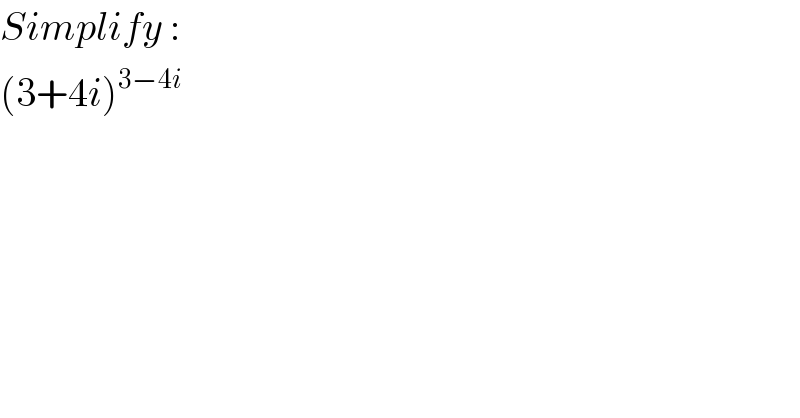
$${Simplify}\:: \\ $$$$\left(\mathrm{3}+\mathrm{4}{i}\right)^{\mathrm{3}−\mathrm{4}{i}} \\ $$
Commented by 112358 last updated on 29/Sep/15
![Define z=(3+4i)^(3−4i) and w=3+4i. ∣w∣=(√(4^2 +3^2 ))=5. With the argument of w being θ we get θ=tan^(−1) ((4/3)) The exponential form of p is then p=5e^(iθ) where θ=tan^(−1) ((4/3)). Therefore, z=(5e^(iθ) )^(3−4i) . Taking logs to base e we obtain lnz=ln[(5e^(iθ) )^(3−4i) ] =(3−4i)ln(5e^(iθ) ) =(3−4i)ln5+(3−4i)iθ =ln125−iln625+3iθ+4θ =ln125+4θ+i(3θ−ln625) Thus we get z=e^(ln125+4θ+i(3θ−ln625)) . z=125e^(4θ) e^(i(3θ−ln625)) z=125e^(4tan^(−1) ((4/3))) e^(i(3tan^(−1) ((4/3))−ln625)) This is of form z=re^(iθ) . Therefore ∣z∣=125e^(4tan^(−1) (4/3)) and its argument is θ=3tan^(−1) ((4/3))−ln625.](https://www.tinkutara.com/question/Q1792.png)
$${Define}\:{z}=\left(\mathrm{3}+\mathrm{4}{i}\right)^{\mathrm{3}−\mathrm{4}{i}} \:{and}\:{w}=\mathrm{3}+\mathrm{4}{i}. \\ $$$$\mid{w}\mid=\sqrt{\mathrm{4}^{\mathrm{2}} +\mathrm{3}^{\mathrm{2}} }=\mathrm{5}.\:{With}\:{the}\:{argument} \\ $$$${of}\:{w}\:{being}\:\theta\:{we}\:{get}\:\theta={tan}^{−\mathrm{1}} \left(\frac{\mathrm{4}}{\mathrm{3}}\right) \\ $$$${The}\:{exponential}\:{form}\:{of}\:{p}\:{is}\:{then} \\ $$$${p}=\mathrm{5}{e}^{{i}\theta} \:\:{where}\:\theta={tan}^{−\mathrm{1}} \left(\frac{\mathrm{4}}{\mathrm{3}}\right). \\ $$$${Therefore},\:{z}=\left(\mathrm{5}{e}^{{i}\theta} \right)^{\mathrm{3}−\mathrm{4}{i}} .\:{Taking} \\ $$$${logs}\:{to}\:{base}\:{e}\:{we}\:{obtain}\: \\ $$$${lnz}={ln}\left[\left(\mathrm{5}{e}^{{i}\theta} \right)^{\mathrm{3}−\mathrm{4}{i}} \right] \\ $$$$\:\:\:\:\:\:=\left(\mathrm{3}−\mathrm{4}{i}\right){ln}\left(\mathrm{5}{e}^{{i}\theta} \right) \\ $$$$\:\:\:\:\:\:=\left(\mathrm{3}−\mathrm{4}{i}\right){ln}\mathrm{5}+\left(\mathrm{3}−\mathrm{4}{i}\right){i}\theta \\ $$$$\:\:\:\:\:\:={ln}\mathrm{125}−{iln}\mathrm{625}+\mathrm{3}{i}\theta+\mathrm{4}\theta \\ $$$$\:\:\:\:\:\:={ln}\mathrm{125}+\mathrm{4}\theta+{i}\left(\mathrm{3}\theta−{ln}\mathrm{625}\right) \\ $$$${Thus}\:{we}\:{get}\:{z}={e}^{{ln}\mathrm{125}+\mathrm{4}\theta+{i}\left(\mathrm{3}\theta−{ln}\mathrm{625}\right)} . \\ $$$${z}=\mathrm{125}{e}^{\mathrm{4}\theta} {e}^{{i}\left(\mathrm{3}\theta−{ln}\mathrm{625}\right)} \\ $$$${z}=\mathrm{125}{e}^{\mathrm{4}{tan}^{−\mathrm{1}} \left(\frac{\mathrm{4}}{\mathrm{3}}\right)} {e}^{{i}\left(\mathrm{3}{tan}^{−\mathrm{1}} \left(\frac{\mathrm{4}}{\mathrm{3}}\right)−{ln}\mathrm{625}\right)} \\ $$$${This}\:{is}\:{of}\:{form}\:{z}={re}^{{i}\theta} .\:{Therefore} \\ $$$$\mid{z}\mid=\mathrm{125}{e}^{\mathrm{4}{tan}^{−\mathrm{1}} \left(\mathrm{4}/\mathrm{3}\right)} \:{and}\:{its}\:{argument} \\ $$$${is}\:\theta=\mathrm{3}{tan}^{−\mathrm{1}} \left(\frac{\mathrm{4}}{\mathrm{3}}\right)−{ln}\mathrm{625}.\: \\ $$$$ \\ $$$$ \\ $$