
Question Number 148237 by puissant last updated on 26/Jul/21

$${f}\left({t}\right)={sin}\left({pt}\right)\:{fourier}\:{serie}.. \\ $$
Answered by Olaf_Thorendsen last updated on 26/Jul/21
![f est une fonction impaire et donc a_0 = 0. Les autres a_n sont nuls egalement. La periode T de f est ((2π)/p). • Calculons b_1 a part : b_1 = (2/T)∫_(−(T/2)) ^(+(T/2)) f(t)sin(((2πt)/T)) dt b_1 = (p/π)∫_(−(π/p)) ^(+(π/p)) sin(pt)sin(pt) dt b_1 = (p/π)∫_(−(π/p)) ^(+(π/p)) (1/2)(1−cos(2pt)) dt b_1 = (p/(2π))[t−((sin(2pt))/(2p))]_(−(π/p)) ^(+(π/p)) = 1 • Calculons les autres b_n , n> 1 : b_n = (2/T)∫_(−(T/2)) ^(+(T/2)) f(t)sin(((2πnt)/T)) dt b_n = (p/π)∫_(−(π/p)) ^(+(π/p)) sin(pt)sin(pnt) dt b_n = (p/π)∫_(−(π/p)) ^(+(π/p)) (1/2)[cos(pnt−pt)−cos(pnt+pt)] dt b_n = (p/π)∫_(−(π/p)) ^(+(π/p)) (1/2)[cos((n−1)pt)−cos((n+1)pt)] dt b_n = (p/(2π))[((sin((n−1)pt))/(n−1))−((sin((n+1)pt))/(n+1))]_(−(π/p)) ^(+(π/p)) b_n = (p/π)[((sin((n−1)π))/(n−1))−((sin((n+1)π))/(n+1))]_(−(π/p)) ^(+(π/p)) b_n = (p/π)((((−1)^(n−1) )/(n−1))−(((−1)^(n+1) )/(n+1))) b_n = −((p(−1)^n )/π)((1/(n−1))−(1/(n+1))) b_n = −((p(−1)^n )/(π(n^2 −1))) Remarque : dans l′expression de b_n , le denominateur est nul pour n = 1. C′est pour ca qu′on a pris soin de calculer b_1 a part. Resultat des courses : Sur une periode T = ((2π)/p), on a: f(t) = sin(pt) = sin(pt)−(p/π)Σ_(n=2) ^∞ (((−1)^n )/(n^2 −1))sin(pnt)](https://www.tinkutara.com/question/Q148243.png)
$${f}\:\mathrm{est}\:\mathrm{une}\:\mathrm{fonction}\:\mathrm{impaire}\:\mathrm{et}\: \\ $$$$\mathrm{donc}\:{a}_{\mathrm{0}} \:=\:\mathrm{0}.\:\mathrm{Les}\:\mathrm{autres}\:{a}_{{n}} \mathrm{sont}\:\mathrm{nuls} \\ $$$$\mathrm{egalement}. \\ $$$$ \\ $$$$\mathrm{La}\:\mathrm{periode}\:\mathrm{T}\:\mathrm{de}\:{f}\:\mathrm{est}\:\frac{\mathrm{2}\pi}{{p}}. \\ $$$$\bullet\:\mathrm{Calculons}\:{b}_{\mathrm{1}} \:\mathrm{a}\:\mathrm{part}\:: \\ $$$${b}_{\mathrm{1}} \:=\:\frac{\mathrm{2}}{\mathrm{T}}\int_{−\frac{\mathrm{T}}{\mathrm{2}}} ^{+\frac{\mathrm{T}}{\mathrm{2}}} {f}\left({t}\right)\mathrm{sin}\left(\frac{\mathrm{2}\pi{t}}{\mathrm{T}}\right)\:{dt} \\ $$$${b}_{\mathrm{1}} \:=\:\frac{{p}}{\pi}\int_{−\frac{\pi}{{p}}} ^{+\frac{\pi}{{p}}} \mathrm{sin}\left({pt}\right)\mathrm{sin}\left({pt}\right)\:{dt} \\ $$$${b}_{\mathrm{1}} \:=\:\frac{{p}}{\pi}\int_{−\frac{\pi}{{p}}} ^{+\frac{\pi}{{p}}} \frac{\mathrm{1}}{\mathrm{2}}\left(\mathrm{1}−\mathrm{cos}\left(\mathrm{2}{pt}\right)\right)\:{dt} \\ $$$${b}_{\mathrm{1}} \:=\:\frac{{p}}{\mathrm{2}\pi}\left[{t}−\frac{\mathrm{sin}\left(\mathrm{2}{pt}\right)}{\mathrm{2}{p}}\right]_{−\frac{\pi}{{p}}} ^{+\frac{\pi}{{p}}} \:=\:\mathrm{1} \\ $$$$ \\ $$$$\bullet\:\mathrm{Calculons}\:\mathrm{les}\:\mathrm{autres}\:{b}_{{n}} ,\:{n}>\:\mathrm{1}\:: \\ $$$${b}_{{n}} \:=\:\frac{\mathrm{2}}{\mathrm{T}}\int_{−\frac{\mathrm{T}}{\mathrm{2}}} ^{+\frac{\mathrm{T}}{\mathrm{2}}} {f}\left({t}\right)\mathrm{sin}\left(\frac{\mathrm{2}\pi{nt}}{\mathrm{T}}\right)\:{dt} \\ $$$${b}_{{n}} \:=\:\frac{{p}}{\pi}\int_{−\frac{\pi}{{p}}} ^{+\frac{\pi}{{p}}} \mathrm{sin}\left({pt}\right)\mathrm{sin}\left({pnt}\right)\:{dt} \\ $$$${b}_{{n}} \:=\:\frac{{p}}{\pi}\int_{−\frac{\pi}{{p}}} ^{+\frac{\pi}{{p}}} \frac{\mathrm{1}}{\mathrm{2}}\left[\mathrm{cos}\left({pnt}−{pt}\right)−\mathrm{cos}\left({pnt}+{pt}\right)\right]\:{dt} \\ $$$${b}_{{n}} \:=\:\frac{{p}}{\pi}\int_{−\frac{\pi}{{p}}} ^{+\frac{\pi}{{p}}} \frac{\mathrm{1}}{\mathrm{2}}\left[\mathrm{cos}\left(\left({n}−\mathrm{1}\right){pt}\right)−\mathrm{cos}\left(\left({n}+\mathrm{1}\right){pt}\right)\right]\:{dt} \\ $$$${b}_{{n}} \:=\:\frac{{p}}{\mathrm{2}\pi}\left[\frac{\mathrm{sin}\left(\left({n}−\mathrm{1}\right){pt}\right)}{{n}−\mathrm{1}}−\frac{\mathrm{sin}\left(\left({n}+\mathrm{1}\right){pt}\right)}{{n}+\mathrm{1}}\right]_{−\frac{\pi}{{p}}} ^{+\frac{\pi}{{p}}} \\ $$$${b}_{{n}} \:=\:\frac{{p}}{\pi}\left[\frac{\mathrm{sin}\left(\left({n}−\mathrm{1}\right)\pi\right)}{{n}−\mathrm{1}}−\frac{\mathrm{sin}\left(\left({n}+\mathrm{1}\right)\pi\right)}{{n}+\mathrm{1}}\right]_{−\frac{\pi}{{p}}} ^{+\frac{\pi}{{p}}} \\ $$$${b}_{{n}} \:=\:\frac{{p}}{\pi}\left(\frac{\left(−\mathrm{1}\right)^{{n}−\mathrm{1}} }{{n}−\mathrm{1}}−\frac{\left(−\mathrm{1}\right)^{{n}+\mathrm{1}} }{{n}+\mathrm{1}}\right) \\ $$$${b}_{{n}} \:=\:−\frac{{p}\left(−\mathrm{1}\right)^{{n}} }{\pi}\left(\frac{\mathrm{1}}{{n}−\mathrm{1}}−\frac{\mathrm{1}}{{n}+\mathrm{1}}\right) \\ $$$${b}_{{n}} \:=\:−\frac{{p}\left(−\mathrm{1}\right)^{{n}} }{\pi\left({n}^{\mathrm{2}} −\mathrm{1}\right)} \\ $$$$\mathrm{Remarque}\::\:\mathrm{dans}\:\mathrm{l}'\mathrm{expression}\:\mathrm{de}\:{b}_{{n}} , \\ $$$$\mathrm{le}\:\mathrm{denominateur}\:\mathrm{est}\:\mathrm{nul}\:\mathrm{pour}\:{n}\:=\:\mathrm{1}. \\ $$$$\mathrm{C}'\mathrm{est}\:\mathrm{pour}\:\mathrm{ca}\:\mathrm{qu}'\mathrm{on}\:\mathrm{a}\:\mathrm{pris}\:\mathrm{soin}\:\mathrm{de} \\ $$$$\mathrm{calculer}\:{b}_{\mathrm{1}} \:\mathrm{a}\:\mathrm{part}. \\ $$$$ \\ $$$$\mathrm{Resultat}\:\mathrm{des}\:\mathrm{courses}\:: \\ $$$$\mathrm{Sur}\:\mathrm{une}\:\mathrm{periode}\:\mathrm{T}\:=\:\frac{\mathrm{2}\pi}{{p}},\:\mathrm{on}\:\mathrm{a}: \\ $$$${f}\left({t}\right)\:=\:\mathrm{sin}\left({pt}\right)\:=\:\mathrm{sin}\left({pt}\right)−\frac{{p}}{\pi}\underset{{n}=\mathrm{2}} {\overset{\infty} {\sum}}\frac{\left(−\mathrm{1}\right)^{{n}} }{{n}^{\mathrm{2}} −\mathrm{1}}\mathrm{sin}\left({pnt}\right) \\ $$
Commented by Olaf_Thorendsen last updated on 26/Jul/21
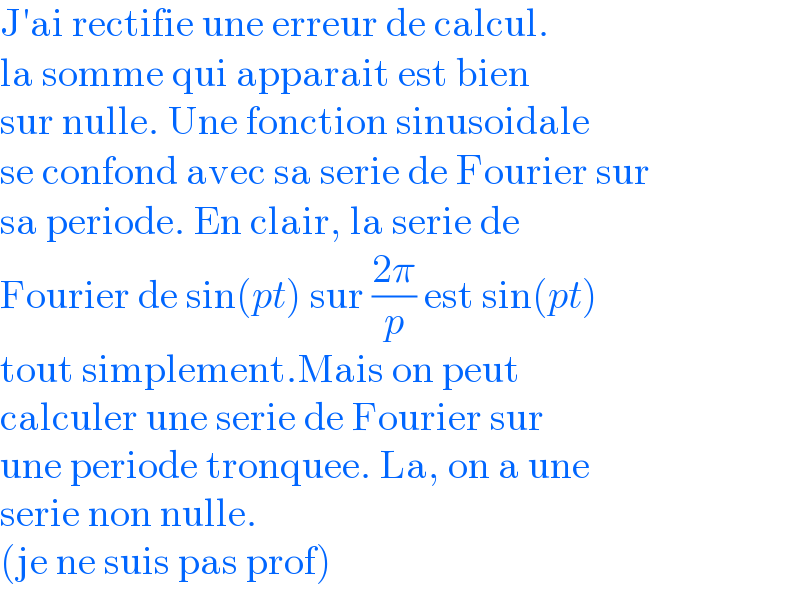
$$\mathrm{J}'\mathrm{ai}\:\mathrm{rectifie}\:\mathrm{une}\:\mathrm{erreur}\:\mathrm{de}\:\mathrm{calcul}. \\ $$$$\mathrm{la}\:\mathrm{somme}\:\mathrm{qui}\:\mathrm{apparait}\:\mathrm{est}\:\mathrm{bien} \\ $$$$\mathrm{sur}\:\mathrm{nulle}.\:\mathrm{Une}\:\mathrm{fonction}\:\mathrm{sinusoidale} \\ $$$$\mathrm{se}\:\mathrm{confond}\:\mathrm{avec}\:\mathrm{sa}\:\mathrm{serie}\:\mathrm{de}\:\mathrm{Fourier}\:\mathrm{sur} \\ $$$$\mathrm{sa}\:\mathrm{periode}.\:\mathrm{En}\:\mathrm{clair},\:\mathrm{la}\:\mathrm{serie}\:\mathrm{de} \\ $$$$\mathrm{Fourier}\:\mathrm{de}\:\mathrm{sin}\left({pt}\right)\:\mathrm{sur}\:\frac{\mathrm{2}\pi}{{p}}\:\mathrm{est}\:\mathrm{sin}\left({pt}\right) \\ $$$$\mathrm{tout}\:\mathrm{simplement}.\mathrm{Mais}\:\mathrm{on}\:\mathrm{peut} \\ $$$$\mathrm{calculer}\:\mathrm{une}\:\mathrm{serie}\:\mathrm{de}\:\mathrm{Fourier}\:\mathrm{sur} \\ $$$$\mathrm{une}\:\mathrm{periode}\:\mathrm{tronquee}.\:\mathrm{La},\:\mathrm{on}\:\mathrm{a}\:\mathrm{une} \\ $$$$\mathrm{serie}\:\mathrm{non}\:\mathrm{nulle}. \\ $$$$\left(\mathrm{je}\:\mathrm{ne}\:\mathrm{suis}\:\mathrm{pas}\:\mathrm{prof}\right) \\ $$