
Question Number 55359 by gunawan last updated on 22/Feb/19
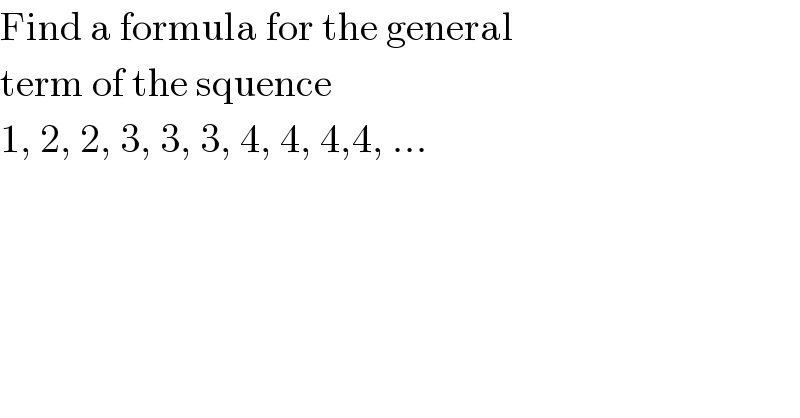
$$\mathrm{Find}\:\mathrm{a}\:\mathrm{formula}\:\mathrm{for}\:\mathrm{the}\:\mathrm{general}\: \\ $$$$\mathrm{term}\:\mathrm{of}\:\mathrm{the}\:\mathrm{squence} \\ $$$$\mathrm{1},\:\mathrm{2},\:\mathrm{2},\:\mathrm{3},\:\mathrm{3},\:\mathrm{3},\:\mathrm{4},\:\mathrm{4},\:\mathrm{4},\mathrm{4},\:… \\ $$
Answered by tanmay.chaudhury50@gmail.com last updated on 22/Feb/19
![1→ nos of term→1 (2,2)→ do → 2 (3,3,3) → do→ 3 (4,4,4,4)→ do → 4 ... ... (n,n,n,...n)→ do→ n now 1,2,2,3,3,3,4,4,4,4.....n,n,n....n total nos of term of this series s=1+2+3+4+..+n s=(n/2)[2×1+(n−1)×1]→((n^2 +n)/2) example let to find 19th term of the sequence put n=5 in ((n^2 +n)/2)→ ((5^2 +5)/2)=15 put n=6 in ((n^2 +n)/2) →((6^2 +6)/2)=21 21>19>15 so T_(19) =6 T_(100) 100th term... i)chose n such that ((n^2 +n)/2) nearest to 100 ((14^2 +14)/2)=105 ((13^2 +13)/2)=91 ((15^2 +15)/2)=120 1,(2,2),(3,3,3),(4,4,4,4),...,(13,13,..13) if we count nos of terms it is 91 1,(2,2),(3,3,3),(4,4,4,4)...(14,14,14,..14) if we count nos of terms =91+14=105 so T_(100) =14 so T_r =n [n=+ve integer when ((n^2 +n)/2)=r] T_r =n+1 [when (((n+1)^2 +n)/2)> r>((n^2 +n)/2)] example find T_(19) and T_(100) using above formulla step...1)put n=1,2,3...so that ((n^2 +n)/2) approaches to 19 ((4^2 +4)/2)=10 ((5^2 +5)/2)=15 ←look here ((6^2 +6)/2)=21 now look 19>15 when n=5 that means 1,2,2,3,3,3...5,5,5,5,5 ←total 15 terms 1,2,2,3,3,3....5,5,5,5,5,6,6,6,6_↑_(19th term) ,6,6←21 terms pls check...](https://www.tinkutara.com/question/Q55363.png)
$$\mathrm{1}\rightarrow\:\:\:\:\:\:\:\:\:\:\:\:\:\:\:{nos}\:{of}\:{term}\rightarrow\mathrm{1} \\ $$$$\left(\mathrm{2},\mathrm{2}\right)\rightarrow\:\:\:\:\:\:\:\:\:{do}\:\rightarrow\:\:\:\:\:\:\:\:\:\:\:\:\:\:\:\:\:\:\mathrm{2} \\ $$$$\left(\mathrm{3},\mathrm{3},\mathrm{3}\right)\:\rightarrow\:\:\:{do}\rightarrow\:\:\:\:\:\:\:\:\:\:\:\:\:\:\:\:\:\:\:\mathrm{3} \\ $$$$\left(\mathrm{4},\mathrm{4},\mathrm{4},\mathrm{4}\right)\rightarrow\:{do}\:\rightarrow\:\:\:\:\:\:\:\:\:\:\:\:\:\:\:\:\:\:\mathrm{4} \\ $$$$…\:\:\:\:\:\:\:\:\:\:\:\: \\ $$$$… \\ $$$$\left({n},{n},{n},…{n}\right)\rightarrow\:{do}\rightarrow\:\:\:\:\:\:\:\:\:\:\:\:{n} \\ $$$${now} \\ $$$$\mathrm{1},\mathrm{2},\mathrm{2},\mathrm{3},\mathrm{3},\mathrm{3},\mathrm{4},\mathrm{4},\mathrm{4},\mathrm{4}…..{n},{n},{n}….{n} \\ $$$${total}\:{nos}\:{of}\:{term}\:{of}\:{this}\:{series} \\ $$$${s}=\mathrm{1}+\mathrm{2}+\mathrm{3}+\mathrm{4}+..+{n} \\ $$$${s}=\frac{{n}}{\mathrm{2}}\left[\mathrm{2}×\mathrm{1}+\left({n}−\mathrm{1}\right)×\mathrm{1}\right]\rightarrow\frac{{n}^{\mathrm{2}} +{n}}{\mathrm{2}} \\ $$$${example} \\ $$$${let}\:{to}\:{find}\:\mathrm{19}{th}\:{term}\:{of}\:{the}\:{sequence} \\ $$$${put}\:{n}=\mathrm{5}\:\:\:\:\:{in}\:\:\frac{{n}^{\mathrm{2}} +{n}}{\mathrm{2}}\rightarrow\:\frac{\mathrm{5}^{\mathrm{2}} +\mathrm{5}}{\mathrm{2}}=\mathrm{15} \\ $$$${put}\:{n}=\mathrm{6}\:\:\:\:{in}\:\frac{{n}^{\mathrm{2}} +{n}}{\mathrm{2}}\:\rightarrow\frac{\mathrm{6}^{\mathrm{2}} +\mathrm{6}}{\mathrm{2}}=\mathrm{21} \\ $$$$\:\:\:\:\:\:\mathrm{21}>\mathrm{19}>\mathrm{15}\:\:{so}\:\:{T}_{\mathrm{19}} =\mathrm{6} \\ $$$${T}_{\mathrm{100}} \:\:\mathrm{100}{th}\:{term}… \\ $$$$\left.{i}\right){chose}\:{n}\:{such}\:{that}\:\frac{{n}^{\mathrm{2}} +{n}}{\mathrm{2}}\:{nearest}\:\:{to}\:\mathrm{100} \\ $$$$\frac{\mathrm{14}^{\mathrm{2}} +\mathrm{14}}{\mathrm{2}}=\mathrm{105}\:\:\:\:\:\:\frac{\mathrm{13}^{\mathrm{2}} +\mathrm{13}}{\mathrm{2}}=\mathrm{91}\:\:\:\:\frac{\mathrm{15}^{\mathrm{2}} +\mathrm{15}}{\mathrm{2}}=\mathrm{120} \\ $$$$\mathrm{1},\left(\mathrm{2},\mathrm{2}\right),\left(\mathrm{3},\mathrm{3},\mathrm{3}\right),\left(\mathrm{4},\mathrm{4},\mathrm{4},\mathrm{4}\right),…,\left(\mathrm{13},\mathrm{13},..\mathrm{13}\right) \\ $$$${if}\:{we}\:{count}\:{nos}\:{of}\:{terms}\:\:{it}\:{is}\:\mathrm{91} \\ $$$$\mathrm{1},\left(\mathrm{2},\mathrm{2}\right),\left(\mathrm{3},\mathrm{3},\mathrm{3}\right),\left(\mathrm{4},\mathrm{4},\mathrm{4},\mathrm{4}\right)…\left(\mathrm{14},\mathrm{14},\mathrm{14},..\mathrm{14}\right) \\ $$$${if}\:{we}\:{count}\:{nos}\:{of}\:{terms}\:=\mathrm{91}+\mathrm{14}=\mathrm{105} \\ $$$${so}\:{T}_{\mathrm{100}} =\mathrm{14} \\ $$$$\boldsymbol{{so}}\:\boldsymbol{{T}}_{\boldsymbol{{r}}} =\boldsymbol{{n}}\:\:\left[\boldsymbol{{n}}=+\boldsymbol{{ve}}\:\boldsymbol{{integer}}\:\boldsymbol{{when}}\:\frac{\boldsymbol{{n}}^{\mathrm{2}} +\boldsymbol{{n}}}{\mathrm{2}}=\boldsymbol{{r}}\right] \\ $$$$\boldsymbol{{T}}_{{r}} =\boldsymbol{{n}}+\mathrm{1}\:\:\left[\boldsymbol{{when}}\:\:\:\frac{\left(\boldsymbol{{n}}+\mathrm{1}\right)^{\mathrm{2}} +\boldsymbol{{n}}}{\mathrm{2}}>\:\boldsymbol{{r}}>\frac{\boldsymbol{{n}}^{\mathrm{2}} +\boldsymbol{{n}}}{\mathrm{2}}\right] \\ $$$$\boldsymbol{{example}}\:\:{find}\:\boldsymbol{{T}}_{\mathrm{19}} \:{and}\:{T}_{\mathrm{100}} \:{using}\:{above}\:{formulla} \\ $$$$\left.{step}…\mathrm{1}\right){put}\:{n}=\mathrm{1},\mathrm{2},\mathrm{3}…{so}\:{that}\:\frac{{n}^{\mathrm{2}} +{n}}{\mathrm{2}}\:{approaches}\:{to}\:\mathrm{19} \\ $$$$\frac{\mathrm{4}^{\mathrm{2}} +\mathrm{4}}{\mathrm{2}}=\mathrm{10} \\ $$$$\frac{\mathrm{5}^{\mathrm{2}} +\mathrm{5}}{\mathrm{2}}=\mathrm{15}\:\leftarrow{look}\:{here} \\ $$$$\frac{\mathrm{6}^{\mathrm{2}} +\mathrm{6}}{\mathrm{2}}=\mathrm{21} \\ $$$$\boldsymbol{{now}}\:\boldsymbol{{look}}\:\mathrm{19}>\mathrm{15}\:\:\boldsymbol{{when}}\:\boldsymbol{{n}}=\mathrm{5} \\ $$$${that}\:{means} \\ $$$$\mathrm{1},\mathrm{2},\mathrm{2},\mathrm{3},\mathrm{3},\mathrm{3}…\mathrm{5},\mathrm{5},\mathrm{5},\mathrm{5},\mathrm{5}\:\:\leftarrow{total}\:\mathrm{15}\:{terms} \\ $$$$\mathrm{1},\mathrm{2},\mathrm{2},\mathrm{3},\mathrm{3},\mathrm{3}….\mathrm{5},\mathrm{5},\mathrm{5},\mathrm{5},\mathrm{5},\mathrm{6},\mathrm{6},\mathrm{6},\underset{\underset{\mathrm{19}{th}\:{term}} {\uparrow}} {\mathrm{6}},\mathrm{6},\mathrm{6}\leftarrow\mathrm{21}\:{terms} \\ $$$${pls}\:{check}… \\ $$
Commented by gunawan last updated on 22/Feb/19

$$\mathrm{thank}\:\mathrm{you}\:\mathrm{Sir} \\ $$$$\mathrm{I}\:\mathrm{really}\:\mathrm{appreciate} \\ $$