
Question Number 114272 by bemath last updated on 18/Sep/20
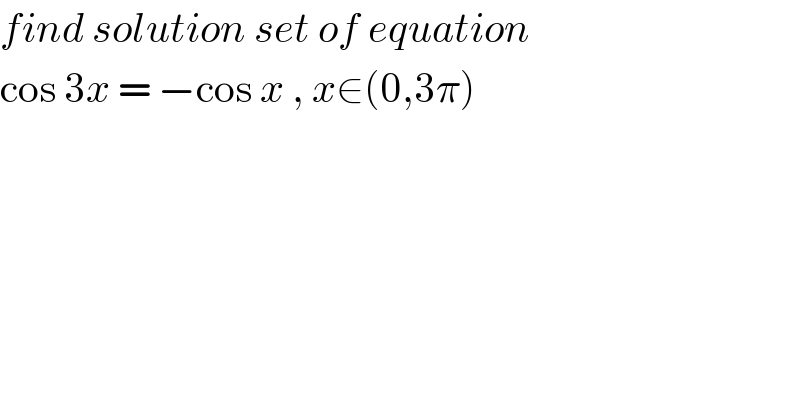
$${find}\:{solution}\:{set}\:{of}\:{equation}\: \\ $$$$\mathrm{cos}\:\mathrm{3}{x}\:=\:−\mathrm{cos}\:{x}\:,\:{x}\in\left(\mathrm{0},\mathrm{3}\pi\right) \\ $$
Commented by malwaan last updated on 18/Sep/20
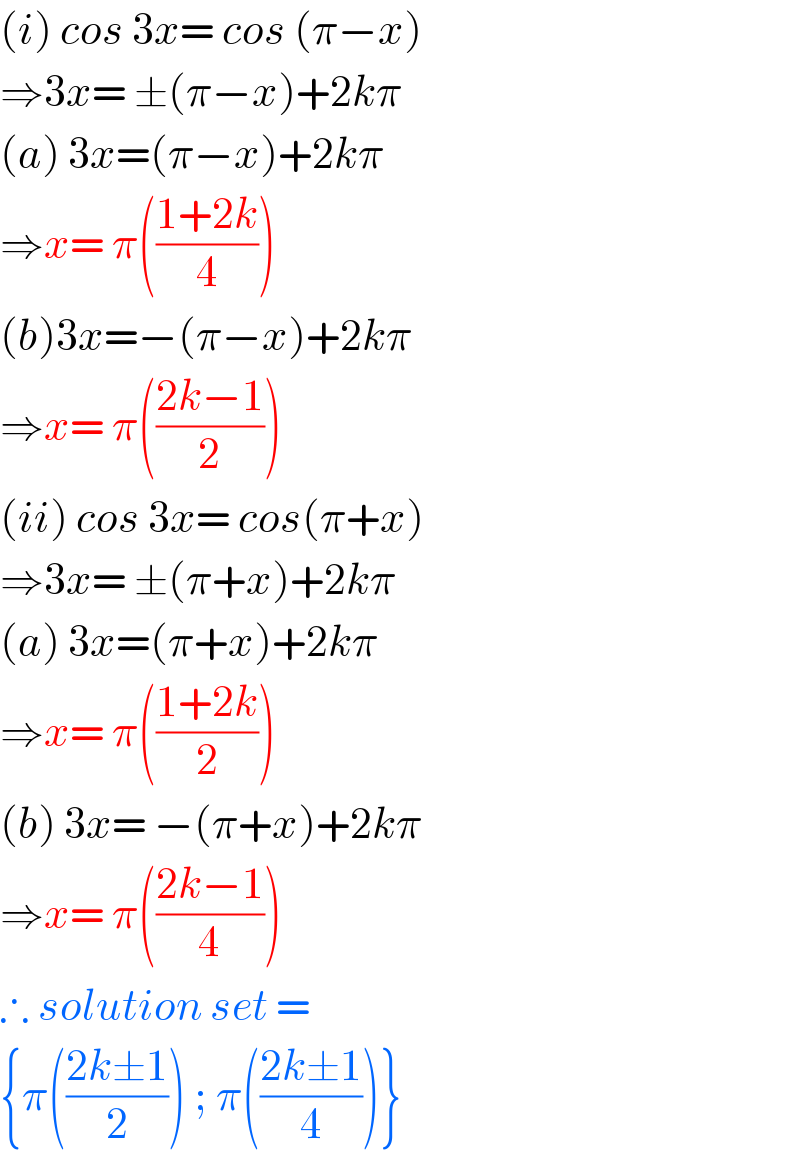
$$\left({i}\right)\:{cos}\:\mathrm{3}{x}=\:{cos}\:\left(\pi−{x}\right) \\ $$$$\Rightarrow\mathrm{3}{x}=\:\pm\left(\pi−{x}\right)+\mathrm{2}{k}\pi \\ $$$$\left({a}\right)\:\mathrm{3}{x}=\left(\pi−{x}\right)+\mathrm{2}{k}\pi \\ $$$$\Rightarrow{x}=\:\pi\left(\frac{\mathrm{1}+\mathrm{2}{k}}{\mathrm{4}}\right) \\ $$$$\left({b}\right)\mathrm{3}{x}=−\left(\pi−{x}\right)+\mathrm{2}{k}\pi \\ $$$$\Rightarrow{x}=\:\pi\left(\frac{\mathrm{2}{k}−\mathrm{1}}{\mathrm{2}}\right) \\ $$$$\left({ii}\right)\:{cos}\:\mathrm{3}{x}=\:{cos}\left(\pi+{x}\right) \\ $$$$\Rightarrow\mathrm{3}{x}=\:\pm\left(\pi+{x}\right)+\mathrm{2}{k}\pi \\ $$$$\left({a}\right)\:\mathrm{3}{x}=\left(\pi+{x}\right)+\mathrm{2}{k}\pi \\ $$$$\Rightarrow{x}=\:\pi\left(\frac{\mathrm{1}+\mathrm{2}{k}}{\mathrm{2}}\right) \\ $$$$\left({b}\right)\:\mathrm{3}{x}=\:−\left(\pi+{x}\right)+\mathrm{2}{k}\pi \\ $$$$\Rightarrow{x}=\:\pi\left(\frac{\mathrm{2}{k}−\mathrm{1}}{\mathrm{4}}\right) \\ $$$$\therefore\:{solution}\:{set}\:= \\ $$$$\left\{\pi\left(\frac{\mathrm{2}{k}\pm\mathrm{1}}{\mathrm{2}}\right)\:;\:\pi\left(\frac{\mathrm{2}{k}\pm\mathrm{1}}{\mathrm{4}}\right)\right\} \\ $$
Commented by bemath last updated on 18/Sep/20

$${hahaha}\:{santuy} \\ $$
Commented by abdullahquwatan last updated on 18/Sep/20

$${kenapa}\:{pake}\:{santuy}\:{sih}?? \\ $$
Answered by bemath last updated on 18/Sep/20

Answered by malwaan last updated on 18/Sep/20
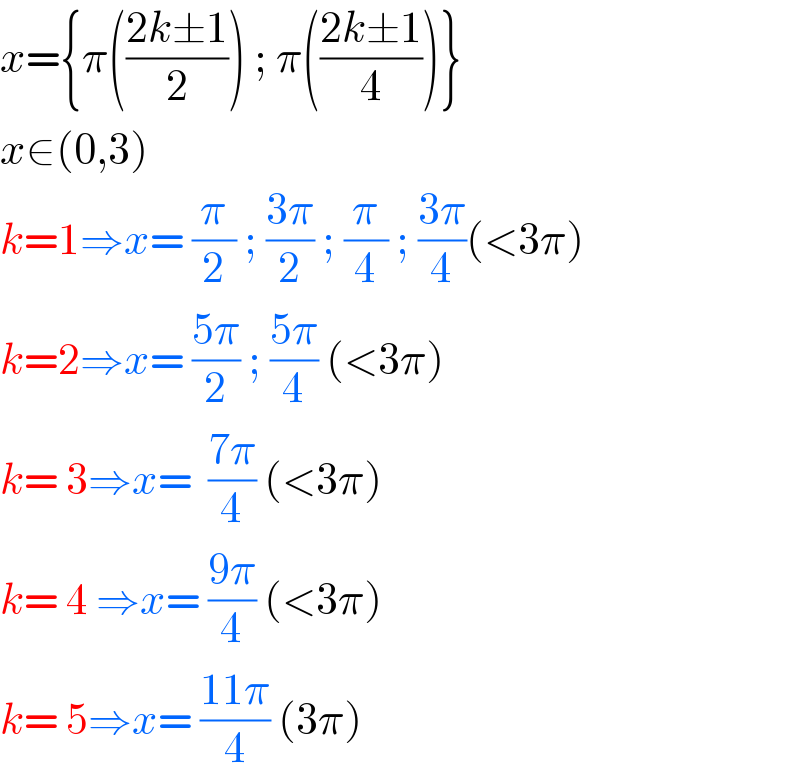
$${x}=\left\{\pi\left(\frac{\mathrm{2}{k}\pm\mathrm{1}}{\mathrm{2}}\right)\:;\:\pi\left(\frac{\mathrm{2}{k}\pm\mathrm{1}}{\mathrm{4}}\right)\right\} \\ $$$${x}\in\left(\mathrm{0},\mathrm{3}\right) \\ $$$${k}=\mathrm{1}\Rightarrow{x}=\:\frac{\pi}{\mathrm{2}}\:;\:\frac{\mathrm{3}\pi}{\mathrm{2}}\:;\:\frac{\pi}{\mathrm{4}}\:;\:\frac{\mathrm{3}\pi}{\mathrm{4}}\left(<\mathrm{3}\pi\right) \\ $$$${k}=\mathrm{2}\Rightarrow{x}=\:\frac{\mathrm{5}\pi}{\mathrm{2}}\:;\:\frac{\mathrm{5}\pi}{\mathrm{4}}\:\left(<\mathrm{3}\pi\right) \\ $$$${k}=\:\mathrm{3}\Rightarrow{x}=\:\:\frac{\mathrm{7}\pi}{\mathrm{4}}\:\left(<\mathrm{3}\pi\right) \\ $$$${k}=\:\mathrm{4}\:\Rightarrow{x}=\:\frac{\mathrm{9}\pi}{\mathrm{4}}\:\left(<\mathrm{3}\pi\right) \\ $$$${k}=\:\mathrm{5}\Rightarrow{x}=\:\frac{\mathrm{11}\pi}{\mathrm{4}}\:\left(\mathrm{3}\pi\right) \\ $$
Answered by Dwaipayan Shikari last updated on 18/Sep/20
![cos3x+cosx=0 2cos2xcosx=0 cos2x=0 2x=kπ+(π/2) x=((kπ)/2)+(π/4) or x=kπ+(π/2) (k∈Z) Solution set x∈[(π/4),((3π)/4),((5π)/4),((7π)/4),((9π)/4),((11π)/4)] x∈[(π/2),((3π)/2),((5π)/2)]](https://www.tinkutara.com/question/Q114278.png)
$${cos}\mathrm{3}{x}+{cosx}=\mathrm{0} \\ $$$$\mathrm{2}{cos}\mathrm{2}{xcosx}=\mathrm{0} \\ $$$${cos}\mathrm{2}{x}=\mathrm{0} \\ $$$$\mathrm{2}{x}={k}\pi+\frac{\pi}{\mathrm{2}} \\ $$$${x}=\frac{{k}\pi}{\mathrm{2}}+\frac{\pi}{\mathrm{4}} \\ $$$${or} \\ $$$${x}={k}\pi+\frac{\pi}{\mathrm{2}}\:\:\:\:\left({k}\in\mathbb{Z}\right) \\ $$$${Solution}\:{set} \\ $$$${x}\in\left[\frac{\pi}{\mathrm{4}},\frac{\mathrm{3}\pi}{\mathrm{4}},\frac{\mathrm{5}\pi}{\mathrm{4}},\frac{\mathrm{7}\pi}{\mathrm{4}},\frac{\mathrm{9}\pi}{\mathrm{4}},\frac{\mathrm{11}\pi}{\mathrm{4}}\right] \\ $$$${x}\in\left[\frac{\pi}{\mathrm{2}},\frac{\mathrm{3}\pi}{\mathrm{2}},\frac{\mathrm{5}\pi}{\mathrm{2}}\right] \\ $$