
Question Number 151418 by mathdanisur last updated on 20/Aug/21
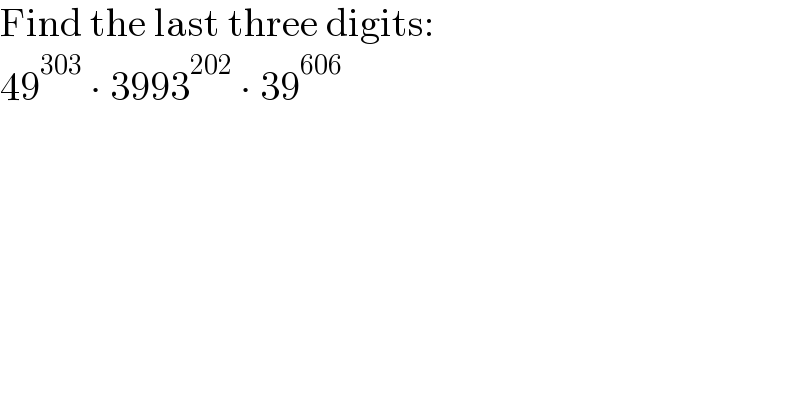
$$\mathrm{Find}\:\mathrm{the}\:\mathrm{last}\:\mathrm{three}\:\mathrm{digits}: \\ $$$$\mathrm{49}^{\mathrm{303}} \:\centerdot\:\mathrm{3993}^{\mathrm{202}} \:\centerdot\:\mathrm{39}^{\mathrm{606}} \\ $$
Answered by Olaf_Thorendsen last updated on 21/Aug/21
![x = 49^(303) .3993^(202) .39^(606) x = (7^2 )^(303) .(3.11^3 )^(202) (3.13)^(606) x = (7.11.13)^(606) .3^(808) x = (1001)^(606) .3^(808) By Fermat little theorem 3^(400) ≡ 1 [1000] and 1001 ≡ 1 [1000] ⇒ x ≡ (1)^(606) .3^8 [1000] (3^8 = 6561) x ≡ 561 [1000] Hence the last 3 digits are 561.](https://www.tinkutara.com/question/Q151424.png)
$${x}\:=\:\mathrm{49}^{\mathrm{303}} .\mathrm{3993}^{\mathrm{202}} .\mathrm{39}^{\mathrm{606}} \\ $$$${x}\:=\:\left(\mathrm{7}^{\mathrm{2}} \right)^{\mathrm{303}} .\left(\mathrm{3}.\mathrm{11}^{\mathrm{3}} \right)^{\mathrm{202}} \left(\mathrm{3}.\mathrm{13}\right)^{\mathrm{606}} \\ $$$${x}\:=\:\left(\mathrm{7}.\mathrm{11}.\mathrm{13}\right)^{\mathrm{606}} .\mathrm{3}^{\mathrm{808}} \\ $$$${x}\:=\:\left(\mathrm{1001}\right)^{\mathrm{606}} .\mathrm{3}^{\mathrm{808}} \\ $$$$\mathrm{By}\:\mathrm{Fermat}\:\mathrm{little}\:\mathrm{theorem}\:\mathrm{3}^{\mathrm{400}} \:\equiv\:\mathrm{1}\:\left[\mathrm{1000}\right] \\ $$$$\mathrm{and}\:\mathrm{1001}\:\equiv\:\mathrm{1}\:\left[\mathrm{1000}\right] \\ $$$$\Rightarrow\:{x}\:\equiv\:\left(\mathrm{1}\right)^{\mathrm{606}} .\mathrm{3}^{\mathrm{8}} \:\left[\mathrm{1000}\right]\:\:\:\:\left(\mathrm{3}^{\mathrm{8}} \:=\:\mathrm{6561}\right) \\ $$$${x}\:\:\equiv\:\:\mathrm{561}\:\left[\mathrm{1000}\right] \\ $$$$\mathrm{Hence}\:\mathrm{the}\:\mathrm{last}\:\mathrm{3}\:\mathrm{digits}\:\mathrm{are}\:\mathrm{561}. \\ $$