
Question Number 108842 by Study last updated on 19/Aug/20
Commented by Study last updated on 19/Aug/20
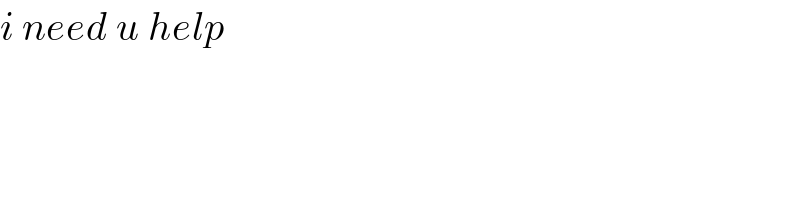
$${i}\:{need}\:{u}\:{help} \\ $$
Commented by 150505R last updated on 19/Aug/20
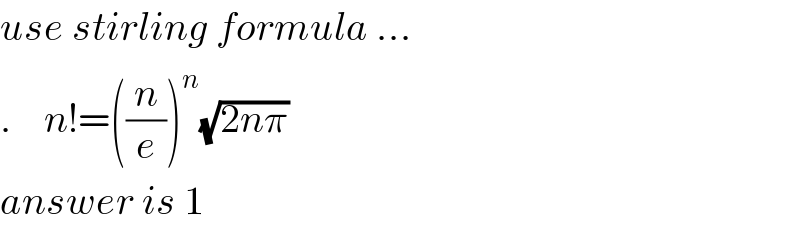
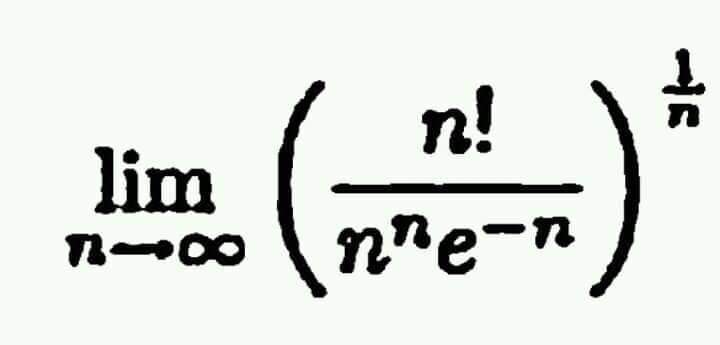
$${use}\:{stirling}\:{formula}\:… \\ $$$$.\:\:\:\:{n}!=\left(\frac{{n}}{{e}}\right)^{{n}} \sqrt{\mathrm{2}{n}\pi} \\ $$$${answer}\:{is}\:\mathrm{1} \\ $$
Commented by Study last updated on 19/Aug/20
$$=?????????? \\ $$
Answered by Dwaipayan Shikari last updated on 19/Aug/20
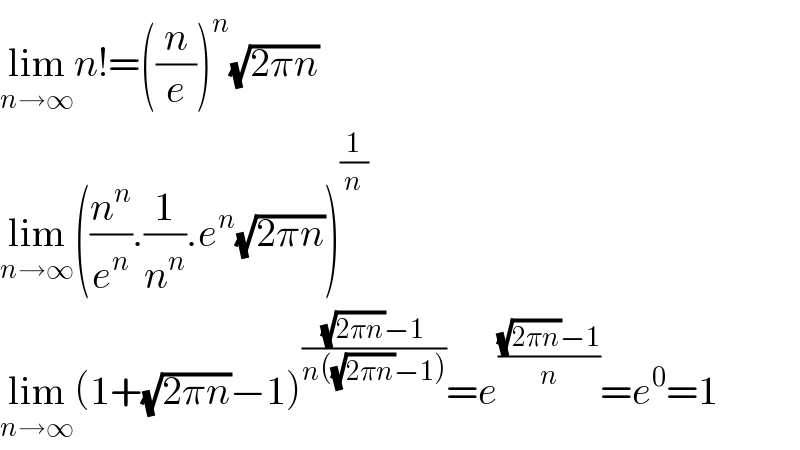
$$\underset{{n}\rightarrow\infty} {\mathrm{lim}}{n}!=\left(\frac{{n}}{{e}}\right)^{{n}} \sqrt{\mathrm{2}\pi{n}} \\ $$$$\underset{{n}\rightarrow\infty} {\mathrm{lim}}\left(\frac{{n}^{{n}} }{{e}^{{n}} }.\frac{\mathrm{1}}{{n}^{{n}} }.{e}^{{n}} \sqrt{\mathrm{2}\pi{n}}\right)^{\frac{\mathrm{1}}{{n}}} \\ $$$$\underset{{n}\rightarrow\infty} {\mathrm{lim}}\left(\mathrm{1}+\sqrt{\mathrm{2}\pi{n}}−\mathrm{1}\right)^{\frac{\sqrt{\mathrm{2}\pi{n}}−\mathrm{1}}{{n}\left(\sqrt{\mathrm{2}\pi{n}}−\mathrm{1}\right)}} ={e}^{\frac{\sqrt{\mathrm{2}\pi{n}}−\mathrm{1}}{{n}}} ={e}^{\mathrm{0}} =\mathrm{1} \\ $$
Commented by Study last updated on 19/Aug/20
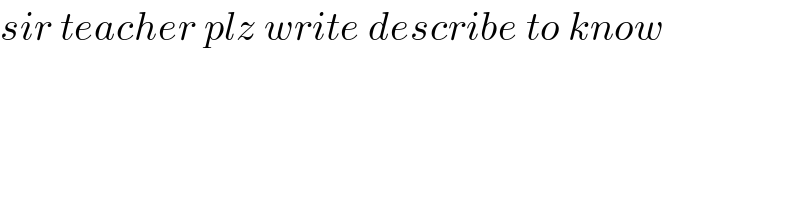
$${sir}\:{teacher}\:{plz}\:{write}\:{describe}\:{to}\:{know} \\ $$
Commented by Dwaipayan Shikari last updated on 19/Aug/20
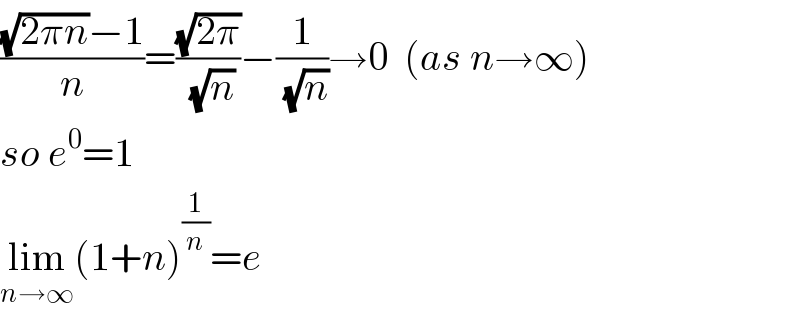
$$\frac{\sqrt{\mathrm{2}\pi{n}}−\mathrm{1}}{{n}}=\frac{\sqrt{\mathrm{2}\pi}}{\:\sqrt{{n}}}−\frac{\mathrm{1}}{\:\sqrt{{n}}}\rightarrow\mathrm{0}\:\:\left({as}\:{n}\rightarrow\infty\right) \\ $$$${so}\:{e}^{\mathrm{0}} =\mathrm{1} \\ $$$$\underset{{n}\rightarrow\infty} {\mathrm{lim}}\left(\mathrm{1}+{n}\right)^{\frac{\mathrm{1}}{{n}}} ={e} \\ $$
Answered by Dwaipayan Shikari last updated on 19/Aug/20
![Another way lim_(n→∞) (((n!)/n^n ))^(1/n) e=y (1/n)(log(1)+log(1−(1/n))+....+(log(1−(n/n)))+1=logy (1/n)Σ_(r=1) ^n log(1−(r/n))+1=logy ∫_0 ^1 log(1−x)dx+1=logy xlog(1−x)−∫(x/(1−x))+1=logy [xlog(1−x)−x+logx]_0 ^1 +1=logy logy=−1+1 y=1](https://www.tinkutara.com/question/Q108856.png)
$${Another}\:{way} \\ $$$$\underset{{n}\rightarrow\infty} {\mathrm{lim}}\left(\frac{{n}!}{{n}^{{n}} }\right)^{\frac{\mathrm{1}}{{n}}} {e}={y} \\ $$$$\frac{\mathrm{1}}{{n}}\left({log}\left(\mathrm{1}\right)+{log}\left(\mathrm{1}−\frac{\mathrm{1}}{{n}}\right)+….+\left({log}\left(\mathrm{1}−\frac{{n}}{{n}}\right)\right)+\mathrm{1}={logy}\right. \\ $$$$\frac{\mathrm{1}}{{n}}\underset{{r}=\mathrm{1}} {\overset{{n}} {\sum}}{log}\left(\mathrm{1}−\frac{{r}}{{n}}\right)+\mathrm{1}={logy} \\ $$$$\int_{\mathrm{0}} ^{\mathrm{1}} {log}\left(\mathrm{1}−{x}\right){dx}+\mathrm{1}={logy} \\ $$$${xlog}\left(\mathrm{1}−{x}\right)−\int\frac{{x}}{\mathrm{1}−{x}}+\mathrm{1}={logy} \\ $$$$\left[{xlog}\left(\mathrm{1}−{x}\right)−{x}+{logx}\right]_{\mathrm{0}} ^{\mathrm{1}} +\mathrm{1}={logy} \\ $$$${logy}=−\mathrm{1}+\mathrm{1} \\ $$$${y}=\mathrm{1} \\ $$$$ \\ $$$$ \\ $$