
Question Number 119629 by 9764954060 last updated on 25/Oct/20
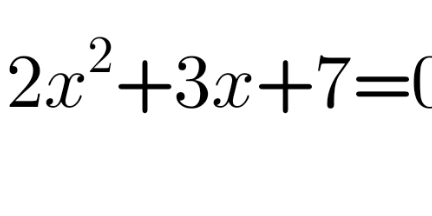
Answered by TANMAY PANACEA last updated on 25/Oct/20
![ax^2 +bx+c=0 x=((−b±(√(b^2 −4ac)))/(2a)) so here x=((−3±(√(3^2 −4×2×7)))/(2×2))=((−3±(√(−47)))/4) x=((−3±i(√(47)))/4) [i=(√(−1)) ]](https://www.tinkutara.com/question/Q119630.png)
$${ax}^{\mathrm{2}} +{bx}+{c}=\mathrm{0} \\ $$$${x}=\frac{−{b}\pm\sqrt{{b}^{\mathrm{2}} −\mathrm{4}{ac}}}{\mathrm{2}{a}} \\ $$$${so}\:{here}\:{x}=\frac{−\mathrm{3}\pm\sqrt{\mathrm{3}^{\mathrm{2}} −\mathrm{4}×\mathrm{2}×\mathrm{7}}}{\mathrm{2}×\mathrm{2}}=\frac{−\mathrm{3}\pm\sqrt{−\mathrm{47}}}{\mathrm{4}} \\ $$$${x}=\frac{−\mathrm{3}\pm{i}\sqrt{\mathrm{47}}}{\mathrm{4}}\:\:\:\left[{i}=\sqrt{−\mathrm{1}}\:\right] \\ $$