
Question Number 172681 by mnjuly1970 last updated on 30/Jun/22

Answered by Jamshidbek last updated on 30/Jun/22
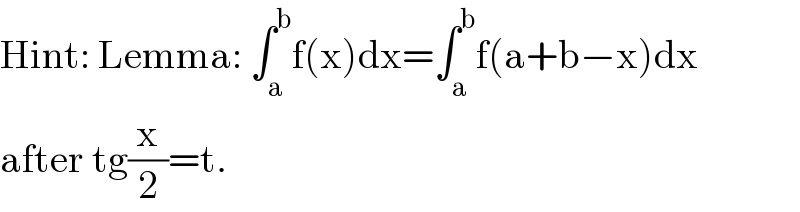
$$\mathrm{Hint}:\:\mathrm{Lemma}:\:\int_{\mathrm{a}} ^{\mathrm{b}} \mathrm{f}\left(\mathrm{x}\right)\mathrm{dx}=\int_{\mathrm{a}} ^{\mathrm{b}} \mathrm{f}\left(\mathrm{a}+\mathrm{b}−\mathrm{x}\right)\mathrm{dx} \\ $$$$\mathrm{after}\:\mathrm{tg}\frac{\mathrm{x}}{\mathrm{2}}=\mathrm{t}. \\ $$
Answered by Mathspace last updated on 30/Jun/22
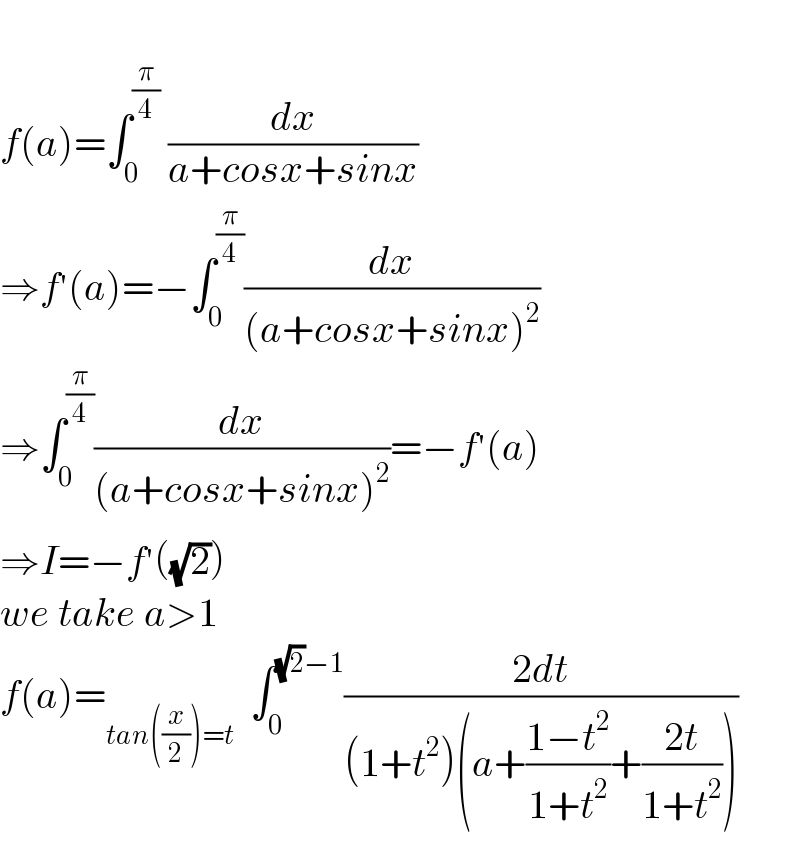
$$ \\ $$$${f}\left({a}\right)=\int_{\mathrm{0}} ^{\frac{\pi}{\mathrm{4}}} \:\frac{{dx}}{{a}+{cosx}+{sinx}} \\ $$$$\Rightarrow{f}^{'} \left({a}\right)=−\int_{\mathrm{0}} ^{\frac{\pi}{\mathrm{4}}} \frac{{dx}}{\left({a}+{cosx}+{sinx}\right)^{\mathrm{2}} } \\ $$$$\Rightarrow\int_{\mathrm{0}} ^{\frac{\pi}{\mathrm{4}}} \frac{{dx}}{\left({a}+{cosx}+{sinx}\right)^{\mathrm{2}} }=−{f}^{'} \left({a}\right) \\ $$$$\Rightarrow{I}=−{f}^{'} \left(\sqrt{\mathrm{2}}\right) \\ $$$${we}\:{take}\:{a}>\mathrm{1} \\ $$$${f}\left({a}\right)=_{{tan}\left(\frac{{x}}{\mathrm{2}}\right)={t}} \:\:\int_{\mathrm{0}} ^{\sqrt{\mathrm{2}}−\mathrm{1}} \frac{\mathrm{2}{dt}}{\left(\mathrm{1}+{t}^{\mathrm{2}} \right)\left({a}+\frac{\mathrm{1}−{t}^{\mathrm{2}} }{\mathrm{1}+{t}^{\mathrm{2}} }+\frac{\mathrm{2}{t}}{\mathrm{1}+{t}^{\mathrm{2}} }\right)} \\ $$
Commented by Mathspace last updated on 30/Jun/22
![f(a)=2∫_0 ^((√2)−1) (dt/(a+at^2 +1−t^2 +2t)) =2∫_0 ^((√2)−1) (dt/((a−1)t^2 +2t +a+1)) Δ^′ =1−(a^2 −1)=2−a^2 t_1 =((−1+(√(2−a^2 )))/(a−1)) t_2 =((−1−(√(2−a^2 )))/(a−1)) ⇒ f(a)=2∫_0 ^((√2)−1) (dt/((a−1)(t−t_1 )(t−t_2 ))) =(2/(a−1))×((2(√(2−a^2 )))/(a−1))∫_0 ^((√2)−1) ((1/(t−t_1 ))−(1/(t−t_2 )))dt =((4(√(2−a^2 )))/((a−1)^2 ))[ln∣((t−t_1 )/(t−t_2 ))∣]_0 ^((√2)−1) =((4(√(2−a^2 )))/((a−1)^2 )){ln∣(((√2)−1−t_1 )/( (√2)−1−t_2 ))∣+ln∣(t_2 /t_1 )∣} rest to calculate f^′ (a)...be continued...](https://www.tinkutara.com/question/Q172728.png)
$${f}\left({a}\right)=\mathrm{2}\int_{\mathrm{0}} ^{\sqrt{\mathrm{2}}−\mathrm{1}} \:\frac{{dt}}{{a}+{at}^{\mathrm{2}} +\mathrm{1}−{t}^{\mathrm{2}} +\mathrm{2}{t}} \\ $$$$=\mathrm{2}\int_{\mathrm{0}} ^{\sqrt{\mathrm{2}}−\mathrm{1}} \frac{{dt}}{\left({a}−\mathrm{1}\right){t}^{\mathrm{2}} +\mathrm{2}{t}\:+{a}+\mathrm{1}} \\ $$$$\Delta^{'} =\mathrm{1}−\left({a}^{\mathrm{2}} −\mathrm{1}\right)=\mathrm{2}−{a}^{\mathrm{2}} \\ $$$${t}_{\mathrm{1}} =\frac{−\mathrm{1}+\sqrt{\mathrm{2}−{a}^{\mathrm{2}} }}{{a}−\mathrm{1}} \\ $$$${t}_{\mathrm{2}} =\frac{−\mathrm{1}−\sqrt{\mathrm{2}−{a}^{\mathrm{2}} }}{{a}−\mathrm{1}}\:\Rightarrow \\ $$$${f}\left({a}\right)=\mathrm{2}\int_{\mathrm{0}} ^{\sqrt{\mathrm{2}}−\mathrm{1}} \frac{{dt}}{\left({a}−\mathrm{1}\right)\left({t}−{t}_{\mathrm{1}} \right)\left({t}−{t}_{\mathrm{2}} \right)} \\ $$$$=\frac{\mathrm{2}}{{a}−\mathrm{1}}×\frac{\mathrm{2}\sqrt{\mathrm{2}−{a}^{\mathrm{2}} }}{{a}−\mathrm{1}}\int_{\mathrm{0}} ^{\sqrt{\mathrm{2}}−\mathrm{1}} \left(\frac{\mathrm{1}}{{t}−{t}_{\mathrm{1}} }−\frac{\mathrm{1}}{{t}−{t}_{\mathrm{2}} }\right){dt} \\ $$$$=\frac{\mathrm{4}\sqrt{\mathrm{2}−{a}^{\mathrm{2}} }}{\left({a}−\mathrm{1}\right)^{\mathrm{2}} }\left[{ln}\mid\frac{{t}−{t}_{\mathrm{1}} }{{t}−{t}_{\mathrm{2}} }\mid\right]_{\mathrm{0}} ^{\sqrt{\mathrm{2}}−\mathrm{1}} \\ $$$$=\frac{\mathrm{4}\sqrt{\mathrm{2}−{a}^{\mathrm{2}} }}{\left({a}−\mathrm{1}\right)^{\mathrm{2}} }\left\{{ln}\mid\frac{\sqrt{\mathrm{2}}−\mathrm{1}−{t}_{\mathrm{1}} }{\:\sqrt{\mathrm{2}}−\mathrm{1}−{t}_{\mathrm{2}} }\mid+{ln}\mid\frac{{t}_{\mathrm{2}} }{{t}_{\mathrm{1}} }\mid\right\} \\ $$$${rest}\:{to}\:{calculate}\:{f}^{'} \left({a}\right)…{be}\:{continued}… \\ $$
Answered by Mathspace last updated on 30/Jun/22
![Φ=∫_0 ^(π/4) (dx/(((√2)+(√2)cos(x−(π/4)))^2 )) =(1/2)∫_0 ^(π/4) (dx/((1+cos(x−(π/4)))^2 )) =_(x−(π/4)=−t) (1/2)∫_(π/4) ^o ((−dt)/((1+cost)^2 )) =(1/2)∫_0 ^(π/4) (dt/((1+cost)^2 )) (tan((t/2))=y) =(1/2)∫_0 ^((√2)−1) ((2dy)/((y^2 +1)(1+((1−y^2 )/(1+y^2 )))^2 )) =∫_0 ^((√2)−1) (dy/((y^2 +1)((2/(1+y^2 )))^2 )) =∫_0 ^((√2)−1) ((1+y^2 )/4)dy =(1/4)((√2)−1)+(1/(12))[y^3 ]_0 ^((√2)−1) =(((√2)−1)/4)+((((√2)−1)^3 )/(12))](https://www.tinkutara.com/question/Q172729.png)
$$\Phi=\int_{\mathrm{0}} ^{\frac{\pi}{\mathrm{4}}} \frac{{dx}}{\left(\sqrt{\mathrm{2}}+\sqrt{\mathrm{2}}{cos}\left({x}−\frac{\pi}{\mathrm{4}}\right)\right)^{\mathrm{2}} } \\ $$$$=\frac{\mathrm{1}}{\mathrm{2}}\int_{\mathrm{0}} ^{\frac{\pi}{\mathrm{4}}} \frac{{dx}}{\left(\mathrm{1}+{cos}\left({x}−\frac{\pi}{\mathrm{4}}\right)\right)^{\mathrm{2}} } \\ $$$$=_{{x}−\frac{\pi}{\mathrm{4}}=−{t}} \:\:\frac{\mathrm{1}}{\mathrm{2}}\int_{\frac{\pi}{\mathrm{4}}} ^{{o}} \frac{−{dt}}{\left(\mathrm{1}+{cost}\right)^{\mathrm{2}} } \\ $$$$=\frac{\mathrm{1}}{\mathrm{2}}\int_{\mathrm{0}} ^{\frac{\pi}{\mathrm{4}}} \:\:\frac{{dt}}{\left(\mathrm{1}+{cost}\right)^{\mathrm{2}} }\:\:\left({tan}\left(\frac{{t}}{\mathrm{2}}\right)={y}\right) \\ $$$$=\frac{\mathrm{1}}{\mathrm{2}}\int_{\mathrm{0}} ^{\sqrt{\mathrm{2}}−\mathrm{1}} \frac{\mathrm{2}{dy}}{\left({y}^{\mathrm{2}} +\mathrm{1}\right)\left(\mathrm{1}+\frac{\mathrm{1}−{y}^{\mathrm{2}} }{\mathrm{1}+{y}^{\mathrm{2}} }\right)^{\mathrm{2}} } \\ $$$$=\int_{\mathrm{0}} ^{\sqrt{\mathrm{2}}−\mathrm{1}} \:\frac{{dy}}{\left({y}^{\mathrm{2}} +\mathrm{1}\right)\left(\frac{\mathrm{2}}{\mathrm{1}+{y}^{\mathrm{2}} }\right)^{\mathrm{2}} } \\ $$$$=\int_{\mathrm{0}} ^{\sqrt{\mathrm{2}}−\mathrm{1}} \frac{\mathrm{1}+{y}^{\mathrm{2}} }{\mathrm{4}}{dy} \\ $$$$=\frac{\mathrm{1}}{\mathrm{4}}\left(\sqrt{\mathrm{2}}−\mathrm{1}\right)+\frac{\mathrm{1}}{\mathrm{12}}\left[{y}^{\mathrm{3}} \right]_{\mathrm{0}} ^{\sqrt{\mathrm{2}}−\mathrm{1}} \\ $$$$=\frac{\sqrt{\mathrm{2}}−\mathrm{1}}{\mathrm{4}}+\frac{\left(\sqrt{\mathrm{2}}−\mathrm{1}\right)^{\mathrm{3}} }{\mathrm{12}} \\ $$
Commented by Tawa11 last updated on 01/Jul/22

$$\mathrm{Great}\:\mathrm{sir} \\ $$
Answered by mr W last updated on 30/Jun/22
![cos x+sin x=(√2) cos (x−(π/4)) Ω=∫_0 ^(π/4) ((d(x−(π/4)))/(2(1+cos (x−(π/4)))^2 )) Ω=∫_(−(π/4)) ^0 (dt/(2(1+cos t)^2 )) Ω=(1/4)∫_(−(π/4)) ^0 ((d((t/2)))/(cos^4 ((t/2)))) Ω=(1/4)∫_(−(π/8)) ^0 (du/(cos^4 u)) Ω=(1/4)[tan u+((tan^3 u)/3)]_(−(π/8)) ^0 Ω=(1/4)tan (π/8)(1+(1/3)×tan^2 (π/8)) Ω=(((√2)−1)/4)(1+((((√2)−1)^2 )/3))=((4(√2)−5)/6) ✓ tan (π/4)=((2tan (π/8))/(1−tan^2 (π/8)))=1 ⇒tan (π/8)=(√2)−1](https://www.tinkutara.com/question/Q172739.png)
$$\mathrm{cos}\:{x}+\mathrm{sin}\:{x}=\sqrt{\mathrm{2}}\:\mathrm{cos}\:\left({x}−\frac{\pi}{\mathrm{4}}\right) \\ $$$$\Omega=\int_{\mathrm{0}} ^{\frac{\pi}{\mathrm{4}}} \frac{{d}\left({x}−\frac{\pi}{\mathrm{4}}\right)}{\mathrm{2}\left(\mathrm{1}+\mathrm{cos}\:\left({x}−\frac{\pi}{\mathrm{4}}\right)\right)^{\mathrm{2}} } \\ $$$$\Omega=\int_{−\frac{\pi}{\mathrm{4}}} ^{\mathrm{0}} \frac{{dt}}{\mathrm{2}\left(\mathrm{1}+\mathrm{cos}\:{t}\right)^{\mathrm{2}} } \\ $$$$\Omega=\frac{\mathrm{1}}{\mathrm{4}}\int_{−\frac{\pi}{\mathrm{4}}} ^{\mathrm{0}} \frac{{d}\left(\frac{{t}}{\mathrm{2}}\right)}{\mathrm{cos}^{\mathrm{4}} \:\left(\frac{{t}}{\mathrm{2}}\right)} \\ $$$$\Omega=\frac{\mathrm{1}}{\mathrm{4}}\int_{−\frac{\pi}{\mathrm{8}}} ^{\mathrm{0}} \frac{{du}}{\mathrm{cos}^{\mathrm{4}} {u}} \\ $$$$\Omega=\frac{\mathrm{1}}{\mathrm{4}}\left[\mathrm{tan}\:{u}+\frac{\mathrm{tan}^{\mathrm{3}} \:{u}}{\mathrm{3}}\right]_{−\frac{\pi}{\mathrm{8}}} ^{\mathrm{0}} \\ $$$$\Omega=\frac{\mathrm{1}}{\mathrm{4}}\mathrm{tan}\:\frac{\pi}{\mathrm{8}}\left(\mathrm{1}+\frac{\mathrm{1}}{\mathrm{3}}×\mathrm{tan}^{\mathrm{2}} \:\frac{\pi}{\mathrm{8}}\right) \\ $$$$\Omega=\frac{\sqrt{\mathrm{2}}−\mathrm{1}}{\mathrm{4}}\left(\mathrm{1}+\frac{\left(\sqrt{\mathrm{2}}−\mathrm{1}\right)^{\mathrm{2}} }{\mathrm{3}}\right)=\frac{\mathrm{4}\sqrt{\mathrm{2}}−\mathrm{5}}{\mathrm{6}}\:\checkmark \\ $$$$ \\ $$$$\mathrm{tan}\:\frac{\pi}{\mathrm{4}}=\frac{\mathrm{2tan}\:\frac{\pi}{\mathrm{8}}}{\mathrm{1}−\mathrm{tan}^{\mathrm{2}} \:\frac{\pi}{\mathrm{8}}}=\mathrm{1} \\ $$$$\Rightarrow\mathrm{tan}\:\frac{\pi}{\mathrm{8}}=\sqrt{\mathrm{2}}−\mathrm{1} \\ $$
Commented by Tawa11 last updated on 01/Jul/22

$$\mathrm{Great}\:\mathrm{sir} \\ $$