Question Number 52787 by peter frank last updated on 13/Jan/19
Answered by tanmay.chaudhury50@gmail.com last updated on 13/Jan/19
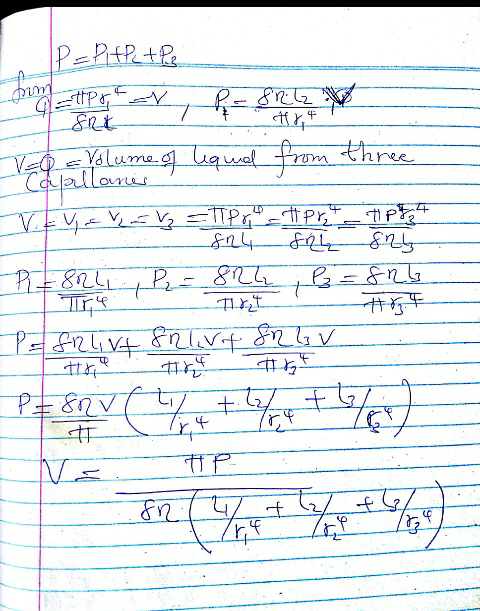
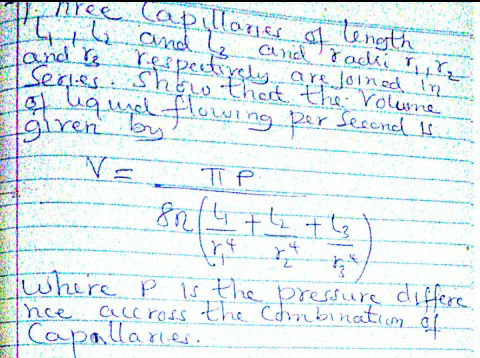
![flow of fluid in pipe formula (dV/dt)=((△p×πr^4 )/(8ηl))=((△p)/((8ηl)/(πr^4 ))) compare it with flow of current in resistance.. here current i→(dV/dt) potential difference→△p resistance→((8ηl)/(πr^4 )) so cappilary joined in series is equivalant to resistance in series connection (R_(eq) =R_1 +R_2 +R_3 +... Resistance in series) same way equivalant viscous resitance ((8ηl_1 )/(πr_1 ^4 ))+((8ηl_2 )/(πr_2 ^4 ))+((8ηl_3 )/(πr_3 ^4 )) now use formula current=((p.d)/(resistance))=(V/(R_1 +R_2 +R_3 ))=i similar way rate of flow (dV/dt)=((△p)/(((8ηl_1 )/(πr_1 ^4 ))+((8ηl_2 )/(πr_2 ^4 +))+((8ηl_3 )/(πr_3 ^4 ))))=((π△p)/(8η((l_1 /r_1 ^4 )+(l_2 /r_2 ^4 )+(l_3 /r_3 ^4 )))) so answer is (dV/dt)=((πp)/(8η((l_1 /r_1 ^4 )+(l_2 /r_2 ^4 )+(l_3 /r_3 ^4 )))) [given △p=p]](https://www.tinkutara.com/question/Q52788.png)
$${flow}\:{of}\:{fluid}\:{in}\:{pipe}\:{formula} \\ $$$$\frac{{dV}}{{dt}}=\frac{\bigtriangleup{p}×\pi{r}^{\mathrm{4}} }{\mathrm{8}\eta{l}}=\frac{\bigtriangleup{p}}{\frac{\mathrm{8}\eta{l}}{\pi{r}^{\mathrm{4}} }} \\ $$$${compare}\:{it}\:{with}\:{flow}\:{of}\:{current}\:{in}\:{resistance}.. \\ $$$${here}\:{current}\:{i}\rightarrow\frac{{dV}}{{dt}} \\ $$$${potential}\:{difference}\rightarrow\bigtriangleup{p} \\ $$$${resistance}\rightarrow\frac{\mathrm{8}\eta{l}}{\pi{r}^{\mathrm{4}} } \\ $$$${so}\:{cappilary}\:{joined}\:{in}\:{series}\:{is}\:{equivalant} \\ $$$${to}\:{resistance}\:{in}\:{series}\:{connection} \\ $$$$\left({R}_{{eq}} ={R}_{\mathrm{1}} +{R}_{\mathrm{2}} +{R}_{\mathrm{3}} +…\:{Resistance}\:{in}\:{series}\right) \\ $$$${same}\:{way}\:\:{equivalant}\:{viscous}\:{resitance} \\ $$$$\frac{\mathrm{8}\eta{l}_{\mathrm{1}} }{\pi{r}_{\mathrm{1}} ^{\mathrm{4}} }+\frac{\mathrm{8}\eta{l}_{\mathrm{2}} }{\pi{r}_{\mathrm{2}} ^{\mathrm{4}} }+\frac{\mathrm{8}\eta{l}_{\mathrm{3}} }{\pi{r}_{\mathrm{3}} ^{\mathrm{4}} } \\ $$$${now}\:{use}\:{formula}\:\:\:{current}=\frac{{p}.{d}}{{resistance}}=\frac{{V}}{{R}_{\mathrm{1}} +{R}_{\mathrm{2}} +{R}_{\mathrm{3}} }={i} \\ $$$${similar}\:{way} \\ $$$${rate}\:{of}\:{flow}\:\frac{{dV}}{{dt}}=\frac{\bigtriangleup{p}}{\frac{\mathrm{8}\eta{l}_{\mathrm{1}} }{\pi{r}_{\mathrm{1}} ^{\mathrm{4}} }+\frac{\mathrm{8}\eta{l}_{\mathrm{2}} }{\pi{r}_{\mathrm{2}} ^{\mathrm{4}} +}+\frac{\mathrm{8}\eta{l}_{\mathrm{3}} }{\pi{r}_{\mathrm{3}} ^{\mathrm{4}} }}=\frac{\pi\bigtriangleup{p}}{\mathrm{8}\eta\left(\frac{{l}_{\mathrm{1}} }{{r}_{\mathrm{1}} ^{\mathrm{4}} }+\frac{{l}_{\mathrm{2}} }{{r}_{\mathrm{2}} ^{\mathrm{4}} }+\frac{{l}_{\mathrm{3}} }{{r}_{\mathrm{3}} ^{\mathrm{4}} }\right)} \\ $$$${so}\:{answer}\:{is} \\ $$$$\frac{{dV}}{{dt}}=\frac{\pi{p}}{\mathrm{8}\eta\left(\frac{{l}_{\mathrm{1}} }{{r}_{\mathrm{1}} ^{\mathrm{4}} }+\frac{{l}_{\mathrm{2}} }{{r}_{\mathrm{2}} ^{\mathrm{4}} }+\frac{{l}_{\mathrm{3}} }{{r}_{\mathrm{3}} ^{\mathrm{4}} }\right)}\:\:\:\left[{given}\:\bigtriangleup{p}={p}\right] \\ $$
Commented by peter frank last updated on 13/Jan/19
$${thanks} \\ $$
Answered by peter frank last updated on 13/Jan/19