
Question Number 60367 by bhanukumarb2@gmail.com last updated on 20/May/19
Commented by bhanukumarb2@gmail.com last updated on 20/May/19
$$\mathrm{1}\: \\ $$
Commented by Mr X pcx last updated on 20/May/19
![I_2 =∫_0 ^1 (dx/((1+x^2 )^2 )) vhangement x=tanθ give I_2 =∫_0 ^(π/4) ((1+tan^2 θ)/((1+tan^2 θ)^2 ))dθ =∫_0 ^(π/4) (dθ/(1+tan^2 θ)) =∫_0 ^(π/4) cos^2 θ dθ =∫_0 ^(π/4) ((1+cos(2θ))/2)dθ =(π/8) +[(1/4)sin(2θ)]_0 ^(π/4) =(π/8) +(1/4) so the answer (B) is correct.](https://www.tinkutara.com/question/Q60373.png)
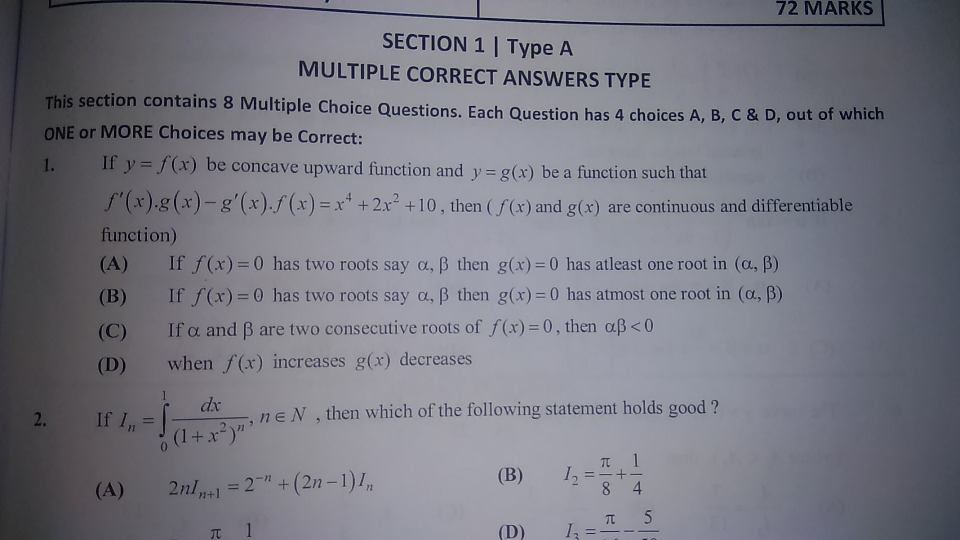
$${I}_{\mathrm{2}} =\int_{\mathrm{0}} ^{\mathrm{1}} \:\:\frac{{dx}}{\left(\mathrm{1}+{x}^{\mathrm{2}} \right)^{\mathrm{2}} }\:{vhangement}\:{x}={tan}\theta \\ $$$${give}\:{I}_{\mathrm{2}} =\int_{\mathrm{0}} ^{\frac{\pi}{\mathrm{4}}} \:\:\frac{\mathrm{1}+{tan}^{\mathrm{2}} \theta}{\left(\mathrm{1}+{tan}^{\mathrm{2}} \theta\right)^{\mathrm{2}} }{d}\theta \\ $$$$=\int_{\mathrm{0}} ^{\frac{\pi}{\mathrm{4}}} \:\:\:\frac{{d}\theta}{\mathrm{1}+{tan}^{\mathrm{2}} \theta}\:=\int_{\mathrm{0}} ^{\frac{\pi}{\mathrm{4}}} \:{cos}^{\mathrm{2}} \theta\:{d}\theta \\ $$$$=\int_{\mathrm{0}} ^{\frac{\pi}{\mathrm{4}}} \:\frac{\mathrm{1}+{cos}\left(\mathrm{2}\theta\right)}{\mathrm{2}}{d}\theta\:=\frac{\pi}{\mathrm{8}}\:+\left[\frac{\mathrm{1}}{\mathrm{4}}{sin}\left(\mathrm{2}\theta\right)\right]_{\mathrm{0}} ^{\frac{\pi}{\mathrm{4}}} \\ $$$$=\frac{\pi}{\mathrm{8}}\:+\frac{\mathrm{1}}{\mathrm{4}}\:\:{so}\:{the}\:{answer}\:\left({B}\right)\:{is}\:{correct}. \\ $$
Commented by bhanukumarb2@gmail.com last updated on 20/May/19
$$\mathrm{1}\:{question}\:{sir}\: \\ $$
Commented by Mr X pcx last updated on 20/May/19
![we have I_n =∫_0 ^1 (dx/((1+x^2 )^n )) =∫_0 ^1 ((1+x^2 )/((1+x^2 )^(n+1) )) dx =I_(n+1) +∫_0 ^1 x (x/((1+x^2 )^(n+1) ))dx by parts u=x and v^′ =x (1+x^2 )^(−n−1) ∫_0 ^1 x (x/((1+x^2 )^(n+1) ))dx =[x(−(1/(2n)) (1+x^2 )^(−n) ]_0 ^1 −∫_0 ^1 1.(−(1/(2n))(1+x^2 )^(−n) )dx =−(1/(2n)) 2^(−n) +(1/(2n)) I_n ⇒ I_n =I_(n+1) +(1/(2n))I_n −(1/(2n)) 2^(−n) ⇒ (1−(1/(2n)))I_n = I_(n+1) −(1/(2n)) 2^(−n) ⇒(2n−1) I_n =2n I_(n+1) −(1/2^n ) ⇒ 2n I_(n+1) =(1/2^n ) +(2n−1)I_n](https://www.tinkutara.com/question/Q60411.png)
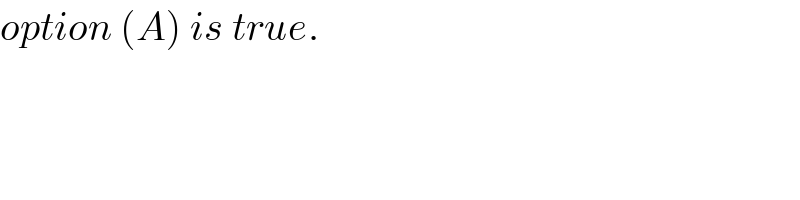
$${we}\:{have}\:{I}_{{n}} =\int_{\mathrm{0}} ^{\mathrm{1}} \:\:\frac{{dx}}{\left(\mathrm{1}+{x}^{\mathrm{2}} \right)^{{n}} } \\ $$$$=\int_{\mathrm{0}} ^{\mathrm{1}} \:\:\:\frac{\mathrm{1}+{x}^{\mathrm{2}} }{\left(\mathrm{1}+{x}^{\mathrm{2}} \right)^{{n}+\mathrm{1}} }\:{dx}\:={I}_{{n}+\mathrm{1}} \:\:+\int_{\mathrm{0}} ^{\mathrm{1}} \:\:{x}\:\frac{{x}}{\left(\mathrm{1}+{x}^{\mathrm{2}} \right)^{{n}+\mathrm{1}} }{dx} \\ $$$${by}\:{parts}\:{u}={x}\:{and}\:{v}^{'} ={x}\:\left(\mathrm{1}+{x}^{\mathrm{2}} \right)^{−{n}−\mathrm{1}} \\ $$$$\int_{\mathrm{0}} ^{\mathrm{1}} \:{x}\:\:\frac{{x}}{\left(\mathrm{1}+{x}^{\mathrm{2}} \right)^{{n}+\mathrm{1}} }{dx}\:=\left[{x}\left(−\frac{\mathrm{1}}{\mathrm{2}{n}}\:\left(\mathrm{1}+{x}^{\mathrm{2}} \right)^{−{n}} \right]_{\mathrm{0}} ^{\mathrm{1}} \right. \\ $$$$−\int_{\mathrm{0}} ^{\mathrm{1}} \:\:\mathrm{1}.\left(−\frac{\mathrm{1}}{\mathrm{2}{n}}\left(\mathrm{1}+{x}^{\mathrm{2}} \right)^{−{n}} \right){dx} \\ $$$$=−\frac{\mathrm{1}}{\mathrm{2}{n}}\:\mathrm{2}^{−{n}} \:\:+\frac{\mathrm{1}}{\mathrm{2}{n}}\:{I}_{{n}} \:\Rightarrow\:{I}_{{n}} ={I}_{{n}+\mathrm{1}} +\frac{\mathrm{1}}{\mathrm{2}{n}}{I}_{{n}} \\ $$$$−\frac{\mathrm{1}}{\mathrm{2}{n}}\:\mathrm{2}^{−{n}} \:\Rightarrow\:\left(\mathrm{1}−\frac{\mathrm{1}}{\mathrm{2}{n}}\right){I}_{{n}} =\:{I}_{{n}+\mathrm{1}} −\frac{\mathrm{1}}{\mathrm{2}{n}}\:\mathrm{2}^{−{n}} \\ $$$$\Rightarrow\left(\mathrm{2}{n}−\mathrm{1}\right)\:{I}_{{n}} =\mathrm{2}{n}\:{I}_{{n}+\mathrm{1}} −\frac{\mathrm{1}}{\mathrm{2}^{{n}} }\:\Rightarrow \\ $$$$\mathrm{2}{n}\:{I}_{{n}+\mathrm{1}} =\frac{\mathrm{1}}{\mathrm{2}^{{n}} }\:+\left(\mathrm{2}{n}−\mathrm{1}\right){I}_{{n}} \\ $$
Commented by Mr X pcx last updated on 20/May/19
$${option}\:\left({A}\right)\:{is}\:{true}. \\ $$
Commented by bhanukumarb2@gmail.com last updated on 21/May/19
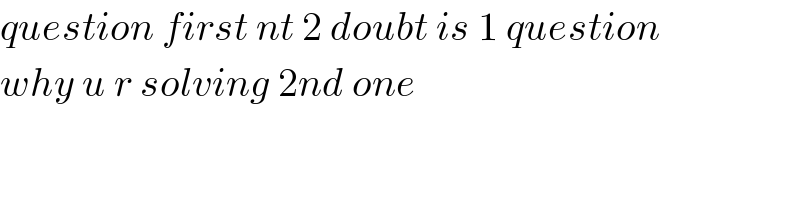
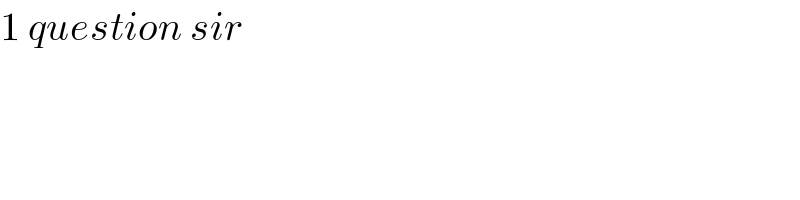
$${question}\:{first}\:{nt}\:\mathrm{2}\:{doubt}\:{is}\:\mathrm{1}\:{question}\: \\ $$$${why}\:{u}\:{r}\:{solving}\:\mathrm{2}{nd}\:{one} \\ $$