
Question Number 11977 by 786786AM last updated on 08/Apr/17
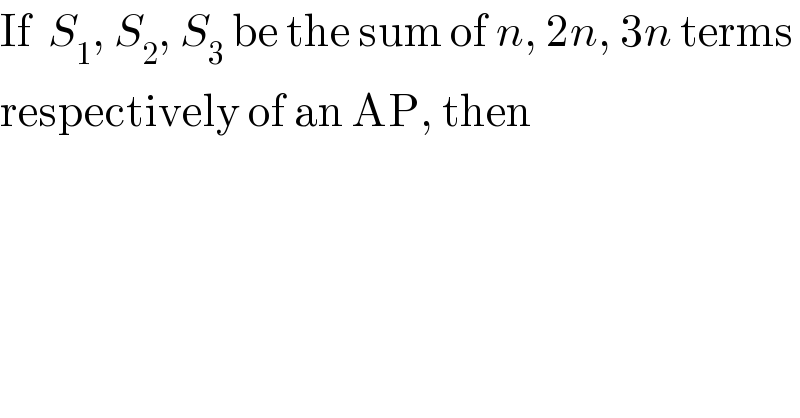
$$\mathrm{If}\:\:{S}_{\mathrm{1}} ,\:{S}_{\mathrm{2}} ,\:{S}_{\mathrm{3}} \:\mathrm{be}\:\mathrm{the}\:\mathrm{sum}\:\mathrm{of}\:{n},\:\mathrm{2}{n},\:\mathrm{3}{n}\:\mathrm{terms} \\ $$$$\mathrm{respectively}\:\mathrm{of}\:\mathrm{an}\:\mathrm{AP},\:\mathrm{then} \\ $$
Answered by ajfour last updated on 08/Apr/17
![S_1 =(n/2)[2a+(n−1)d] S_2 =n[2a+(2n−1)d] S_3 =((3n)/2)[2a+(3n−1)d] S_2 −2S_1 = n^2 d S_3 −3S_1 =((3n)/2)(2nd)=3n^2 d ⇒ S_3 −3S_1 =3(S_2 −2S_1 ) or S_3 =3(S_2 −S_1 ) .](https://www.tinkutara.com/question/Q11981.png)
$${S}_{\mathrm{1}} =\frac{{n}}{\mathrm{2}}\left[\mathrm{2}{a}+\left({n}−\mathrm{1}\right){d}\right] \\ $$$${S}_{\mathrm{2}} ={n}\left[\mathrm{2}{a}+\left(\mathrm{2}{n}−\mathrm{1}\right){d}\right] \\ $$$${S}_{\mathrm{3}} =\frac{\mathrm{3}{n}}{\mathrm{2}}\left[\mathrm{2}{a}+\left(\mathrm{3}{n}−\mathrm{1}\right){d}\right] \\ $$$${S}_{\mathrm{2}} −\mathrm{2}{S}_{\mathrm{1}} =\:{n}^{\mathrm{2}} {d} \\ $$$${S}_{\mathrm{3}} −\mathrm{3}{S}_{\mathrm{1}} =\frac{\mathrm{3}{n}}{\mathrm{2}}\left(\mathrm{2}{nd}\right)=\mathrm{3}{n}^{\mathrm{2}} {d} \\ $$$$\Rightarrow\:{S}_{\mathrm{3}} −\mathrm{3}{S}_{\mathrm{1}} =\mathrm{3}\left({S}_{\mathrm{2}} −\mathrm{2}{S}_{\mathrm{1}} \right) \\ $$$${or} \\ $$$${S}_{\mathrm{3}} =\mathrm{3}\left({S}_{\mathrm{2}} −{S}_{\mathrm{1}} \right)\:. \\ $$