
Question Number 80830 by jagoll last updated on 07/Feb/20
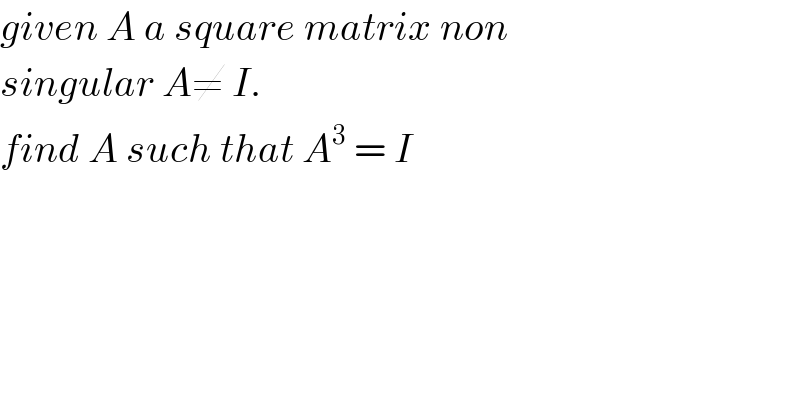
$${given}\:{A}\:{a}\:{square}\:{matrix}\:{non} \\ $$$${singular}\:{A}\neq\:{I}. \\ $$$${find}\:{A}\:{such}\:{that}\:{A}^{\mathrm{3}} \:=\:{I} \\ $$
Answered by ~blr237~ last updated on 07/Feb/20
![M=diag(1,j,j^− ) with j=[1,−((2π)/3)] the problem will be a little difficult if we want a matrix with reals factors in this case : let f the linear application related to A A^3 −I=0 ⇔ f^3 −id=(f−id)○(f^2 +f+id)=0^∼ then Im(f^2 +f+id)⊆ker(f−id) if we want a 2−square matrix , as A≠I we will have ker(f−id)={0} cause if not π(f)(x)=(x−1)(x−a) with a another real (that can be equal to 1) but as π(f)(x) should divide (x^3 −1) that show a is not real : absurd So Im(f^2 +f+id)={0} then f^2 +f+id=0^∼ using x^2 +x+1=(3/4)[(((2x+1)/( (√3))))^2 +1] we got (((2f+id)/( (√3))))^2 +id=0^∼ ( now we just have to find 2−square matrix such as B^2 =−I ) and we already have i≅anti diag(1,−1) and −i≅anti diag(−1,1) so f can be A= { ((diag(((−1)/2),−(1/2)))),((anti diag(((√3)/2) ,−((√3)/2)))) :} if we want A a 3−square matrix ( so degree(π(f))=3 and it divide x^3 −1 then π(f)(x)=(x−1)(x^2 +x+1) now theorem of decomposition allow that ker(f−id)⊕ker(f^2 +f+id)=E and the are each of them steady let assumed that ker(f−id)=<u> and ker(f^2 +f+id)=<v,w> B=(u,v,w) is a base of E such as f(ker(f^2 +f+id))⊆ker(f^2 +f+id) there exist (a,b,c,d)∈R_∗ ^4 such as { ((f(v)=av+bw)),((f(w)=cv+dw)) :} that show the matrix M of the restriction of f on ker(f^2 +f+id) and we know that it distinctive polynomial can be π′(f)(x)=x^2 −trMx+detM secondly the theorem of decomposition tell us that π′(f)=x^2 +x+1 so by unicity trM=det=−1 then { ((a+d=−1)),((ad−bc=−1)) :} now just choose your value we can take a=d=−(1/2) , then bc=(5/4) , b=5 and c=(1/4) finaly in the base B you will got a matrix A such as f(u)=u ; f(v)=−(v/2)+5w ;f(w)=(v/4)−(w/2)](https://www.tinkutara.com/question/Q80839.png)
$${M}={diag}\left(\mathrm{1},{j},\overset{−} {{j}}\right)\:\:{with}\:\:{j}=\left[\mathrm{1},−\frac{\mathrm{2}\pi}{\mathrm{3}}\right] \\ $$$${the}\:{problem}\:{will}\:{be}\:{a}\:{little}\:{difficult}\:{if}\:{we}\: \\ $$$${want}\:{a}\:{matrix}\:{with}\:{reals}\:{factors}\: \\ $$$${in}\:{this}\:{case}\::\:{let}\:{f}\:{the}\:{linear}\:{application}\:{related}\:{to}\:{A} \\ $$$${A}^{\mathrm{3}} −{I}=\mathrm{0}\:\Leftrightarrow\:{f}^{\mathrm{3}} −{id}=\left({f}−{id}\right)\circ\left({f}^{\mathrm{2}} +{f}+{id}\right)=\overset{\sim} {\mathrm{0}}\: \\ $$$$\:\:{then}\:\:\:\:\:{Im}\left({f}^{\mathrm{2}} +{f}+{id}\right)\subseteq{ker}\left({f}−{id}\right)\:\: \\ $$$${if}\:{we}\:{want}\:{a}\:\mathrm{2}−{square}\:{matrix}\:,\:{as}\:{A}\neq{I}\:{we}\:{will}\:{have}\:{ker}\left({f}−{id}\right)=\left\{\mathrm{0}\right\}\: \\ $$$${cause}\:{if}\:{not}\:\:\pi\left({f}\right)\left({x}\right)=\left({x}−\mathrm{1}\right)\left({x}−{a}\right)\:{with}\:{a}\:\:{another}\:{real}\:\left({that}\:{can}\:{be}\:{equal}\:{to}\:\mathrm{1}\right) \\ $$$${but}\:{as}\:\:\pi\left({f}\right)\left({x}\right)\:{should}\:{divide}\:\left({x}^{\mathrm{3}} −\mathrm{1}\right)\:\:{that}\:{show}\:{a}\:{is}\:{not}\:{real}\::\:{absurd} \\ $$$${So}\:\:\:{Im}\left({f}^{\mathrm{2}} +{f}+{id}\right)=\left\{\mathrm{0}\right\}\:{then}\:\:{f}^{\mathrm{2}} +{f}+{id}=\overset{\sim} {\mathrm{0}}\: \\ $$$${using}\:\:{x}^{\mathrm{2}} +{x}+\mathrm{1}=\frac{\mathrm{3}}{\mathrm{4}}\left[\left(\frac{\mathrm{2}{x}+\mathrm{1}}{\:\sqrt{\mathrm{3}}}\right)^{\mathrm{2}} +\mathrm{1}\right] \\ $$$${we}\:{got}\:\left(\frac{\mathrm{2}{f}+{id}}{\:\sqrt{\mathrm{3}}}\right)^{\mathrm{2}} +{id}=\overset{\sim} {\mathrm{0}}\:\:\left(\:{now}\:{we}\:{just}\:{have}\:{to}\:{find}\:\mathrm{2}−{square}\:{matrix}\:{such}\:{as}\:{B}^{\mathrm{2}} =−{I}\:\right) \\ $$$${and}\:{we}\:{already}\:{have}\:\:{i}\cong{anti}\:{diag}\left(\mathrm{1},−\mathrm{1}\right)\:{and}\:−{i}\cong{anti}\:{diag}\left(−\mathrm{1},\mathrm{1}\right) \\ $$$${so}\:{f}\:{can}\:{be}\:\:{A}=\:\begin{cases}{{diag}\left(\frac{−\mathrm{1}}{\mathrm{2}},−\frac{\mathrm{1}}{\mathrm{2}}\right)}\\{{anti}\:{diag}\left(\frac{\sqrt{\mathrm{3}}}{\mathrm{2}}\:,−\frac{\sqrt{\mathrm{3}}}{\mathrm{2}}\right)}\end{cases}\: \\ $$$${if}\:{we}\:{want}\:{A}\:{a}\:\mathrm{3}−{square}\:{matrix}\:\:\:\left(\:{so}\:\:{degree}\left(\pi\left({f}\right)\right)=\mathrm{3}\:\:{and}\:{it}\:{divide}\:{x}^{\mathrm{3}} −\mathrm{1}\:\right. \\ $$$${then}\:\:\pi\left({f}\right)\left({x}\right)=\left({x}−\mathrm{1}\right)\left({x}^{\mathrm{2}} +{x}+\mathrm{1}\right)\: \\ $$$${now}\:\:{theorem}\:{of}\:{decomposition}\:{allow}\:{that} \\ $$$${ker}\left({f}−{id}\right)\oplus{ker}\left({f}^{\mathrm{2}} +{f}+{id}\right)={E}\:{and}\:{the}\:{are}\:{each}\:{of}\:{them}\:{steady}\: \\ $$$${let}\:{assumed}\:{that}\:{ker}\left({f}−{id}\right)=<{u}>\:{and}\:{ker}\left({f}^{\mathrm{2}} +{f}+{id}\right)=<{v},{w}> \\ $$$${B}=\left({u},{v},{w}\right)\:{is}\:{a}\:{base}\:{of}\:{E}\: \\ $$$${such}\:{as}\:{f}\left({ker}\left({f}^{\mathrm{2}} +{f}+{id}\right)\right)\subseteq{ker}\left({f}^{\mathrm{2}} +{f}+{id}\right) \\ $$$${there}\:{exist}\:\left({a},{b},{c},{d}\right)\in\mathbb{R}_{\ast} ^{\mathrm{4}} \:{such}\:{as}\:\begin{cases}{{f}\left({v}\right)={av}+{bw}}\\{{f}\left({w}\right)={cv}+{dw}}\end{cases} \\ $$$${that}\:{show}\:{the}\:{matrix}\:{M}\:{of}\:{the}\:{restriction}\:{of}\:{f}\:{on}\:{ker}\left({f}^{\mathrm{2}} +{f}+{id}\right) \\ $$$${and}\:{we}\:{know}\:{that}\:{it}\:\:{distinctive}\:{polynomial}\:{can}\:{be}\:\pi'\left({f}\right)\left({x}\right)={x}^{\mathrm{2}} −{trMx}+{detM}\: \\ $$$${secondly}\:\:{the}\:{theorem}\:{of}\:{decomposition}\:{tell}\:{us}\:{that}\:\pi'\left({f}\right)={x}^{\mathrm{2}} +{x}+\mathrm{1}\: \\ $$$${so}\:{by}\:{unicity}\:\:{trM}={det}=−\mathrm{1}\: \\ $$$${then}\:\:\:\begin{cases}{{a}+{d}=−\mathrm{1}}\\{{ad}−{bc}=−\mathrm{1}}\end{cases} \\ $$$${now}\:{just}\:{choose}\:{your}\:{value}\: \\ $$$${we}\:{can}\:{take}\:\:{a}={d}=−\frac{\mathrm{1}}{\mathrm{2}}\:,\:{then}\:{bc}=\frac{\mathrm{5}}{\mathrm{4}}\:,\:{b}=\mathrm{5}\:{and}\:{c}=\frac{\mathrm{1}}{\mathrm{4}}\: \\ $$$${finaly}\:\:\:{in}\:{the}\:{base}\:{B}\:{you}\:{will}\:{got}\:{a}\:{matrix}\:{A}\:{such}\:{as} \\ $$$${f}\left({u}\right)={u}\:\:;\:{f}\left({v}\right)=−\frac{{v}}{\mathrm{2}}+\mathrm{5}{w}\:;{f}\left({w}\right)=\frac{{v}}{\mathrm{4}}−\frac{{w}}{\mathrm{2}}\: \\ $$
Commented by jagoll last updated on 07/Feb/20

$${thank}\:{you}\:{mister} \\ $$