
Question Number 1418 by Rasheed Ahmad last updated on 04/Aug/15

$${Solve}\:{the}\:{following}\:{compound} \\ $$$${inequation}\:{in}\:{interval}\:\left(\mathrm{0},\:\mathrm{2}\pi\right), \\ $$$${tan}\frac{{x}}{\mathrm{2}}\:\leqslant\:−\mathrm{1}\:\:{and}\:\:{tan}\frac{{x}}{\mathrm{2}}\:<\:\mathrm{0}\:. \\ $$
Commented by 123456 last updated on 31/Jul/15

$$\mathrm{tan}\:\frac{\pi}{\mathrm{4}}=−\mathrm{tan}\:\frac{\mathrm{3}\pi}{\mathrm{4}}=\mathrm{tan}\:\frac{\mathrm{5}\pi}{\mathrm{4}}=−\mathrm{tan}\:\frac{\mathrm{7}\pi}{\mathrm{4}}=\mathrm{1} \\ $$
Answered by 123456 last updated on 31/Jul/15
![tan (x/2)<0 (x/2)∈((π/2)+2πk,π+2πk)∪(((3π)/2)+2πk,2π+2πk),k∈Z x∈(π+4πk,2π+4πk)∪(3π+4πk,4π+4πk) tan (x/2)≤−1 (x/2)∈((π/2)+2πk,((3π)/4)+2πk]∪(((3π)/2)+2πk,((7π)/4)+2πk] x∈(π+4πk,((3π)/2)+4πk]∪(3π+4πk,((7π)/2)+4πk]](https://www.tinkutara.com/question/Q1419.png)
$$\mathrm{tan}\:\frac{{x}}{\mathrm{2}}<\mathrm{0} \\ $$$$\frac{{x}}{\mathrm{2}}\in\left(\frac{\pi}{\mathrm{2}}+\mathrm{2}\pi{k},\pi+\mathrm{2}\pi{k}\right)\cup\left(\frac{\mathrm{3}\pi}{\mathrm{2}}+\mathrm{2}\pi{k},\mathrm{2}\pi+\mathrm{2}\pi{k}\right),{k}\in\mathbb{Z} \\ $$$${x}\in\left(\pi+\mathrm{4}\pi{k},\mathrm{2}\pi+\mathrm{4}\pi{k}\right)\cup\left(\mathrm{3}\pi+\mathrm{4}\pi{k},\mathrm{4}\pi+\mathrm{4}\pi{k}\right) \\ $$$$\mathrm{tan}\:\frac{{x}}{\mathrm{2}}\leqslant−\mathrm{1} \\ $$$$\frac{{x}}{\mathrm{2}}\in\left(\frac{\pi}{\mathrm{2}}+\mathrm{2}\pi{k},\frac{\mathrm{3}\pi}{\mathrm{4}}+\mathrm{2}\pi{k}\right]\cup\left(\frac{\mathrm{3}\pi}{\mathrm{2}}+\mathrm{2}\pi{k},\frac{\mathrm{7}\pi}{\mathrm{4}}+\mathrm{2}\pi{k}\right] \\ $$$${x}\in\left(\pi+\mathrm{4}\pi{k},\frac{\mathrm{3}\pi}{\mathrm{2}}+\mathrm{4}\pi{k}\right]\cup\left(\mathrm{3}\pi+\mathrm{4}\pi{k},\frac{\mathrm{7}\pi}{\mathrm{2}}+\mathrm{4}\pi{k}\right] \\ $$
Commented by Rasheed Ahmad last updated on 03/Aug/15
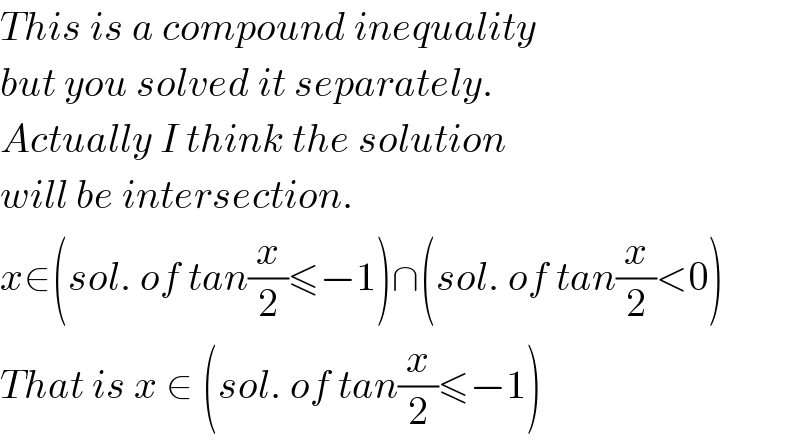
$${This}\:{is}\:{a}\:{compound}\:{inequality}\: \\ $$$${but}\:{you}\:{solved}\:{it}\:{separately}. \\ $$$${Actually}\:{I}\:{think}\:{the}\:{solution} \\ $$$${will}\:{be}\:{intersection}. \\ $$$${x}\in\left({sol}.\:{of}\:{tan}\frac{{x}}{\mathrm{2}}\leqslant−\mathrm{1}\right)\cap\left({sol}.\:{of}\:{tan}\frac{{x}}{\mathrm{2}}<\mathrm{0}\right) \\ $$$${That}\:{is}\:{x}\:\in\:\left({sol}.\:{of}\:{tan}\frac{{x}}{\mathrm{2}}\leqslant−\mathrm{1}\right) \\ $$
Commented by 123456 last updated on 03/Aug/15
![yes, i didn′t see it, the solution then is the intersection of these two solution x∈(π+4πk,((3π)/2)+4πk]∪(3π+4πk,((7π)/2)+4πk] for x∈[0,2π) we have x∈(π,((3π)/2)]](https://www.tinkutara.com/question/Q1432.png)
$$\mathrm{yes},\:\mathrm{i}\:\mathrm{didn}'\mathrm{t}\:\mathrm{see}\:\mathrm{it},\:\mathrm{the}\:\mathrm{solution}\:\mathrm{then} \\ $$$$\mathrm{is}\:\mathrm{the}\:\mathrm{intersection}\:\mathrm{of}\:\mathrm{these}\:\mathrm{two}\:\mathrm{solution} \\ $$$${x}\in\left(\pi+\mathrm{4}\pi{k},\frac{\mathrm{3}\pi}{\mathrm{2}}+\mathrm{4}\pi{k}\right]\cup\left(\mathrm{3}\pi+\mathrm{4}\pi{k},\frac{\mathrm{7}\pi}{\mathrm{2}}+\mathrm{4}\pi{k}\right] \\ $$$$\mathrm{for}\:{x}\in\left[\mathrm{0},\mathrm{2}\pi\right)\:\mathrm{we}\:\mathrm{have} \\ $$$${x}\in\left(\pi,\frac{\mathrm{3}\pi}{\mathrm{2}}\right] \\ $$