
Question Number 93248 by i jagooll last updated on 12/May/20
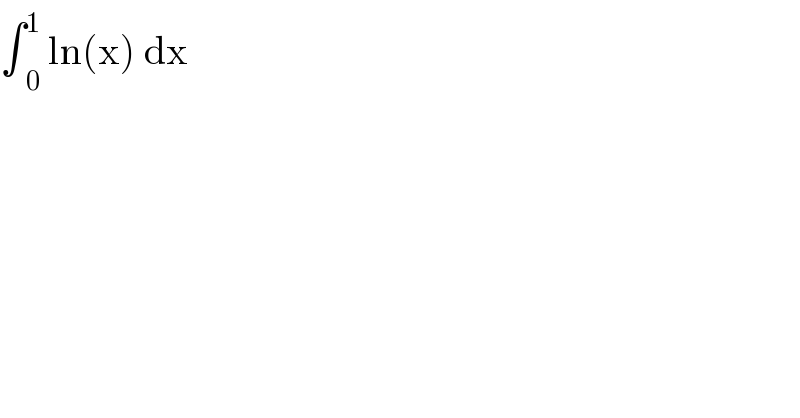
$$\int\underset{\mathrm{0}} {\overset{\mathrm{1}} {\:}}\:\mathrm{ln}\left(\mathrm{x}\right)\:\mathrm{dx}\: \\ $$
Commented by abdomathmax last updated on 12/May/20
![∫_0 ^1 ln(x)dx =lim_(a→0^+ ) ∫_a ^1 ln(x)dx =lim_(a→0^+ ) [xlnx−x]_a ^1 =lim_(a→0^+ ) (−1−alna+a) =−1](https://www.tinkutara.com/question/Q93264.png)
$$\int_{\mathrm{0}} ^{\mathrm{1}} {ln}\left({x}\right){dx}\:={lim}_{{a}\rightarrow\mathrm{0}^{+} } \:\:\int_{{a}} ^{\mathrm{1}} {ln}\left({x}\right){dx} \\ $$$$={lim}_{{a}\rightarrow\mathrm{0}^{+} } \:\:\:\:\left[{xlnx}−{x}\right]_{{a}} ^{\mathrm{1}} \: \\ $$$$={lim}_{{a}\rightarrow\mathrm{0}^{+} } \:\:\left(−\mathrm{1}−{alna}+{a}\right)\:=−\mathrm{1} \\ $$
Answered by john santu last updated on 12/May/20
![D.I method ∫_0 ^1 ln(x) dx = lim_(p→0^+ ) { ∫_p ^1 ln(x) dx } = lim_(p→0^+ ) { x ln(x)−x }]_p ^1 = lim_(p→0^+ ) {−1+p−pln(p)} = −1+ lim_(p→0^+ ) p(1−ln(p)) = −1+ lim_(p→0^+ ) ((1−ln(p))/(((1/p)))) =−1+ lim^(LH) _(p→0^+ ) (((−((1/p)))/(−((1/p^2 ))))) = −1 + lim_(p→0^+ ) (p) = −1+0 = −1](https://www.tinkutara.com/question/Q93253.png)
$$\mathrm{D}.\mathrm{I}\:\mathrm{method}\: \\ $$$$\underset{\mathrm{0}} {\overset{\mathrm{1}} {\int}}\:\mathrm{ln}\left({x}\right)\:{dx}\:=\:\underset{{p}\rightarrow\mathrm{0}^{+} } {\mathrm{lim}}\:\left\{\:\underset{\mathrm{p}} {\overset{\mathrm{1}} {\int}}\:\mathrm{ln}\left({x}\right)\:{dx}\:\right\} \\ $$$$\left.=\:\underset{{p}\rightarrow\mathrm{0}^{+} } {\mathrm{lim}}\:\left\{\:{x}\:\mathrm{ln}\left({x}\right)−{x}\:\right\}\right]_{{p}} ^{\mathrm{1}} \\ $$$$=\:\underset{{p}\rightarrow\mathrm{0}^{+} } {\mathrm{lim}}\:\left\{−\mathrm{1}+{p}−{p}\mathrm{ln}\left({p}\right)\right\} \\ $$$$=\:−\mathrm{1}+\:\underset{\mathrm{p}\rightarrow\mathrm{0}^{+} } {\mathrm{lim}}\:{p}\left(\mathrm{1}−\mathrm{ln}\left({p}\right)\right) \\ $$$$=\:−\mathrm{1}+\:\underset{{p}\rightarrow\mathrm{0}^{+} } {\mathrm{lim}}\:\frac{\mathrm{1}−\mathrm{ln}\left({p}\right)}{\left(\frac{\mathrm{1}}{{p}}\right)} \\ $$$$=−\mathrm{1}+\:\underset{{p}\rightarrow\mathrm{0}^{+} } {\mathrm{li}\overset{{L}\mathrm{H}} {\mathrm{m}}}\:\left(\frac{−\left(\frac{\mathrm{1}}{{p}}\right)}{−\left(\frac{\mathrm{1}}{{p}^{\mathrm{2}} }\right)}\right)\: \\ $$$$=\:−\mathrm{1}\:+\:\underset{{p}\rightarrow\mathrm{0}^{+} } {\mathrm{lim}}\:\left({p}\right)\:=\:−\mathrm{1}+\mathrm{0}\:=\:−\mathrm{1} \\ $$
Commented by i jagooll last updated on 12/May/20

$$\mathrm{thank}\:\mathrm{you}… \\ $$