
Question Number 36316 by ajfour last updated on 31/May/18

$${Find}\:{domain}\:{and}\:{range}\:{of}\:{the} \\ $$$${function}\:\:{f}\left({x}\right)=\frac{{x}^{\mathrm{2}} −\mathrm{6}{x}+\mathrm{8}}{{x}−\mathrm{5}}\:\:. \\ $$$${Also}\:{draw}\:{the}\:{graph}. \\ $$
Answered by tanmay.chaudhury50@gmail.com last updated on 31/May/18
![y=((x^2 −6x+8)/(x−5)) x^2 −6x+8−xy+5y=0 x^2 +x(−6−y)+8+5y=0 discriminant D=B^2 −4AC =(6+y)^2 −4(8+5y) =36+12y+y^2 −32−20y =y^2 −8y+4 =y^2 −2.y.4+(4)^2 +4−16 =(y−4)^2 −(2(√3) )^2 =(y−4)^2 −(2(√3) )^2 =(y−4+2(√3) )(y−4−2(√3) ) critical value of y are(4−2(√3) ),(4+2(√3) ) D>0 when y>4+2(√3) D>0 when y<(4−2(√3) so y can not have value between (4−2(√3) ) and(4+2(√3) ) value of y (−∞,4−2(√3) ] ∪ [4+2(√3),+∞) at x=5 y is undefined so x can not be 5 pls check and suggest domain of x=R−{5}](https://www.tinkutara.com/question/Q36324.png)
$${y}=\frac{{x}^{\mathrm{2}} −\mathrm{6}{x}+\mathrm{8}}{{x}−\mathrm{5}} \\ $$$${x}^{\mathrm{2}} −\mathrm{6}{x}+\mathrm{8}−{xy}+\mathrm{5}{y}=\mathrm{0} \\ $$$${x}^{\mathrm{2}} +{x}\left(−\mathrm{6}−{y}\right)+\mathrm{8}+\mathrm{5}{y}=\mathrm{0} \\ $$$${discriminant} \\ $$$${D}={B}^{\mathrm{2}} −\mathrm{4}{AC} \\ $$$$=\left(\mathrm{6}+{y}\right)^{\mathrm{2}} −\mathrm{4}\left(\mathrm{8}+\mathrm{5}{y}\right) \\ $$$$=\mathrm{36}+\mathrm{12}{y}+{y}^{\mathrm{2}} −\mathrm{32}−\mathrm{20}{y} \\ $$$$={y}^{\mathrm{2}} −\mathrm{8}{y}+\mathrm{4} \\ $$$$={y}^{\mathrm{2}} −\mathrm{2}.{y}.\mathrm{4}+\left(\mathrm{4}\right)^{\mathrm{2}} +\mathrm{4}−\mathrm{16} \\ $$$$=\left({y}−\mathrm{4}\right)^{\mathrm{2}} −\left(\mathrm{2}\sqrt{\mathrm{3}}\:\right)^{\mathrm{2}} \\ $$$$=\left({y}−\mathrm{4}\right)^{\mathrm{2}} −\left(\mathrm{2}\sqrt{\mathrm{3}}\:\right)^{\mathrm{2}} \\ $$$$ \\ $$$$=\left({y}−\mathrm{4}+\mathrm{2}\sqrt{\mathrm{3}}\:\right)\left({y}−\mathrm{4}−\mathrm{2}\sqrt{\mathrm{3}}\:\:\right) \\ $$$${critical}\:{value}\:{of}\:{y}\:{are}\left(\mathrm{4}−\mathrm{2}\sqrt{\mathrm{3}}\:\right),\left(\mathrm{4}+\mathrm{2}\sqrt{\mathrm{3}}\:\right) \\ $$$$ \\ $$$$ \\ $$$${D}>\mathrm{0}\:{when}\:{y}>\mathrm{4}+\mathrm{2}\sqrt{\mathrm{3}}\: \\ $$$$ \\ $$$${D}>\mathrm{0}\:{when}\:{y}<\left(\mathrm{4}−\mathrm{2}\sqrt{\mathrm{3}}\:\right. \\ $$$${so}\:{y}\:{can}\:{not}\:{have}\:{value}\:{between}\:\left(\mathrm{4}−\mathrm{2}\sqrt{\mathrm{3}}\:\right) \\ $$$${and}\left(\mathrm{4}+\mathrm{2}\sqrt{\mathrm{3}}\:\right) \\ $$$${value}\:{of}\:{y} \\ $$$$\left(−\infty,\mathrm{4}−\mathrm{2}\sqrt{\mathrm{3}}\:\right]\:\cup\:\left[\mathrm{4}+\mathrm{2}\sqrt{\mathrm{3}},+\infty\right) \\ $$$${at}\:{x}=\mathrm{5}\:\:\:{y}\:{is}\:{undefined}\:{so}\:{x}\:{can}\:{not}\:{be}\:\mathrm{5} \\ $$$${pls}\:{check}\:{and}\:{suggest} \\ $$$${domain}\:{of}\:{x}={R}−\left\{\mathrm{5}\right\} \\ $$
Commented by tanmay.chaudhury50@gmail.com last updated on 31/May/18

$${later}\:{corrected}\:{and}\:{put}\:{in}\:{red}\:{coloured}\:{font} \\ $$
Commented by tanmay.chaudhury50@gmail.com last updated on 31/May/18
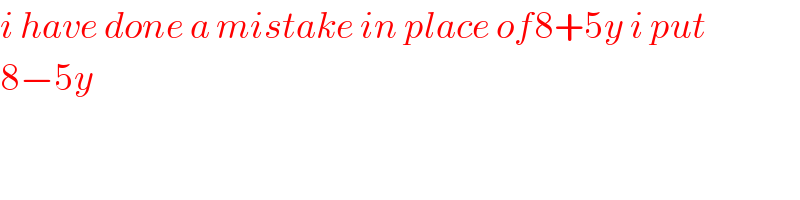
$${i}\:{have}\:{done}\:{a}\:{mistake}\:{in}\:{place}\:{of}\mathrm{8}+\mathrm{5}{y}\:{i}\:{put}\: \\ $$$$\mathrm{8}−\mathrm{5}{y} \\ $$
Answered by ajfour last updated on 31/May/18

Commented by ajfour last updated on 31/May/18
![((df(x))/dx)=(((2x−6)(x−5)−(x^2 −6x+8))/((x−5)^2 )) ⇒ f ′(x)=0 for x^2 −10x+22=0 ⇒ x= ((10±(√(100−88)))/2) =5±(√3) (point of local minima and maxima) f(x)=(((x−2)(x−4))/((x−5))) f(5−(√3))=(((3−(√3))(1−(√3)))/(−(√3))) =((4(√3)−6)/( (√3))) = 4−2(√3) f(5+(√3)) = (((3+(√3))(1+(√3)))/( (√3))) =4+2(√3) . Domain : x∈ R−{5} Range : f(x) ∈ (−∞, 4−2(√3) ]∪[4+2(√3) ,∞).](https://www.tinkutara.com/question/Q36327.png)
$$\frac{{df}\left({x}\right)}{{dx}}=\frac{\left(\mathrm{2}{x}−\mathrm{6}\right)\left({x}−\mathrm{5}\right)−\left({x}^{\mathrm{2}} −\mathrm{6}{x}+\mathrm{8}\right)}{\left({x}−\mathrm{5}\right)^{\mathrm{2}} } \\ $$$$\Rightarrow\:\:{f}\:'\left({x}\right)=\mathrm{0}\:\:\:{for}\:\: \\ $$$$\:\:\:\:\:\:{x}^{\mathrm{2}} −\mathrm{10}{x}+\mathrm{22}=\mathrm{0} \\ $$$$\:\:\Rightarrow\:{x}=\:\frac{\mathrm{10}\pm\sqrt{\mathrm{100}−\mathrm{88}}}{\mathrm{2}}\: \\ $$$$\:\:\:\:\:\:\:\:\:\:=\mathrm{5}\pm\sqrt{\mathrm{3}}\:\:\:\left({point}\:{of}\:{local}\right. \\ $$$$\left.{minima}\:{and}\:{maxima}\right) \\ $$$${f}\left({x}\right)=\frac{\left({x}−\mathrm{2}\right)\left({x}−\mathrm{4}\right)}{\left({x}−\mathrm{5}\right)} \\ $$$${f}\left(\mathrm{5}−\sqrt{\mathrm{3}}\right)=\frac{\left(\mathrm{3}−\sqrt{\mathrm{3}}\right)\left(\mathrm{1}−\sqrt{\mathrm{3}}\right)}{−\sqrt{\mathrm{3}}} \\ $$$$\:\:\:\:\:\:\:\:\:\:\:\:\:\:\:\:\:\:=\frac{\mathrm{4}\sqrt{\mathrm{3}}−\mathrm{6}}{\:\sqrt{\mathrm{3}}}\:=\:\mathrm{4}−\mathrm{2}\sqrt{\mathrm{3}} \\ $$$${f}\left(\mathrm{5}+\sqrt{\mathrm{3}}\right)\:=\:\frac{\left(\mathrm{3}+\sqrt{\mathrm{3}}\right)\left(\mathrm{1}+\sqrt{\mathrm{3}}\right)}{\:\sqrt{\mathrm{3}}} \\ $$$$\:\:\:\:\:\:\:\:\:\:\:\:\:\:\:\:\:\:\:=\mathrm{4}+\mathrm{2}\sqrt{\mathrm{3}}\:. \\ $$$${Domain}\::\:\:\:{x}\in\:\mathbb{R}−\left\{\mathrm{5}\right\} \\ $$$${Range}\:: \\ $$$${f}\left({x}\right)\:\in\:\left(−\infty,\:\mathrm{4}−\mathrm{2}\sqrt{\mathrm{3}}\:\right]\cup\left[\mathrm{4}+\mathrm{2}\sqrt{\mathrm{3}}\:,\infty\right). \\ $$
Answered by ajfour last updated on 31/May/18
![xy−5y=x^2 −6x+8 x^2 −(y+6)x+5y+8=0 for real x (y+6)^2 ≥ 4(5y+8) y^2 −8y+4 ≥ 0 ⇒ roots are y=4±2(√3) ⇒ y ∈ (−∞, 4−2(√3) ]∪[4+2(√3) ,∞).](https://www.tinkutara.com/question/Q36330.png)
$${xy}−\mathrm{5}{y}={x}^{\mathrm{2}} −\mathrm{6}{x}+\mathrm{8} \\ $$$${x}^{\mathrm{2}} −\left({y}+\mathrm{6}\right){x}+\mathrm{5}{y}+\mathrm{8}=\mathrm{0} \\ $$$${for}\:{real}\:{x} \\ $$$$\:\:\:\left({y}+\mathrm{6}\right)^{\mathrm{2}} \:\geqslant\:\mathrm{4}\left(\mathrm{5}{y}+\mathrm{8}\right) \\ $$$$\:\:\:\:\:{y}^{\mathrm{2}} −\mathrm{8}{y}+\mathrm{4}\:\geqslant\:\mathrm{0} \\ $$$$\Rightarrow\:\:\:{roots}\:{are}\:\:\:{y}=\mathrm{4}\pm\mathrm{2}\sqrt{\mathrm{3}} \\ $$$$\Rightarrow\:{y}\:\in\:\left(−\infty,\:\mathrm{4}−\mathrm{2}\sqrt{\mathrm{3}}\:\right]\cup\left[\mathrm{4}+\mathrm{2}\sqrt{\mathrm{3}}\:,\infty\right). \\ $$