Question Number 102369 by bobhans last updated on 08/Jul/20
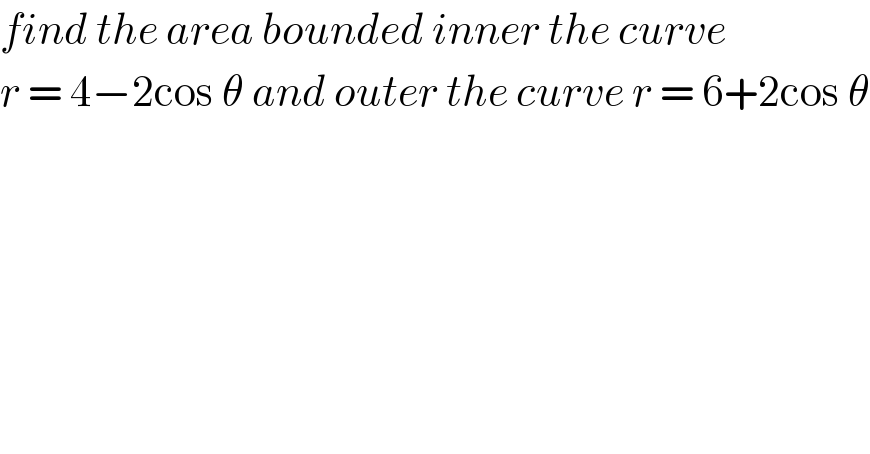
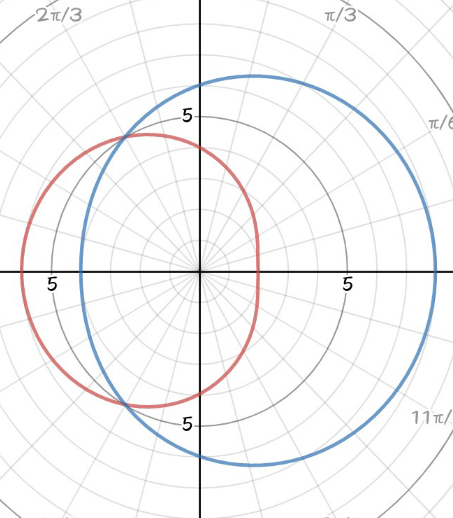
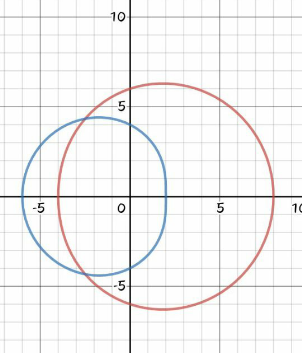
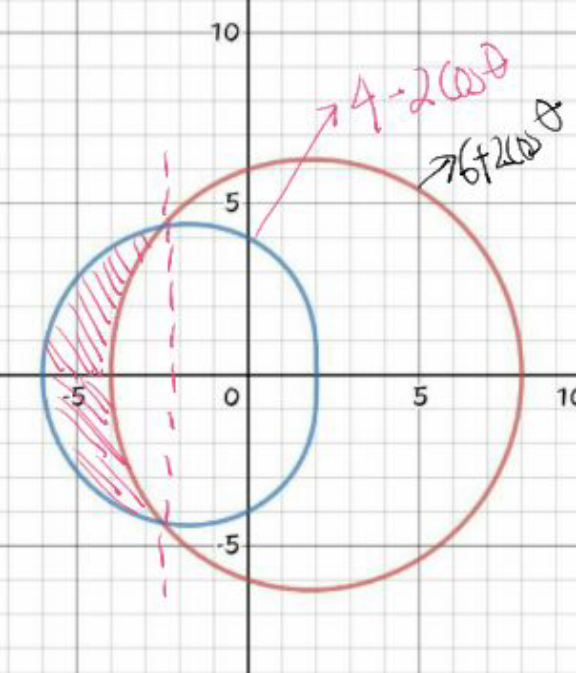
$${find}\:{the}\:{area}\:{bounded}\:{inner}\:{the}\:{curve} \\ $$$${r}\:=\:\mathrm{4}−\mathrm{2cos}\:\theta\:{and}\:{outer}\:{the}\:{curve}\:{r}\:=\:\mathrm{6}+\mathrm{2cos}\:\theta \\ $$
Answered by Ar Brandon last updated on 08/Jul/20
![Area , A=∫_0 ^(2π) ∫_(4−2cosθ) ^(6+2cosθ) rdrdθ=∫_0 ^(2π) [(r^2 /2)]_(4−2cosθ) ^(6+2cosθ) dθ ⇒A=(1/2)∫_0 ^(2π) {(6+2cosθ)^2 −(4−2cosθ)^2 }dθ =(1/2)∫_0 ^(2π) {(36+24cosθ+4cos^2 θ)−(16−16cosθ+4cos^2 θ)}dθ =(1/2)∫_0 ^(2π) (20+40cosθ)dθ=[((20θ+40sinθ)/2)]_0 ^(2π) =20π square units Don′t really know if I′ve done it in the right way. Please let me know what you think.](https://www.tinkutara.com/question/Q102410.png)
$$\mathrm{Area}\:,\:\mathrm{A}=\int_{\mathrm{0}} ^{\mathrm{2}\pi} \int_{\mathrm{4}−\mathrm{2cos}\theta} ^{\mathrm{6}+\mathrm{2cos}\theta} \mathrm{rdrd}\theta=\int_{\mathrm{0}} ^{\mathrm{2}\pi} \left[\frac{\mathrm{r}^{\mathrm{2}} }{\mathrm{2}}\right]_{\mathrm{4}−\mathrm{2cos}\theta} ^{\mathrm{6}+\mathrm{2cos}\theta} \mathrm{d}\theta \\ $$$$\Rightarrow\mathrm{A}=\frac{\mathrm{1}}{\mathrm{2}}\int_{\mathrm{0}} ^{\mathrm{2}\pi} \left\{\left(\mathrm{6}+\mathrm{2cos}\theta\right)^{\mathrm{2}} −\left(\mathrm{4}−\mathrm{2cos}\theta\right)^{\mathrm{2}} \right\}\mathrm{d}\theta \\ $$$$\:\:\:\:\:\:\:\:\:=\frac{\mathrm{1}}{\mathrm{2}}\int_{\mathrm{0}} ^{\mathrm{2}\pi} \left\{\left(\mathrm{36}+\mathrm{24cos}\theta+\mathrm{4cos}^{\mathrm{2}} \theta\right)−\left(\mathrm{16}−\mathrm{16cos}\theta+\mathrm{4cos}^{\mathrm{2}} \theta\right)\right\}\mathrm{d}\theta \\ $$$$\:\:\:\:\:\:\:\:\:=\frac{\mathrm{1}}{\mathrm{2}}\int_{\mathrm{0}} ^{\mathrm{2}\pi} \left(\mathrm{20}+\mathrm{40cos}\theta\right)\mathrm{d}\theta=\left[\frac{\mathrm{20}\theta+\mathrm{40sin}\theta}{\mathrm{2}}\right]_{\mathrm{0}} ^{\mathrm{2}\pi} \\ $$$$\:\:\:\:\:\:\:\:\:=\mathrm{20}\pi\:\mathrm{square}\:\mathrm{units} \\ $$$$ \\ $$$${Don}'{t}\:{really}\:{know}\:{if}\:{I}'{ve}\:{done}\:{it}\:{in}\:{the}\:{right}\:{way}. \\ $$$${Please}\:{let}\:{me}\:{know}\:{what}\:{you}\:{think}. \\ $$
Commented by mr W last updated on 09/Jul/20

$${you}\:{are}\:{right}.\:{i}\:{misread},\:{because}\:{this} \\ $$$${is}\:{how}\:{the}\:{question}\:{is}\:{displayed}\:{on} \\ $$$${my}\:{device}: \\ $$
Commented by mr W last updated on 08/Jul/20
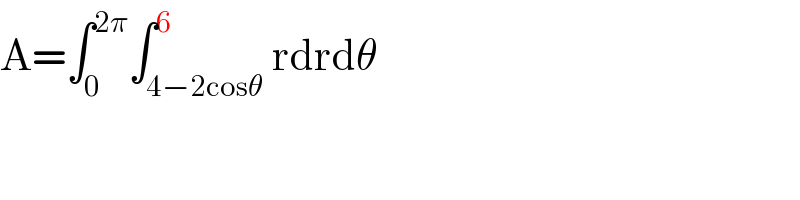
$$\mathrm{A}=\int_{\mathrm{0}} ^{\mathrm{2}\pi} \int_{\mathrm{4}−\mathrm{2cos}\theta} ^{\mathrm{6}} \mathrm{rdrd}\theta \\ $$
Commented by Ar Brandon last updated on 08/Jul/20
Why the 6 at the upper bound, mr W ?
Commented by mr W last updated on 09/Jul/20
Commented by mr W last updated on 09/Jul/20
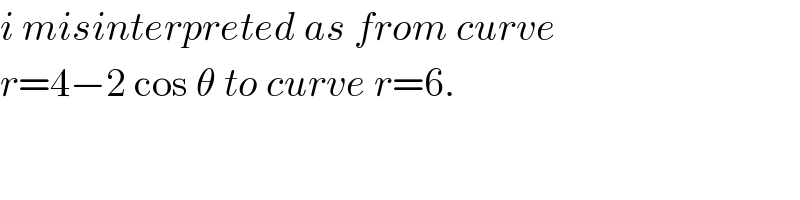
$${i}\:{misinterpreted}\:{as}\:{from}\:{curve} \\ $$$${r}=\mathrm{4}−\mathrm{2}\:\mathrm{cos}\:\theta\:{to}\:{curve}\:{r}=\mathrm{6}. \\ $$
Commented by bobhans last updated on 09/Jul/20
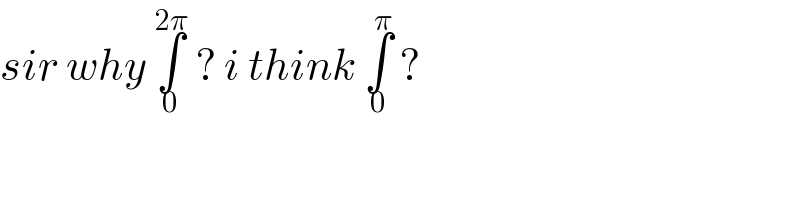
$${sir}\:{why}\:\underset{\mathrm{0}} {\overset{\mathrm{2}\pi} {\int}}\:?\:{i}\:{think}\:\underset{\mathrm{0}} {\overset{\pi} {\int}}\:? \\ $$
Commented by bobhans last updated on 09/Jul/20
Commented by Ar Brandon last updated on 09/Jul/20
OK Sir
Commented by Ar Brandon last updated on 09/Jul/20
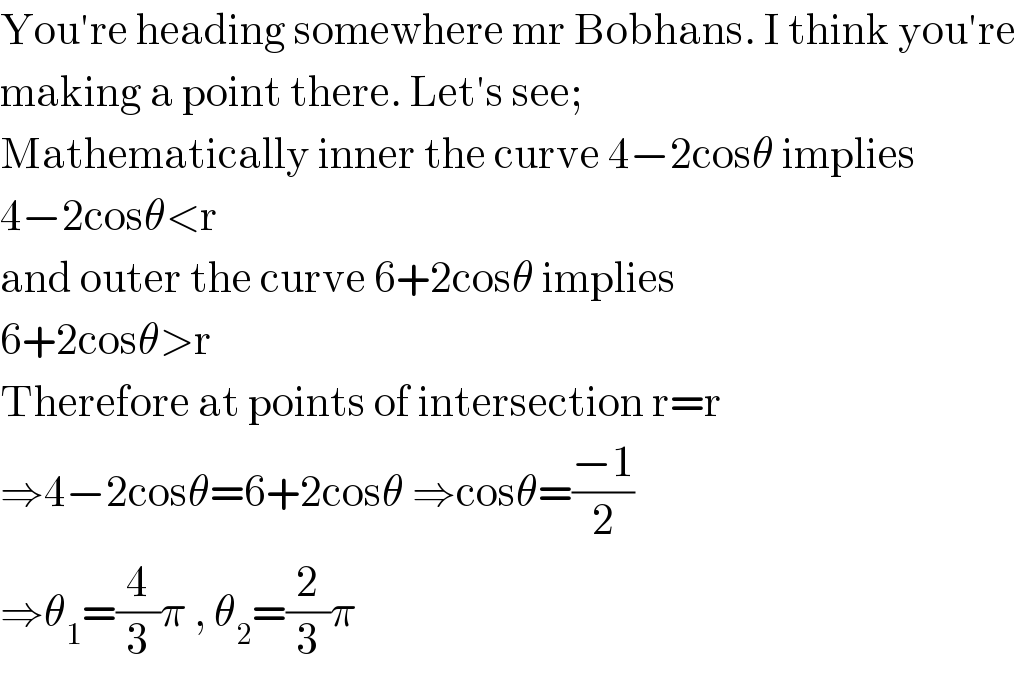
$$\mathrm{You}'\mathrm{re}\:\mathrm{heading}\:\mathrm{somewhere}\:\mathrm{mr}\:\mathrm{Bobhans}.\:\mathrm{I}\:\mathrm{think}\:\mathrm{you}'\mathrm{re} \\ $$$$\mathrm{making}\:\mathrm{a}\:\mathrm{point}\:\mathrm{there}.\:\mathrm{Let}'\mathrm{s}\:\mathrm{see}; \\ $$$$\mathrm{Mathematically}\:\mathrm{inner}\:\mathrm{the}\:\mathrm{curve}\:\mathrm{4}−\mathrm{2cos}\theta\:\mathrm{implies} \\ $$$$\mathrm{4}−\mathrm{2cos}\theta<\mathrm{r} \\ $$$$\mathrm{and}\:\mathrm{outer}\:\mathrm{the}\:\mathrm{curve}\:\mathrm{6}+\mathrm{2cos}\theta\:\mathrm{implies} \\ $$$$\mathrm{6}+\mathrm{2cos}\theta>\mathrm{r} \\ $$$$\mathrm{Therefore}\:\mathrm{at}\:\mathrm{points}\:\mathrm{of}\:\mathrm{intersection}\:\mathrm{r}=\mathrm{r} \\ $$$$\Rightarrow\mathrm{4}−\mathrm{2cos}\theta=\mathrm{6}+\mathrm{2cos}\theta\:\Rightarrow\mathrm{cos}\theta=\frac{−\mathrm{1}}{\mathrm{2}} \\ $$$$\Rightarrow\theta_{\mathrm{1}} =\frac{\mathrm{4}}{\mathrm{3}}\pi\:,\:\theta_{\mathrm{2}} =\frac{\mathrm{2}}{\mathrm{3}}\pi \\ $$
Commented by Ar Brandon last updated on 09/Jul/20

$$\mathrm{And}\:\mathrm{4}−\mathrm{2cos}\theta<\mathrm{r}<\mathrm{6}+\mathrm{2cos}\theta \\ $$
Commented by bemath last updated on 09/Jul/20
Commented by 1549442205 last updated on 09/Jul/20
![If the figure is bounded by { ((r=4−2cosθ)),((r=6)) :} then S=∫_0 ^π [6^2 −(4−2cosθ)^2 ]dθ =∫_0 ^π (20+16cosθ−4cos^2 θ)dθ =(20θ+16sinθ)∣_0 ^π −2∫_0 ^π (1+cos2θ)dθ =20𝛑−(2𝛉+sin2𝛉)∣_0 ^𝛑 =18𝛑 If the figure is bounded { ((r=4−2cosθ)),((r=6+2cosθ)) :}then S=∫_0 ^((2π)/3) [(6+2cosθ)^2 −(4−2cosθ)^2 ]dθ =∫_0 ^((2π)/3) (20+40cosθdθ=(20θ+40sinθ)∣_0 ^((2π)/3) =20×((2𝛑)/3)+40×((√3)/2)=((40𝛑)/3)−20(√(3 )) ≈76.53](https://www.tinkutara.com/question/Q102439.png)
$$\mathrm{If}\:\mathrm{the}\:\mathrm{figure}\:\mathrm{is}\:\mathrm{bounded}\:\mathrm{by} \\ $$$$\begin{cases}{\mathrm{r}=\mathrm{4}−\mathrm{2cos}\theta}\\{\mathrm{r}=\mathrm{6}}\end{cases}\:\:\mathrm{then} \\ $$$$\mathrm{S}=\int_{\mathrm{0}} ^{\pi} \left[\mathrm{6}^{\mathrm{2}} −\left(\mathrm{4}−\mathrm{2cos}\theta\right)^{\mathrm{2}} \right]\mathrm{d}\theta \\ $$$$=\int_{\mathrm{0}} ^{\pi} \left(\mathrm{20}+\mathrm{16cos}\theta−\mathrm{4cos}^{\mathrm{2}} \theta\right)\mathrm{d}\theta \\ $$$$=\left(\mathrm{20}\theta+\mathrm{16sin}\theta\right)\mid_{\mathrm{0}} ^{\pi} −\mathrm{2}\int_{\mathrm{0}} ^{\pi} \left(\mathrm{1}+\mathrm{cos2}\theta\right)\mathrm{d}\theta \\ $$$$=\mathrm{20}\boldsymbol{\pi}−\left(\mathrm{2}\boldsymbol{\theta}+\boldsymbol{\mathrm{sin}}\mathrm{2}\boldsymbol{\theta}\right)\mid_{\mathrm{0}} ^{\boldsymbol{\pi}} =\mathrm{18}\boldsymbol{\pi} \\ $$$$\mathrm{If}\:\mathrm{the}\:\mathrm{figure}\:\mathrm{is}\:\mathrm{bounded}\:\begin{cases}{\mathrm{r}=\mathrm{4}−\mathrm{2cos}\theta}\\{\mathrm{r}=\mathrm{6}+\mathrm{2cos}\theta}\end{cases}\mathrm{then} \\ $$$$\mathrm{S}=\int_{\mathrm{0}} ^{\frac{\mathrm{2}\pi}{\mathrm{3}}} \left[\left(\mathrm{6}+\mathrm{2cos}\theta\right)^{\mathrm{2}} −\left(\mathrm{4}−\mathrm{2cos}\theta\right)^{\mathrm{2}} \right]\mathrm{d}\theta \\ $$$$=\int_{\mathrm{0}} ^{\frac{\mathrm{2}\pi}{\mathrm{3}}} \left(\mathrm{20}+\mathrm{40cos}\theta\mathrm{d}\theta=\left(\mathrm{20}\theta+\mathrm{40sin}\theta\right)\mid_{\mathrm{0}} ^{\frac{\mathrm{2}\pi}{\mathrm{3}}} \right. \\ $$$$=\mathrm{20}×\frac{\mathrm{2}\boldsymbol{\pi}}{\mathrm{3}}+\mathrm{40}×\frac{\sqrt{\mathrm{3}}}{\mathrm{2}}=\frac{\mathrm{40}\boldsymbol{\pi}}{\mathrm{3}}−\mathrm{20}\sqrt{\mathrm{3}\:}\:\approx\mathrm{76}.\mathrm{53} \\ $$
Commented by 1549442205 last updated on 09/Jul/20

$$ \\ $$
Answered by Ar Brandon last updated on 09/Jul/20
![Area , A=∫_((2π)/3) ^((4π)/3) ∫_(4−2cosθ) ^(6+2cosθ) rdrdθ=∫_((2π)/3) ^((4π)/3) [(r^2 /2)]_(4−2cosθ) ^(6+2cosθ) dθ ⇒A=(1/2)∫_((2π)/3) ^((4π)/3) {(6+2cosθ)^2 −(4−2cosθ)^2 }dθ =(1/2)∫_((2π)/3) ^((4π)/3) {(36+24cosθ+4cos^2 θ)−(16−16cosθ+4cos^2 θ)}dθ =(1/2)∫_((2π)/3) ^((4π)/3) (20+40cosθ)dθ=[((20θ+40sinθ)/2)]_((2π)/3) ^((4π)/3) =(1/2)[20×((4π)/3)−40×((√3)/2)−20×((2π)/3)+40×((√3)/2)] =((20)/3)π square units](https://www.tinkutara.com/question/Q102438.png)
$$ \\ $$$$\mathrm{Area}\:,\:\mathrm{A}=\int_{\frac{\mathrm{2}\pi}{\mathrm{3}}} ^{\frac{\mathrm{4}\pi}{\mathrm{3}}} \int_{\mathrm{4}−\mathrm{2cos}\theta} ^{\mathrm{6}+\mathrm{2cos}\theta} \mathrm{rdrd}\theta=\int_{\frac{\mathrm{2}\pi}{\mathrm{3}}} ^{\frac{\mathrm{4}\pi}{\mathrm{3}}} \left[\frac{\mathrm{r}^{\mathrm{2}} }{\mathrm{2}}\right]_{\mathrm{4}−\mathrm{2cos}\theta} ^{\mathrm{6}+\mathrm{2cos}\theta} \mathrm{d}\theta \\ $$$$\Rightarrow\mathrm{A}=\frac{\mathrm{1}}{\mathrm{2}}\int_{\frac{\mathrm{2}\pi}{\mathrm{3}}} ^{\frac{\mathrm{4}\pi}{\mathrm{3}}} \left\{\left(\mathrm{6}+\mathrm{2cos}\theta\right)^{\mathrm{2}} −\left(\mathrm{4}−\mathrm{2cos}\theta\right)^{\mathrm{2}} \right\}\mathrm{d}\theta \\ $$$$\:\:\:\:\:\:\:\:\:=\frac{\mathrm{1}}{\mathrm{2}}\int_{\frac{\mathrm{2}\pi}{\mathrm{3}}} ^{\frac{\mathrm{4}\pi}{\mathrm{3}}} \left\{\left(\mathrm{36}+\mathrm{24cos}\theta+\mathrm{4cos}^{\mathrm{2}} \theta\right)−\left(\mathrm{16}−\mathrm{16cos}\theta+\mathrm{4cos}^{\mathrm{2}} \theta\right)\right\}\mathrm{d}\theta \\ $$$$\:\:\:\:\:\:\:\:\:=\frac{\mathrm{1}}{\mathrm{2}}\int_{\frac{\mathrm{2}\pi}{\mathrm{3}}} ^{\frac{\mathrm{4}\pi}{\mathrm{3}}} \left(\mathrm{20}+\mathrm{40cos}\theta\right)\mathrm{d}\theta=\left[\frac{\mathrm{20}\theta+\mathrm{40sin}\theta}{\mathrm{2}}\right]_{\frac{\mathrm{2}\pi}{\mathrm{3}}} ^{\frac{\mathrm{4}\pi}{\mathrm{3}}} \\ $$$$\:\:\:\:\:\:\:\:\:=\frac{\mathrm{1}}{\mathrm{2}}\left[\mathrm{20}×\frac{\mathrm{4}\pi}{\mathrm{3}}−\mathrm{40}×\frac{\sqrt{\mathrm{3}}}{\mathrm{2}}−\mathrm{20}×\frac{\mathrm{2}\pi}{\mathrm{3}}+\mathrm{40}×\frac{\sqrt{\mathrm{3}}}{\mathrm{2}}\right] \\ $$$$\:\:\:\:\:\:\:\:\:=\frac{\mathrm{20}}{\mathrm{3}}\pi\:\mathrm{square}\:\mathrm{units} \\ $$
Answered by bemath last updated on 09/Jul/20