
Question Number 169792 by mathocean1 last updated on 08/May/22
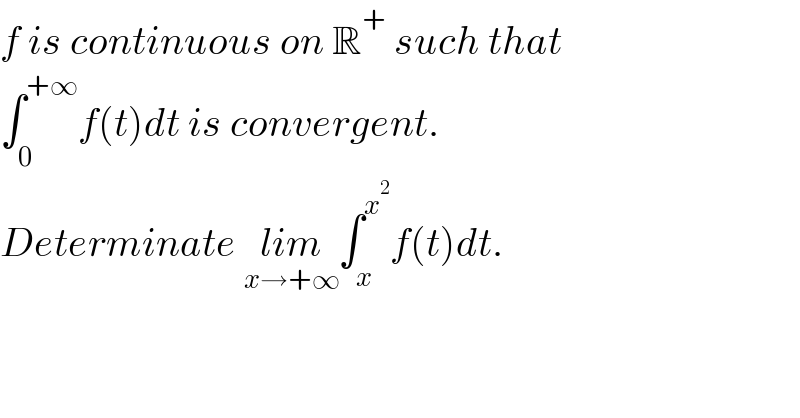
$${f}\:{is}\:{continuous}\:{on}\:\mathbb{R}^{+} \:{such}\:{that} \\ $$$$\int_{\mathrm{0}} ^{+\infty} {f}\left({t}\right){dt}\:{is}\:{convergent}. \\ $$$${Determinate}\:\underset{{x}\rightarrow+\infty} {{lim}}\int_{{x}} ^{{x}^{\mathrm{2}} } {f}\left({t}\right){dt}. \\ $$
Answered by aleks041103 last updated on 08/May/22
![let F(x)=∫_0 ^( x) f(t)dt then by problem construction lim_(x→∞) F(x)=a lim_(x→∞) ∫_x ^( x^2 ) f(t)dt=lim_(x→∞) [F(x^2 )−F(x)]= =a−a=0 ⇒Ans. 0](https://www.tinkutara.com/question/Q169793.png)
$${let}\:{F}\left({x}\right)=\int_{\mathrm{0}} ^{\:{x}} {f}\left({t}\right){dt} \\ $$$${then}\:{by}\:{problem}\:{construction}\:\underset{{x}\rightarrow\infty} {{lim}F}\left({x}\right)={a} \\ $$$$\underset{{x}\rightarrow\infty} {{lim}}\:\int_{{x}} ^{\:{x}^{\mathrm{2}} } {f}\left({t}\right){dt}=\underset{{x}\rightarrow\infty} {{lim}}\left[{F}\left({x}^{\mathrm{2}} \right)−{F}\left({x}\right)\right]= \\ $$$$={a}−{a}=\mathrm{0} \\ $$$$\Rightarrow{Ans}.\:\mathrm{0} \\ $$