
Question Number 105564 by Ar Brandon last updated on 30/Jul/20
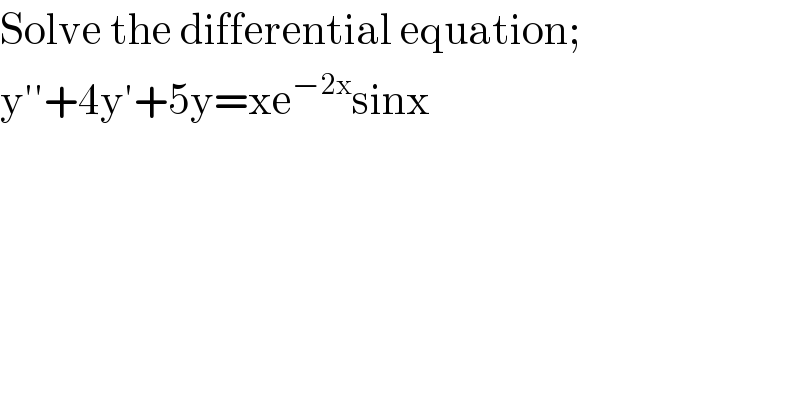
$$\mathrm{Solve}\:\mathrm{the}\:\mathrm{differential}\:\mathrm{equation}; \\ $$$$\mathrm{y}''+\mathrm{4y}'+\mathrm{5y}=\mathrm{xe}^{−\mathrm{2x}} \mathrm{sinx} \\ $$
Answered by bobhans last updated on 30/Jul/20
![Homogenous equation υ^2 +4υ+5=0 →υ=((−4±2i)/2)=−2±i y_h =e^(−2x) {C_1 cos x+C_2 sin x} particular solution y_1 =e^(−2x) cos x⇒y_1 ′=−2e^(−2x) cos x−e^(−2x) sinx y_2 =e^(−2x) sin x⇒y_2 ′=−2e^(−2x) sin x+e^(−2x) cosx W= determinant ((( e^(−2x) cos x e^(−2x) sin x)),((e^(−2x) (−2cos x−sin x) e^(−2x) (−2sin x+cos x))) = e^(−4x) (−2sin xcos x+cos^2 x)−e^(−4x) (−2sinx cos x −sin^2 x) = e^(−4x) u_1 =−∫ ((e^(−2x) sin x(xe^(−2x) sin x)dx)/e^(−4x) ) u_1 =−∫ xsin^2 x dx = −∫x((1/2)−(1/2)cos2x)dx u_1 =−[(1/4)x^2 −((1/4)xcos 2x−(1/8)sin 2x)] u_1 =−(1/4)x^2 +(1/4)xcos 2x−(1/8)sin 2x u_2 =∫ ((e^(−2x) cos x(xe^(−2x) sin x)dx)/e^(−4x) ) u_2 = ∫(1/2)xsin 2x dx = −(1/4)xcos 2x+(1/(16))sin2x y_p = y_1 u_1 +y_2 u_2 y_p = e^(−2x) cos x(−(1/4)x^2 +(1/4)xcos 2x−(1/8)sin2x) + e^(−2x) sin x(−(1/4)xcos 2x+(1/(16))sin 2x) General solution y_G = y_b + y_p .★](https://www.tinkutara.com/question/Q105568.png)
$${Homogenous}\:{equation} \\ $$$$\upsilon^{\mathrm{2}} +\mathrm{4}\upsilon+\mathrm{5}=\mathrm{0}\:\rightarrow\upsilon=\frac{−\mathrm{4}\pm\mathrm{2}{i}}{\mathrm{2}}=−\mathrm{2}\pm{i} \\ $$$${y}_{{h}} ={e}^{−\mathrm{2}{x}} \left\{{C}_{\mathrm{1}} \mathrm{cos}\:{x}+{C}_{\mathrm{2}} \mathrm{sin}\:{x}\right\}\: \\ $$$${particular}\:{solution}\: \\ $$$${y}_{\mathrm{1}} ={e}^{−\mathrm{2}{x}} \mathrm{cos}\:{x}\Rightarrow{y}_{\mathrm{1}} '=−\mathrm{2}{e}^{−\mathrm{2}{x}} \mathrm{cos}\:{x}−{e}^{−\mathrm{2}{x}} \mathrm{sin}{x} \\ $$$${y}_{\mathrm{2}} ={e}^{−\mathrm{2}{x}} \mathrm{sin}\:{x}\Rightarrow{y}_{\mathrm{2}} '=−\mathrm{2}{e}^{−\mathrm{2}{x}} \mathrm{sin}\:{x}+{e}^{−\mathrm{2}{x}} \mathrm{cos}{x} \\ $$$${W}=\begin{vmatrix}{\:\:\:\:\:\:\:\:\:\:\:{e}^{−\mathrm{2}{x}} \mathrm{cos}\:{x}\:\:\:\:\:\:\:\:\:\:\:\:\:\:\:\:\:\:\:\:\:\:\:\:\:\:\:\:\:\:\:\:{e}^{−\mathrm{2}{x}} \mathrm{sin}\:{x}}\\{{e}^{−\mathrm{2}{x}} \left(−\mathrm{2cos}\:{x}−\mathrm{sin}\:{x}\right)\:\:\:{e}^{−\mathrm{2}{x}} \left(−\mathrm{2sin}\:{x}+\mathrm{cos}\:{x}\right.}\end{vmatrix} \\ $$$$=\:{e}^{−\mathrm{4}{x}} \left(−\mathrm{2sin}\:{x}\mathrm{cos}\:{x}+\mathrm{cos}\:^{\mathrm{2}} {x}\right)−{e}^{−\mathrm{4}{x}} \left(−\mathrm{2sin}{x}\right. \\ $$$$\left.\mathrm{cos}\:{x}\:−\mathrm{sin}\:^{\mathrm{2}} {x}\right)\:=\:{e}^{−\mathrm{4}{x}} \\ $$$${u}_{\mathrm{1}} =−\int\:\frac{{e}^{−\mathrm{2}{x}} \mathrm{sin}\:{x}\left({xe}^{−\mathrm{2}{x}} \mathrm{sin}\:{x}\right){dx}}{{e}^{−\mathrm{4}{x}} } \\ $$$${u}_{\mathrm{1}} =−\int\:{x}\mathrm{sin}\:^{\mathrm{2}} {x}\:{dx}\:=\:−\int{x}\left(\frac{\mathrm{1}}{\mathrm{2}}−\frac{\mathrm{1}}{\mathrm{2}}\mathrm{cos2}{x}\right){dx} \\ $$$${u}_{\mathrm{1}} =−\left[\frac{\mathrm{1}}{\mathrm{4}}{x}^{\mathrm{2}} −\left(\frac{\mathrm{1}}{\mathrm{4}}{x}\mathrm{cos}\:\mathrm{2}{x}−\frac{\mathrm{1}}{\mathrm{8}}\mathrm{sin}\:\mathrm{2}{x}\right)\right] \\ $$$${u}_{\mathrm{1}} =−\frac{\mathrm{1}}{\mathrm{4}}{x}^{\mathrm{2}} +\frac{\mathrm{1}}{\mathrm{4}}{x}\mathrm{cos}\:\mathrm{2}{x}−\frac{\mathrm{1}}{\mathrm{8}}\mathrm{sin}\:\mathrm{2}{x} \\ $$$${u}_{\mathrm{2}} =\int\:\frac{{e}^{−\mathrm{2}{x}} \mathrm{cos}\:{x}\left({xe}^{−\mathrm{2}{x}} \mathrm{sin}\:{x}\right){dx}}{{e}^{−\mathrm{4}{x}} } \\ $$$${u}_{\mathrm{2}} =\:\int\frac{\mathrm{1}}{\mathrm{2}}{x}\mathrm{sin}\:\mathrm{2}{x}\:{dx}\:=\:−\frac{\mathrm{1}}{\mathrm{4}}{x}\mathrm{cos}\:\mathrm{2}{x}+\frac{\mathrm{1}}{\mathrm{16}}\mathrm{sin2}{x} \\ $$$${y}_{{p}} =\:{y}_{\mathrm{1}} {u}_{\mathrm{1}} +{y}_{\mathrm{2}} {u}_{\mathrm{2}} \\ $$$${y}_{{p}} =\:{e}^{−\mathrm{2}{x}} \mathrm{cos}\:{x}\left(−\frac{\mathrm{1}}{\mathrm{4}}{x}^{\mathrm{2}} +\frac{\mathrm{1}}{\mathrm{4}}{x}\mathrm{cos}\:\mathrm{2}{x}−\frac{\mathrm{1}}{\mathrm{8}}\mathrm{sin2}{x}\right) \\ $$$$+\:{e}^{−\mathrm{2}{x}} \mathrm{sin}\:{x}\left(−\frac{\mathrm{1}}{\mathrm{4}}{x}\mathrm{cos}\:\mathrm{2}{x}+\frac{\mathrm{1}}{\mathrm{16}}\mathrm{sin}\:\mathrm{2}{x}\right) \\ $$$$\mathcal{G}{eneral}\:{solution}\: \\ $$$${y}_{\mathcal{G}} =\:{y}_{{b}} \:+\:{y}_{{p}} \:.\bigstar \\ $$
Commented by Ar Brandon last updated on 30/Jul/20
Thanks, Sir Bobhans.
Is this Wronskien's method ?��
Commented by bobhans last updated on 30/Jul/20

$${yes}\:{sir}. \\ $$
Commented by Ar Brandon last updated on 30/Jul/20
OK, gracias