
Question Number 173184 by Shrinava last updated on 07/Jul/22
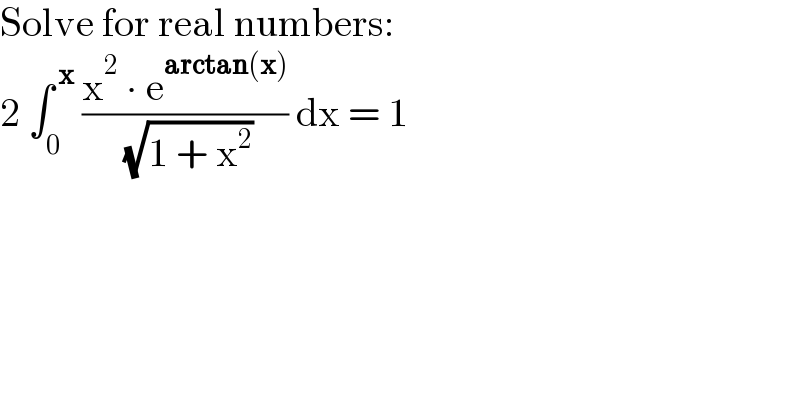
$$\mathrm{Solve}\:\mathrm{for}\:\mathrm{real}\:\mathrm{numbers}: \\ $$$$\mathrm{2}\:\int_{\mathrm{0}} ^{\:\boldsymbol{\mathrm{x}}} \:\frac{\mathrm{x}^{\mathrm{2}} \:\centerdot\:\mathrm{e}^{\boldsymbol{\mathrm{arctan}}\left(\boldsymbol{\mathrm{x}}\right)} }{\:\sqrt{\mathrm{1}\:+\:\mathrm{x}^{\mathrm{2}} }}\:\mathrm{dx}\:=\:\mathrm{1} \\ $$
Answered by aleks041103 last updated on 08/Jul/22
![x=tan t dx=sec^2 t dt ⇒2∫_0 ^( t) ((tan^2 tsec^2 t e^t dt)/(sec t))=2∫_0 ^( t) ((sin^2 t)/(cos^3 t))e^t dt= =2∫_0 ^( t) sin t e^t ((sin t)/(cos^3 t))dt= =∫_0 ^( 1) sin t e^t (−2((d(cos t))/((cos t)^3 )))= =∫_0 ^t sint e^t d((1/(cos^2 t)))= =[((sint)/(cos^2 t))e^t ]_0 ^t −∫_0 ^( t) ((cos t e^t + sin t e^t )/(cos^2 t)) dt= =((sint)/(cos^2 t))e^t −∫_0 ^( t) (e^t /(cos t))dt−∫_0 ^( t) e^t (−(1/(cos^2 t))d(cost))= =((sint)/(cos^2 t))e^t −∫_0 ^( t) (e^t /(cos t))dt−∫_0 ^( t) e^t d((1/(cos t)))= =((sint)/(cos^2 t))e^t −∫_0 ^( t) (e^t /(cos t))dt−{[(e^t /(cos t))]_0 ^t −∫_0 ^( t) (e^t /(cos t))dt}= =((sint)/(cos^2 t))e^t −(e^t /(cos t))+1= =(e^t /(cos t))(tan t − 1)+1= =(x−1)(√(1+x^2 ))e^(arctan(x)) +1 ⇒(x−1)(√(1+x^2 ))e^(arctan(x)) +1=1 ⇒x=1](https://www.tinkutara.com/question/Q173209.png)
$${x}={tan}\:{t} \\ $$$${dx}={sec}^{\mathrm{2}} {t}\:{dt} \\ $$$$\Rightarrow\mathrm{2}\int_{\mathrm{0}} ^{\:{t}} \frac{{tan}^{\mathrm{2}} {tsec}^{\mathrm{2}} {t}\:{e}^{{t}} {dt}}{{sec}\:{t}}=\mathrm{2}\int_{\mathrm{0}} ^{\:{t}} \frac{{sin}^{\mathrm{2}} {t}}{{cos}^{\mathrm{3}} {t}}{e}^{{t}} {dt}= \\ $$$$=\mathrm{2}\int_{\mathrm{0}} ^{\:{t}} \:{sin}\:{t}\:{e}^{{t}} \:\frac{{sin}\:{t}}{{cos}^{\mathrm{3}} {t}}{dt}= \\ $$$$=\int_{\mathrm{0}} ^{\:\mathrm{1}} {sin}\:{t}\:{e}^{{t}} \:\left(−\mathrm{2}\frac{{d}\left({cos}\:{t}\right)}{\left({cos}\:{t}\right)^{\mathrm{3}} }\right)= \\ $$$$=\int_{\mathrm{0}} ^{{t}} {sint}\:{e}^{{t}} \:{d}\left(\frac{\mathrm{1}}{{cos}^{\mathrm{2}} {t}}\right)= \\ $$$$=\left[\frac{{sint}}{{cos}^{\mathrm{2}} {t}}{e}^{{t}} \right]_{\mathrm{0}} ^{{t}} −\int_{\mathrm{0}} ^{\:{t}} \frac{{cos}\:{t}\:{e}^{{t}} \:+\:{sin}\:{t}\:{e}^{{t}} }{{cos}^{\mathrm{2}} {t}}\:{dt}= \\ $$$$=\frac{{sint}}{{cos}^{\mathrm{2}} {t}}{e}^{{t}} −\int_{\mathrm{0}} ^{\:{t}} \frac{{e}^{{t}} }{{cos}\:{t}}{dt}−\int_{\mathrm{0}} ^{\:{t}} {e}^{{t}} \left(−\frac{\mathrm{1}}{{cos}^{\mathrm{2}} {t}}{d}\left({cost}\right)\right)= \\ $$$$=\frac{{sint}}{{cos}^{\mathrm{2}} {t}}{e}^{{t}} −\int_{\mathrm{0}} ^{\:{t}} \frac{{e}^{{t}} }{{cos}\:{t}}{dt}−\int_{\mathrm{0}} ^{\:{t}} {e}^{{t}} {d}\left(\frac{\mathrm{1}}{{cos}\:{t}}\right)= \\ $$$$=\frac{{sint}}{{cos}^{\mathrm{2}} {t}}{e}^{{t}} −\int_{\mathrm{0}} ^{\:{t}} \frac{{e}^{{t}} }{{cos}\:{t}}{dt}−\left\{\left[\frac{{e}^{{t}} }{{cos}\:{t}}\right]_{\mathrm{0}} ^{{t}} −\int_{\mathrm{0}} ^{\:{t}} \:\frac{{e}^{{t}} }{{cos}\:{t}}{dt}\right\}= \\ $$$$=\frac{{sint}}{{cos}^{\mathrm{2}} {t}}{e}^{{t}} −\frac{{e}^{{t}} }{{cos}\:{t}}+\mathrm{1}= \\ $$$$=\frac{{e}^{{t}} }{{cos}\:{t}}\left({tan}\:{t}\:−\:\mathrm{1}\right)+\mathrm{1}= \\ $$$$=\left({x}−\mathrm{1}\right)\sqrt{\mathrm{1}+{x}^{\mathrm{2}} }{e}^{{arctan}\left({x}\right)} +\mathrm{1} \\ $$$$\Rightarrow\left({x}−\mathrm{1}\right)\sqrt{\mathrm{1}+{x}^{\mathrm{2}} }{e}^{{arctan}\left({x}\right)} +\mathrm{1}=\mathrm{1} \\ $$$$\Rightarrow{x}=\mathrm{1} \\ $$
Commented by peter frank last updated on 08/Jul/22

$$\mathrm{thank}\:\mathrm{you} \\ $$
Commented by aleks041103 last updated on 08/Jul/22
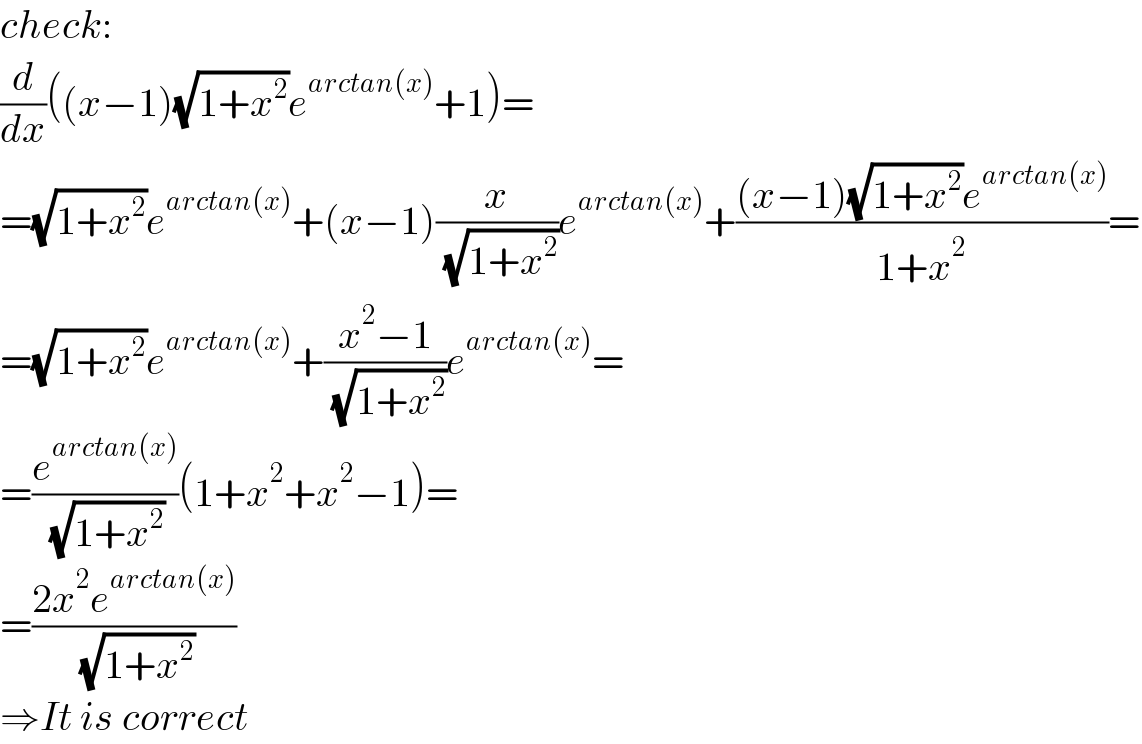
$${check}: \\ $$$$\frac{{d}}{{dx}}\left(\left({x}−\mathrm{1}\right)\sqrt{\mathrm{1}+{x}^{\mathrm{2}} }{e}^{{arctan}\left({x}\right)} +\mathrm{1}\right)= \\ $$$$=\sqrt{\mathrm{1}+{x}^{\mathrm{2}} }{e}^{{arctan}\left({x}\right)} +\left({x}−\mathrm{1}\right)\frac{{x}}{\:\sqrt{\mathrm{1}+{x}^{\mathrm{2}} }}{e}^{{arctan}\left({x}\right)} +\frac{\left({x}−\mathrm{1}\right)\sqrt{\mathrm{1}+{x}^{\mathrm{2}} }{e}^{{arctan}\left({x}\right)} }{\mathrm{1}+{x}^{\mathrm{2}} }= \\ $$$$=\sqrt{\mathrm{1}+{x}^{\mathrm{2}} }{e}^{{arctan}\left({x}\right)} +\frac{{x}^{\mathrm{2}} −\mathrm{1}}{\:\sqrt{\mathrm{1}+{x}^{\mathrm{2}} }}{e}^{{arctan}\left({x}\right)} = \\ $$$$=\frac{{e}^{{arctan}\left({x}\right)} }{\:\sqrt{\mathrm{1}+{x}^{\mathrm{2}} }}\left(\mathrm{1}+{x}^{\mathrm{2}} +{x}^{\mathrm{2}} −\mathrm{1}\right)= \\ $$$$=\frac{\mathrm{2}{x}^{\mathrm{2}} {e}^{{arctan}\left({x}\right)} }{\:\sqrt{\mathrm{1}+{x}^{\mathrm{2}} }} \\ $$$$\Rightarrow{It}\:{is}\:{correct} \\ $$
Commented by Shrinava last updated on 08/Jul/22

$$\mathrm{perfect}\:\mathrm{professor}\:\mathrm{thank}\:\mathrm{you} \\ $$