
Question Number 50007 by Joel578 last updated on 13/Dec/18

$$\mathrm{For}\:{a}\:<\:{x}\:<\:{b},\:\mathrm{find}\: \\ $$$$\underset{{a}} {\overset{{b}} {\int}}\:\sqrt{{x}−{a}}\:.\:\sqrt{{b}−{x}}\:{dx} \\ $$
Commented by Abdo msup. last updated on 13/Dec/18
![changement (√(x−a))=t give x−a=t^2 ⇒ I =∫_0 ^(√(b−a)) t(√(b−(a+t^2 )))2t dt =2∫_0 ^(√(b−a)) t^2 (√(b−a−t^2 ))dt =_(t=(√(b−a))sinu) 2 ∫_0 ^(π/2) (b−a)sin^2 u(√(b−a))cosu (√(b−a))cosu du =2(b−a)^2 ∫_0 ^(π/2) sin^2 u cos^2 u du =2(b−a)^2 (1/4) ∫_0 ^(π/2) sin^2 (2u) du =(((b−a)^2 )/2) ∫_0 ^(π/2) ((1−cos(4u))/2) du =(((b−a)^2 )/4) ∫_0 ^(π/2) (1−cos(4u))du =(π/8)(b−a)^2 −(((b−a)^2 )/(16))[sin(4u)]_0 ^(π/2) ★I=(π/8)(b−a)^2 ★](https://www.tinkutara.com/question/Q50092.png)
$${changement}\:\sqrt{{x}−{a}}={t}\:{give}\:{x}−{a}={t}^{\mathrm{2}} \:\Rightarrow \\ $$$${I}\:=\int_{\mathrm{0}} ^{\sqrt{{b}−{a}}} {t}\sqrt{{b}−\left({a}+{t}^{\mathrm{2}} \right)}\mathrm{2}{t}\:{dt}\:=\mathrm{2}\int_{\mathrm{0}} ^{\sqrt{{b}−{a}}} {t}^{\mathrm{2}} \sqrt{{b}−{a}−{t}^{\mathrm{2}} }{dt} \\ $$$$=_{{t}=\sqrt{{b}−{a}}{sinu}} \:\:\mathrm{2}\:\int_{\mathrm{0}} ^{\frac{\pi}{\mathrm{2}}} \:\left({b}−{a}\right){sin}^{\mathrm{2}} {u}\sqrt{{b}−{a}}{cosu}\:\sqrt{{b}−{a}}{cosu}\:{du} \\ $$$$=\mathrm{2}\left({b}−{a}\right)^{\mathrm{2}} \:\int_{\mathrm{0}} ^{\frac{\pi}{\mathrm{2}}} \:{sin}^{\mathrm{2}} {u}\:{cos}^{\mathrm{2}} {u}\:{du} \\ $$$$=\mathrm{2}\left({b}−{a}\right)^{\mathrm{2}} \:\frac{\mathrm{1}}{\mathrm{4}}\:\int_{\mathrm{0}} ^{\frac{\pi}{\mathrm{2}}} \:{sin}^{\mathrm{2}} \left(\mathrm{2}{u}\right)\:{du} \\ $$$$=\frac{\left({b}−{a}\right)^{\mathrm{2}} }{\mathrm{2}}\:\int_{\mathrm{0}} ^{\frac{\pi}{\mathrm{2}}} \:\frac{\mathrm{1}−{cos}\left(\mathrm{4}{u}\right)}{\mathrm{2}}\:{du} \\ $$$$=\frac{\left({b}−{a}\right)^{\mathrm{2}} }{\mathrm{4}}\:\int_{\mathrm{0}} ^{\frac{\pi}{\mathrm{2}}} \:\:\left(\mathrm{1}−{cos}\left(\mathrm{4}{u}\right)\right){du} \\ $$$$=\frac{\pi}{\mathrm{8}}\left({b}−{a}\right)^{\mathrm{2}} \:−\frac{\left({b}−{a}\right)^{\mathrm{2}} }{\mathrm{16}}\left[{sin}\left(\mathrm{4}{u}\right)\right]_{\mathrm{0}} ^{\frac{\pi}{\mathrm{2}}} \\ $$$$\bigstar{I}=\frac{\pi}{\mathrm{8}}\left({b}−{a}\right)^{\mathrm{2}} \:\bigstar \\ $$
Answered by ajfour last updated on 13/Dec/18
![let x− ((a+b)/2) = t ∫_(−((b−a)/2)) ^( ((b−a)/2)) (√(t+((b−a)/2))) (√(((b−a)/2)−t)) dt let c = ((b−a)/2) =∫_(−c) ^( c) (√(c^2 −t^2 )) dt = 2∫_0 ^( c) (√(c^2 −t^2 )) dt = 2[(t/2)(√(c^2 −t^2 ))+(c^2 /2)sin^(−1) (t/c)]_0 ^c = ((c^2 π)/2) = (((b−a)^2 π)/8) .](https://www.tinkutara.com/question/Q50024.png)
$${let}\:\:{x}−\:\frac{{a}+{b}}{\mathrm{2}}\:=\:{t} \\ $$$$\int_{−\frac{{b}−{a}}{\mathrm{2}}} ^{\:\:\frac{{b}−{a}}{\mathrm{2}}} \sqrt{{t}+\frac{{b}−{a}}{\mathrm{2}}}\:\sqrt{\frac{{b}−{a}}{\mathrm{2}}−{t}}\:{dt} \\ $$$${let}\:\:\:\:{c}\:=\:\frac{{b}−{a}}{\mathrm{2}} \\ $$$$=\int_{−{c}} ^{\:\:{c}} \sqrt{{c}^{\mathrm{2}} −{t}^{\mathrm{2}} }\:{dt}\:=\:\mathrm{2}\int_{\mathrm{0}} ^{\:\:{c}} \sqrt{{c}^{\mathrm{2}} −{t}^{\mathrm{2}} }\:{dt} \\ $$$$=\:\mathrm{2}\left[\frac{{t}}{\mathrm{2}}\sqrt{{c}^{\mathrm{2}} −{t}^{\mathrm{2}} }+\frac{{c}^{\mathrm{2}} }{\mathrm{2}}\mathrm{sin}^{−\mathrm{1}} \frac{{t}}{{c}}\right]_{\mathrm{0}} ^{{c}} \\ $$$$=\:\:\frac{{c}^{\mathrm{2}} \pi}{\mathrm{2}}\:=\:\frac{\left({b}−{a}\right)^{\mathrm{2}} \pi}{\mathrm{8}}\:. \\ $$
Commented by MJS last updated on 13/Dec/18

$$\mathrm{grea}\:\mathrm{solutiont}! \\ $$
Commented by ajfour last updated on 13/Dec/18
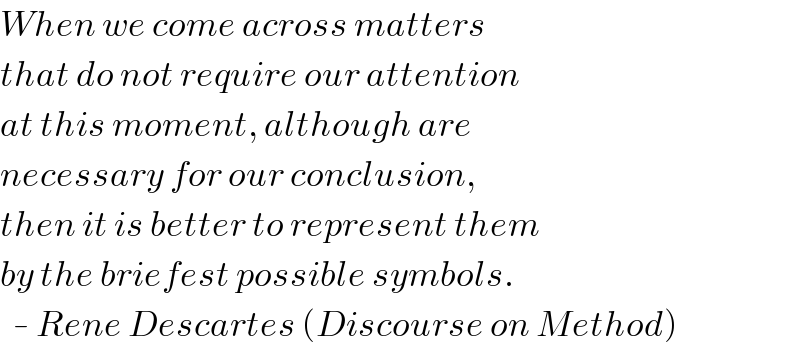
$${When}\:{we}\:{come}\:{across}\:{matters} \\ $$$${that}\:{do}\:{not}\:{require}\:{our}\:{attention} \\ $$$${at}\:{this}\:{moment},\:{although}\:{are} \\ $$$${necessary}\:{for}\:{our}\:{conclusion}, \\ $$$${then}\:{it}\:{is}\:{better}\:{to}\:{represent}\:{them} \\ $$$${by}\:{the}\:{briefest}\:{possible}\:{symbols}. \\ $$$$\:\:-\:{Rene}\:{Descartes}\:\left({Discourse}\:{on}\:{Method}\right) \\ $$
Commented by Joel578 last updated on 13/Dec/18

$${very}\:{well}\:{Sir} \\ $$