
Question Number 50422 by Abdo msup. last updated on 16/Dec/18
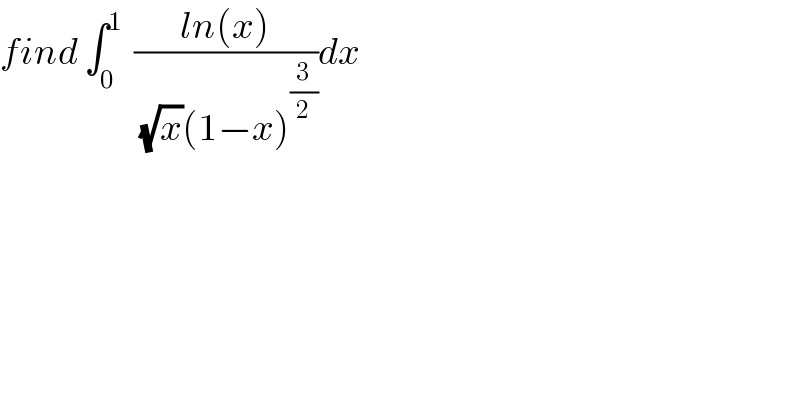
$${find}\:\int_{\mathrm{0}} ^{\mathrm{1}} \:\:\frac{{ln}\left({x}\right)}{\:\sqrt{{x}}\left(\mathrm{1}−{x}\right)^{\frac{\mathrm{3}}{\mathrm{2}}} }{dx} \\ $$
Commented by Abdo msup. last updated on 23/Dec/18
![changement x =sin^2 θ give ∫_0 ^1 ((ln(x))/( (√x)(1−x)^(3/2) ))dx =∫_0 ^(π/2) ((2ln(sinθ))/(sinθ(cos^2 θ)^(3/2) )) 2sinθ cosθ dθ =4∫_0 ^(π/2) ((ln(sinθ))/(cos^2 θ)) dθ by psrts u^′ =(1/(cos^2 θ)) and v=ln(sinθ) =4 { [tanθ ln(sinθ)]_0 ^(π/2) −∫_0 ^(π/2) tanθ ((cosθ)/(sinθ))dθ} =−4 ∫_0 ^(π/2) dθ =−2π .rest to prove that lim_(θ→0) tanθ ln(sinθ)=0 and lim_(θ→(π/2)) tanθ ln(sinθ)=0 for x∈v(0) tanθ∼ θ ,ln(sinθ)∼ln(θ) ⇒ tanθ ln(sinθ)∼θ lnθ →0 (θ→0) ch. θ =(π/2)−t give tanθ ln(sinθ) =tan((π/2)−t)ln(cost) =((ln(cost))/(tan(t))) but cost ∼ 1−(t^2 /2) and ln(cost)∼−(t^2 /2) tan(t)∼ t ⇒((ln(cost))/(tan(t))) ∼ −(t/2) →0(t→0) ⇒the result is proved.](https://www.tinkutara.com/question/Q51067.png)
$${changement}\:{x}\:={sin}^{\mathrm{2}} \theta\:{give} \\ $$$$\int_{\mathrm{0}} ^{\mathrm{1}} \:\:\frac{{ln}\left({x}\right)}{\:\sqrt{{x}}\left(\mathrm{1}−{x}\right)^{\frac{\mathrm{3}}{\mathrm{2}}} }{dx}\:=\int_{\mathrm{0}} ^{\frac{\pi}{\mathrm{2}}} \:\:\:\frac{\mathrm{2}{ln}\left({sin}\theta\right)}{{sin}\theta\left({cos}^{\mathrm{2}} \theta\right)^{\frac{\mathrm{3}}{\mathrm{2}}} }\:\mathrm{2}{sin}\theta\:{cos}\theta\:{d}\theta \\ $$$$=\mathrm{4}\int_{\mathrm{0}} ^{\frac{\pi}{\mathrm{2}}} \:\:\:\:\frac{{ln}\left({sin}\theta\right)}{{cos}^{\mathrm{2}} \theta}\:{d}\theta\:\:{by}\:{psrts}\:{u}^{'} =\frac{\mathrm{1}}{{cos}^{\mathrm{2}} \theta}\:{and}\:{v}={ln}\left({sin}\theta\right) \\ $$$$=\mathrm{4}\:\left\{\:\:\left[{tan}\theta\:{ln}\left({sin}\theta\right)\right]_{\mathrm{0}} ^{\frac{\pi}{\mathrm{2}}} \:−\int_{\mathrm{0}} ^{\frac{\pi}{\mathrm{2}}} \:{tan}\theta\:\:\frac{{cos}\theta}{{sin}\theta}{d}\theta\right\} \\ $$$$=−\mathrm{4}\:\int_{\mathrm{0}} ^{\frac{\pi}{\mathrm{2}}} {d}\theta\:=−\mathrm{2}\pi\:.{rest}\:{to}\:{prove}\:{that} \\ $$$${lim}_{\theta\rightarrow\mathrm{0}} {tan}\theta\:{ln}\left({sin}\theta\right)=\mathrm{0}\:{and}\:{lim}_{\theta\rightarrow\frac{\pi}{\mathrm{2}}} \:{tan}\theta\:{ln}\left({sin}\theta\right)=\mathrm{0} \\ $$$${for}\:{x}\in{v}\left(\mathrm{0}\right)\:\:{tan}\theta\sim\:\theta\:\:\:,{ln}\left({sin}\theta\right)\sim{ln}\left(\theta\right)\:\Rightarrow \\ $$$${tan}\theta\:{ln}\left({sin}\theta\right)\sim\theta\:{ln}\theta\:\rightarrow\mathrm{0}\:\left(\theta\rightarrow\mathrm{0}\right) \\ $$$$\:{ch}.\:\theta\:=\frac{\pi}{\mathrm{2}}−{t}\:{give}\:{tan}\theta\:{ln}\left({sin}\theta\right)\:={tan}\left(\frac{\pi}{\mathrm{2}}−{t}\right){ln}\left({cost}\right) \\ $$$$=\frac{{ln}\left({cost}\right)}{{tan}\left({t}\right)}\:{but}\:\:{cost}\:\sim\:\mathrm{1}−\frac{{t}^{\mathrm{2}} }{\mathrm{2}}\:\:{and}\:{ln}\left({cost}\right)\sim−\frac{{t}^{\mathrm{2}} }{\mathrm{2}} \\ $$$${tan}\left({t}\right)\sim\:{t}\:\Rightarrow\frac{{ln}\left({cost}\right)}{{tan}\left({t}\right)}\:\sim\:−\frac{{t}}{\mathrm{2}}\:\rightarrow\mathrm{0}\left({t}\rightarrow\mathrm{0}\right)\:\Rightarrow{the}\:{result} \\ $$$${is}\:{proved}. \\ $$
Answered by Smail last updated on 27/Dec/18
![by parts u=lnx⇒u′=(1/x) v′=(1/( (√x)(1−x)^(3/2) ))⇒v=((2(√x))/( (√(1−x)))) I=∫_0 ^1 ((lnx)/( (√x)(1−x)^(3/2) ))dx=2[(((√x)lnx)/( (√(1−x))))]_0 ^1 −2∫_0 ^1 (dx/( (√x)(√(1−x)))) let t^2 =x⇒2tdt=dx I=0−4∫_0 ^1 ((tdt)/(t(√(1−t^2 )))) =−4[sin^(−1) t]_0 ^1 =−4((π/2)+2kπ−kπ) =−4((π/2)+kπ)](https://www.tinkutara.com/question/Q51453.png)
$${by}\:{parts} \\ $$$${u}={lnx}\Rightarrow{u}'=\frac{\mathrm{1}}{{x}} \\ $$$${v}'=\frac{\mathrm{1}}{\:\sqrt{{x}}\left(\mathrm{1}−{x}\right)^{\mathrm{3}/\mathrm{2}} }\Rightarrow{v}=\frac{\mathrm{2}\sqrt{{x}}}{\:\sqrt{\mathrm{1}−{x}}} \\ $$$${I}=\int_{\mathrm{0}} ^{\mathrm{1}} \frac{{lnx}}{\:\sqrt{{x}}\left(\mathrm{1}−{x}\right)^{\mathrm{3}/\mathrm{2}} }{dx}=\mathrm{2}\left[\frac{\sqrt{{x}}{lnx}}{\:\sqrt{\mathrm{1}−{x}}}\right]_{\mathrm{0}} ^{\mathrm{1}} −\mathrm{2}\int_{\mathrm{0}} ^{\mathrm{1}} \frac{{dx}}{\:\sqrt{{x}}\sqrt{\mathrm{1}−{x}}} \\ $$$${let}\:{t}^{\mathrm{2}} ={x}\Rightarrow\mathrm{2}{tdt}={dx} \\ $$$${I}=\mathrm{0}−\mathrm{4}\int_{\mathrm{0}} ^{\mathrm{1}} \frac{{tdt}}{{t}\sqrt{\mathrm{1}−{t}^{\mathrm{2}} }} \\ $$$$=−\mathrm{4}\left[{sin}^{−\mathrm{1}} {t}\right]_{\mathrm{0}} ^{\mathrm{1}} =−\mathrm{4}\left(\frac{\pi}{\mathrm{2}}+\mathrm{2}{k}\pi−{k}\pi\right) \\ $$$$=−\mathrm{4}\left(\frac{\pi}{\mathrm{2}}+{k}\pi\right) \\ $$$$ \\ $$