
Question Number 181730 by neinhaltsieger369 last updated on 29/Nov/22
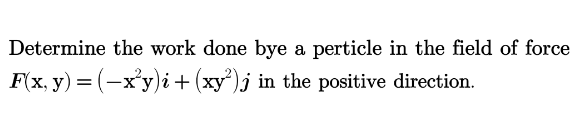
Commented by neinhaltsieger369 last updated on 29/Nov/22

$$\:\boldsymbol{\mathrm{Help}}\:-\:\boldsymbol{\mathrm{me}}! \\ $$
Commented by mr W last updated on 29/Nov/22
![work=force×distance so to determine the work done, you should also know the distance the particle moved. usually you get the distance from the position vector of the particle. for example r(t)=2t^3 i+3tj then r′(t)=6ti+3j W=∫_0 ^1 F(r(t))∙r′(t)dt =∫_0 ^1 [−(2t^3 )^2 ×3t×6t+2t^3 ×(3t)^2 ×3]dt =∫_0 ^1 (−72t^8 +54t^5 )dt =[−8t^9 +9t^6 ]_0 ^1 =−8+9=1 J](https://www.tinkutara.com/question/Q181746.png)
$${work}={force}×{distance} \\ $$$${so}\:{to}\:{determine}\:{the}\:{work}\:{done},\:{you}\: \\ $$$${should}\:{also}\:{know}\:{the}\:{distance}\:{the}\: \\ $$$${particle}\:{moved}.\:{usually}\:{you}\:{get}\:{the} \\ $$$${distance}\:{from}\:{the}\:{position}\:{vector}\:{of} \\ $$$${the}\:{particle}.\:{for}\:{example} \\ $$$$\boldsymbol{{r}}\left(\boldsymbol{{t}}\right)=\mathrm{2}{t}^{\mathrm{3}} {i}+\mathrm{3}{tj} \\ $$$${then}\:\boldsymbol{{r}}'\left(\boldsymbol{{t}}\right)=\mathrm{6}{ti}+\mathrm{3}{j} \\ $$$${W}=\int_{\mathrm{0}} ^{\mathrm{1}} \boldsymbol{{F}}\left(\boldsymbol{{r}}\left(\boldsymbol{{t}}\right)\right)\centerdot\boldsymbol{{r}}'\left(\boldsymbol{{t}}\right){dt} \\ $$$$\:\:\:\:\:=\int_{\mathrm{0}} ^{\mathrm{1}} \left[−\left(\mathrm{2}{t}^{\mathrm{3}} \right)^{\mathrm{2}} ×\mathrm{3}{t}×\mathrm{6}{t}+\mathrm{2}{t}^{\mathrm{3}} ×\left(\mathrm{3}{t}\right)^{\mathrm{2}} ×\mathrm{3}\right]{dt} \\ $$$$\:\:\:\:\:=\int_{\mathrm{0}} ^{\mathrm{1}} \left(−\mathrm{72}{t}^{\mathrm{8}} +\mathrm{54}{t}^{\mathrm{5}} \right){dt} \\ $$$$\:\:\:\:\:=\left[−\mathrm{8}{t}^{\mathrm{9}} +\mathrm{9}{t}^{\mathrm{6}} \right]_{\mathrm{0}} ^{\mathrm{1}} \\ $$$$\:\:\:\:\:=−\mathrm{8}+\mathrm{9}=\mathrm{1}\:{J} \\ $$