
Question Number 137252 by mey3nipaba last updated on 31/Mar/21
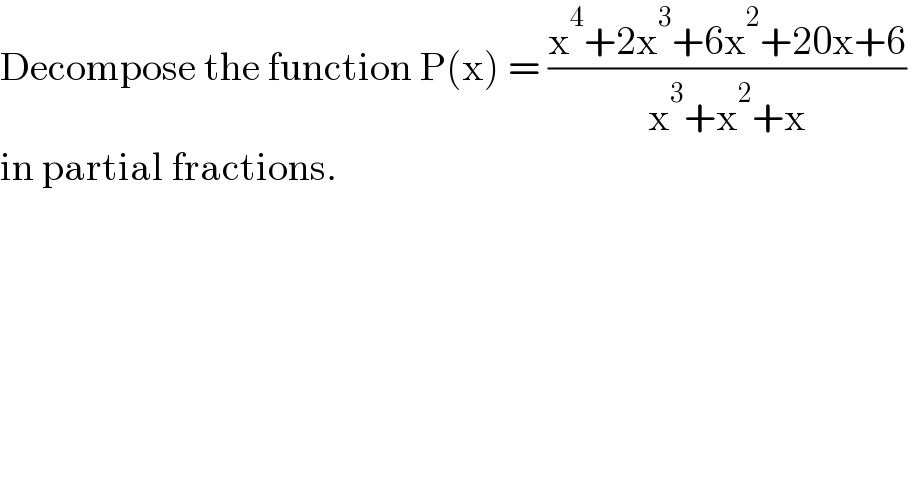
$$\mathrm{Decompose}\:\mathrm{the}\:\mathrm{function}\:\mathrm{P}\left(\mathrm{x}\right)\:=\:\frac{\mathrm{x}^{\mathrm{4}} +\mathrm{2x}^{\mathrm{3}} +\mathrm{6x}^{\mathrm{2}} +\mathrm{20x}+\mathrm{6}}{\mathrm{x}^{\mathrm{3}} +\mathrm{x}^{\mathrm{2}} +\mathrm{x}}\: \\ $$$$\mathrm{in}\:\mathrm{partial}\:\mathrm{fractions}. \\ $$
Answered by bemath last updated on 31/Mar/21
![⇔ x+1 + ((4x^2 +19x+6)/(x(x^2 +x+1))) = ⇔x+1 + (A/x) + ((Bx+C)/(x^2 +x+1)) ⇔ 4x^2 +19x+6 = A(x^2 +x+1)+(Bx+C)x ⇔ A = [((4x^2 +19x+6)/(x^2 +x+1)) ]_(x=0) = 6 put x=1⇒29 = 18+B+C ⇒ B+C = 11 put x=−1⇒−9= 6 −(−B+C) ⇒ −15 = B−C we get { ((B=−2)),((C=13)) :} ⇔ x+1 +(6/x)+ ((13−2x)/(x^2 +x+1))](https://www.tinkutara.com/question/Q137254.png)
$$\Leftrightarrow\:{x}+\mathrm{1}\:+\:\frac{\mathrm{4}{x}^{\mathrm{2}} +\mathrm{19}{x}+\mathrm{6}}{{x}\left({x}^{\mathrm{2}} +{x}+\mathrm{1}\right)}\:= \\ $$$$\Leftrightarrow{x}+\mathrm{1}\:+\:\frac{{A}}{{x}}\:+\:\frac{{Bx}+{C}}{{x}^{\mathrm{2}} +{x}+\mathrm{1}} \\ $$$$\Leftrightarrow\:\mathrm{4}{x}^{\mathrm{2}} +\mathrm{19}{x}+\mathrm{6}\:=\:{A}\left({x}^{\mathrm{2}} +{x}+\mathrm{1}\right)+\left({Bx}+{C}\right){x} \\ $$$$\Leftrightarrow\:\mathrm{A}\:=\:\left[\frac{\mathrm{4x}^{\mathrm{2}} +\mathrm{19x}+\mathrm{6}}{\mathrm{x}^{\mathrm{2}} +\mathrm{x}+\mathrm{1}}\:\right]_{\mathrm{x}=\mathrm{0}} =\:\mathrm{6} \\ $$$$\mathrm{put}\:\mathrm{x}=\mathrm{1}\Rightarrow\mathrm{29}\:=\:\mathrm{18}+\mathrm{B}+\mathrm{C} \\ $$$$\Rightarrow\:\mathrm{B}+\mathrm{C}\:=\:\mathrm{11} \\ $$$$\mathrm{put}\:\mathrm{x}=−\mathrm{1}\Rightarrow−\mathrm{9}=\:\mathrm{6}\:−\left(−\mathrm{B}+\mathrm{C}\right) \\ $$$$\Rightarrow\:−\mathrm{15}\:=\:\mathrm{B}−\mathrm{C} \\ $$$$\mathrm{we}\:\mathrm{get}\:\begin{cases}{\mathrm{B}=−\mathrm{2}}\\{\mathrm{C}=\mathrm{13}}\end{cases} \\ $$$$\Leftrightarrow\:{x}+\mathrm{1}\:+\frac{\mathrm{6}}{{x}}+\:\frac{\mathrm{13}−\mathrm{2}{x}}{{x}^{\mathrm{2}} +{x}+\mathrm{1}} \\ $$