
Question Number 64160 by mathmax by abdo last updated on 14/Jul/19
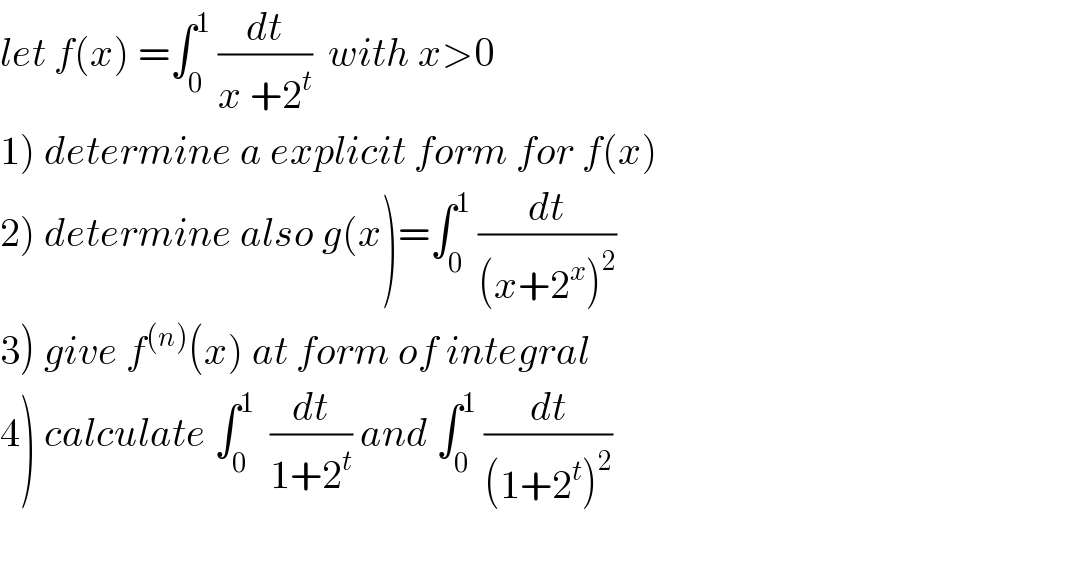
$${let}\:{f}\left({x}\right)\:=\int_{\mathrm{0}} ^{\mathrm{1}} \:\frac{{dt}}{{x}\:+\mathrm{2}^{{t}} }\:\:{with}\:{x}>\mathrm{0} \\ $$$$\left.\mathrm{1}\right)\:{determine}\:{a}\:{explicit}\:{form}\:{for}\:{f}\left({x}\right) \\ $$$$\left.\mathrm{2}\right)\:{determine}\:{also}\:{g}\left({x}\right)=\int_{\mathrm{0}} ^{\mathrm{1}} \:\frac{{dt}}{\left({x}+\mathrm{2}^{{x}} \right)^{\mathrm{2}} } \\ $$$$\left.\mathrm{3}\right)\:{give}\:{f}^{\left({n}\right)} \left({x}\right)\:{at}\:{form}\:{of}\:{integral}\: \\ $$$$\left.\mathrm{4}\right)\:{calculate}\:\int_{\mathrm{0}} ^{\mathrm{1}} \:\:\frac{{dt}}{\mathrm{1}+\mathrm{2}^{{t}} }\:{and}\:\int_{\mathrm{0}} ^{\mathrm{1}} \:\frac{{dt}}{\left(\mathrm{1}+\mathrm{2}^{{t}} \right)^{\mathrm{2}} } \\ $$$$ \\ $$
Commented by mathmax by abdo last updated on 14/Jul/19
![1)we have f(x)=∫_0 ^1 (dt/(x+2^t )) (x>0) changement 2^t =u give e^(tln2) =u ⇒tln(2)=lnu ⇒t=((ln(u))/(ln(2))) ⇒f(x) =∫_1 ^2 (du/(ln(2)u(x+u))) =(1/(ln(2))) (1/x)∫_1 ^2 {(1/u)−(1/(x+u))}du =(1/(xln(2)))[ln((u/(x+u)))]_1 ^2 =(1/(xln(2))){ln((2/(x+2)))−ln((1/(x+1)))}=(1/(xln(2))){ln2−ln(x+2)+ln(x+1)} f(x)=(1/x) +((ln(((x+1)/(x+2))))/(xln(2)))](https://www.tinkutara.com/question/Q64167.png)
$$\left.\mathrm{1}\right){we}\:{have}\:{f}\left({x}\right)=\int_{\mathrm{0}} ^{\mathrm{1}} \frac{{dt}}{{x}+\mathrm{2}^{{t}} }\:\:\:\:\:\left({x}>\mathrm{0}\right)\:{changement}\:\mathrm{2}^{{t}} ={u}\:{give}\: \\ $$$${e}^{{tln}\mathrm{2}} ={u}\:\Rightarrow{tln}\left(\mathrm{2}\right)={lnu}\:\Rightarrow{t}=\frac{{ln}\left({u}\right)}{{ln}\left(\mathrm{2}\right)}\:\Rightarrow{f}\left({x}\right)\:=\int_{\mathrm{1}} ^{\mathrm{2}} \:\:\:\frac{{du}}{{ln}\left(\mathrm{2}\right){u}\left({x}+{u}\right)} \\ $$$$=\frac{\mathrm{1}}{{ln}\left(\mathrm{2}\right)}\:\frac{\mathrm{1}}{{x}}\int_{\mathrm{1}} ^{\mathrm{2}} \left\{\frac{\mathrm{1}}{{u}}−\frac{\mathrm{1}}{{x}+{u}}\right\}{du}\:=\frac{\mathrm{1}}{{xln}\left(\mathrm{2}\right)}\left[{ln}\left(\frac{{u}}{{x}+{u}}\right)\right]_{\mathrm{1}} ^{\mathrm{2}} \\ $$$$=\frac{\mathrm{1}}{{xln}\left(\mathrm{2}\right)}\left\{{ln}\left(\frac{\mathrm{2}}{{x}+\mathrm{2}}\right)−{ln}\left(\frac{\mathrm{1}}{{x}+\mathrm{1}}\right)\right\}=\frac{\mathrm{1}}{{xln}\left(\mathrm{2}\right)}\left\{{ln}\mathrm{2}−{ln}\left({x}+\mathrm{2}\right)+{ln}\left({x}+\mathrm{1}\right)\right\} \\ $$$${f}\left({x}\right)=\frac{\mathrm{1}}{{x}}\:+\frac{{ln}\left(\frac{{x}+\mathrm{1}}{{x}+\mathrm{2}}\right)}{{xln}\left(\mathrm{2}\right)} \\ $$
Commented by mathmax by abdo last updated on 14/Jul/19
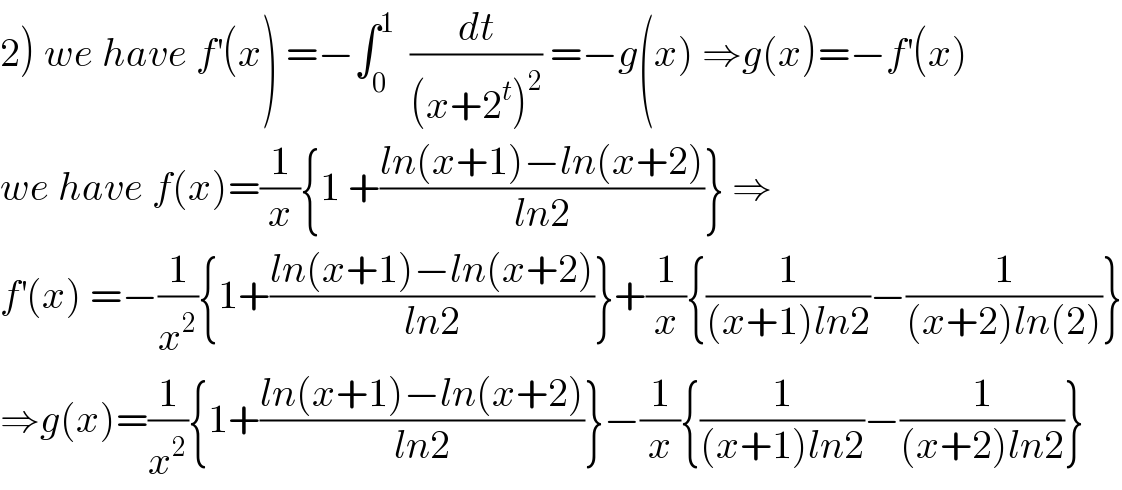
$$\left.\mathrm{2}\right)\:{we}\:{have}\:{f}^{'} \left({x}\right)\:=−\int_{\mathrm{0}} ^{\mathrm{1}} \:\:\frac{{dt}}{\left({x}+\mathrm{2}^{{t}} \right)^{\mathrm{2}} }\:=−{g}\left({x}\right)\:\Rightarrow{g}\left({x}\right)=−{f}^{'} \left({x}\right) \\ $$$${we}\:{have}\:{f}\left({x}\right)=\frac{\mathrm{1}}{{x}}\left\{\mathrm{1}\:+\frac{{ln}\left({x}+\mathrm{1}\right)−{ln}\left({x}+\mathrm{2}\right)}{{ln}\mathrm{2}}\right\}\:\Rightarrow \\ $$$${f}^{'} \left({x}\right)\:=−\frac{\mathrm{1}}{{x}^{\mathrm{2}} }\left\{\mathrm{1}+\frac{{ln}\left({x}+\mathrm{1}\right)−{ln}\left({x}+\mathrm{2}\right)}{{ln}\mathrm{2}}\right\}+\frac{\mathrm{1}}{{x}}\left\{\frac{\mathrm{1}}{\left({x}+\mathrm{1}\right){ln}\mathrm{2}}−\frac{\mathrm{1}}{\left({x}+\mathrm{2}\right){ln}\left(\mathrm{2}\right)}\right\} \\ $$$$\Rightarrow{g}\left({x}\right)=\frac{\mathrm{1}}{{x}^{\mathrm{2}} }\left\{\mathrm{1}+\frac{{ln}\left({x}+\mathrm{1}\right)−{ln}\left({x}+\mathrm{2}\right)}{{ln}\mathrm{2}}\right\}−\frac{\mathrm{1}}{{x}}\left\{\frac{\mathrm{1}}{\left({x}+\mathrm{1}\right){ln}\mathrm{2}}−\frac{\mathrm{1}}{\left({x}+\mathrm{2}\right){ln}\mathrm{2}}\right\} \\ $$
Commented by mathmax by abdo last updated on 14/Jul/19
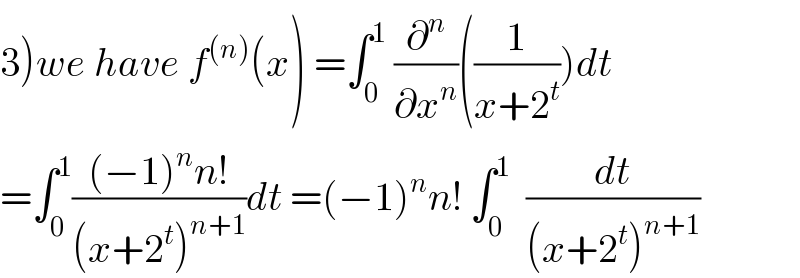
$$\left.\mathrm{3}\right){we}\:{have}\:{f}^{\left({n}\right)} \left({x}\right)\:=\int_{\mathrm{0}} ^{\mathrm{1}} \:\frac{\partial^{{n}} }{\partial{x}^{{n}} }\left(\frac{\mathrm{1}}{{x}+\mathrm{2}^{{t}} }\right){dt} \\ $$$$=\int_{\mathrm{0}} ^{\mathrm{1}} \frac{\left(−\mathrm{1}\right)^{{n}} {n}!}{\left({x}+\mathrm{2}^{{t}} \right)^{{n}+\mathrm{1}} }{dt}\:=\left(−\mathrm{1}\right)^{{n}} {n}!\:\int_{\mathrm{0}} ^{\mathrm{1}} \:\:\frac{{dt}}{\left({x}+\mathrm{2}^{{t}} \right)^{{n}+\mathrm{1}} } \\ $$
Commented by mathmax by abdo last updated on 14/Jul/19
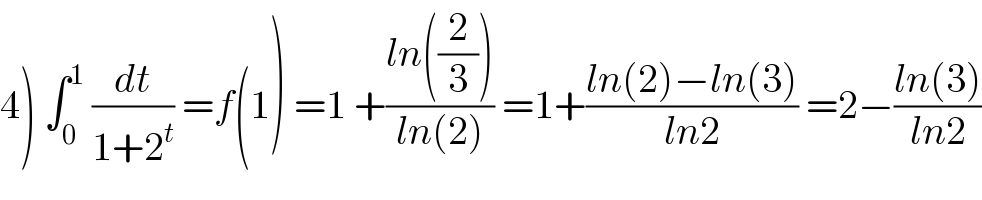
$$\left.\mathrm{4}\right)\:\int_{\mathrm{0}} ^{\mathrm{1}} \:\frac{{dt}}{\mathrm{1}+\mathrm{2}^{{t}} }\:={f}\left(\mathrm{1}\right)\:=\mathrm{1}\:+\frac{{ln}\left(\frac{\mathrm{2}}{\mathrm{3}}\right)}{{ln}\left(\mathrm{2}\right)}\:=\mathrm{1}+\frac{{ln}\left(\mathrm{2}\right)−{ln}\left(\mathrm{3}\right)}{{ln}\mathrm{2}}\:=\mathrm{2}−\frac{{ln}\left(\mathrm{3}\right)}{{ln}\mathrm{2}} \\ $$
Commented by mathmax by abdo last updated on 14/Jul/19
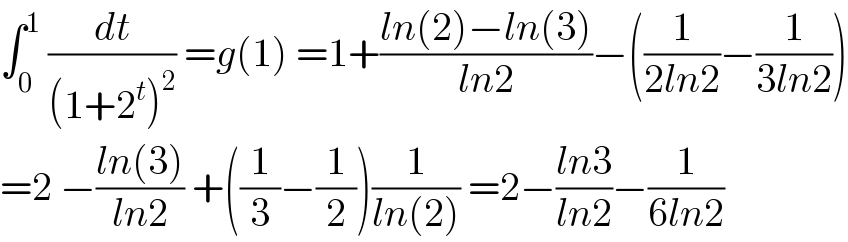
$$\int_{\mathrm{0}} ^{\mathrm{1}} \:\frac{{dt}}{\left(\mathrm{1}+\mathrm{2}^{{t}} \right)^{\mathrm{2}} }\:={g}\left(\mathrm{1}\right)\:=\mathrm{1}+\frac{{ln}\left(\mathrm{2}\right)−{ln}\left(\mathrm{3}\right)}{{ln}\mathrm{2}}−\left(\frac{\mathrm{1}}{\mathrm{2}{ln}\mathrm{2}}−\frac{\mathrm{1}}{\mathrm{3}{ln}\mathrm{2}}\right) \\ $$$$=\mathrm{2}\:−\frac{{ln}\left(\mathrm{3}\right)}{{ln}\mathrm{2}}\:+\left(\frac{\mathrm{1}}{\mathrm{3}}−\frac{\mathrm{1}}{\mathrm{2}}\right)\frac{\mathrm{1}}{{ln}\left(\mathrm{2}\right)}\:=\mathrm{2}−\frac{{ln}\mathrm{3}}{{ln}\mathrm{2}}−\frac{\mathrm{1}}{\mathrm{6}{ln}\mathrm{2}} \\ $$
Answered by Eminem last updated on 14/Jul/19
![1) let u=2^t dt=(du/(uln(2))) f(x)=∫_1 ^2 (du/(uln(2)(x+u)))=∫_1 ^2 (du/(xuln(2)))−∫_1 ^2 (du/(xln(2)(x+u)))=(1/x)−(1/(xln(2)))[ln(x+2)−ln(x+1)]](https://www.tinkutara.com/question/Q64161.png)
$$\left.\mathrm{1}\right)\:\:\:\:{let}\:{u}=\mathrm{2}^{{t}} \:\:\:\:\:{dt}=\frac{{du}}{{uln}\left(\mathrm{2}\right)} \\ $$$${f}\left({x}\right)=\int_{\mathrm{1}} ^{\mathrm{2}} \frac{{du}}{{uln}\left(\mathrm{2}\right)\left({x}+{u}\right)}=\int_{\mathrm{1}} ^{\mathrm{2}} \frac{{du}}{{xuln}\left(\mathrm{2}\right)}−\int_{\mathrm{1}} ^{\mathrm{2}} \frac{{du}}{{xln}\left(\mathrm{2}\right)\left({x}+{u}\right)}=\frac{\mathrm{1}}{{x}}−\frac{\mathrm{1}}{{xln}\left(\mathrm{2}\right)}\left[{ln}\left({x}+\mathrm{2}\right)−{ln}\left({x}+\mathrm{1}\right)\right] \\ $$
Answered by Eminem last updated on 14/Jul/19
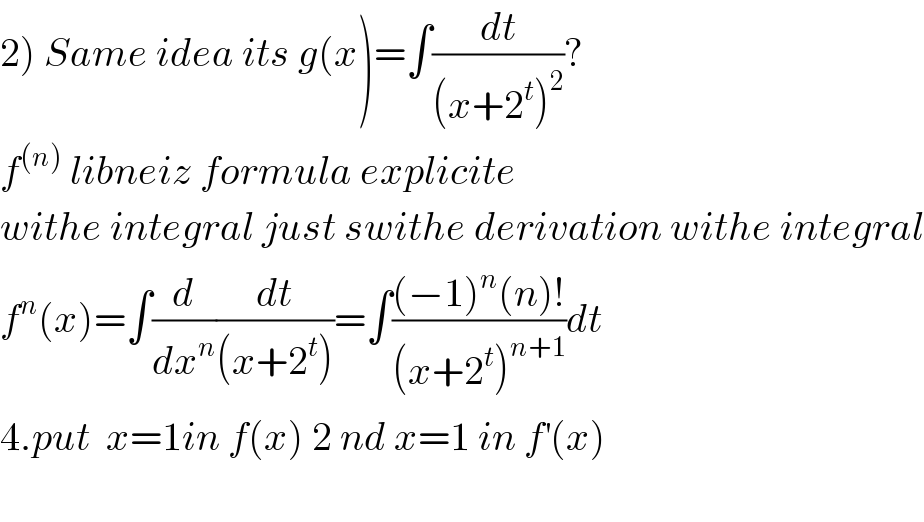
$$\left.\mathrm{2}\right)\:{Same}\:{idea}\:{its}\:{g}\left({x}\right)=\int\frac{{dt}}{\left({x}+\mathrm{2}^{{t}} \right)^{\mathrm{2}} }? \\ $$$${f}^{\left({n}\right)} \:{libneiz}\:{formula}\:{explicite}\: \\ $$$${withe}\:{integral}\:{just}\:{swithe}\:{derivation}\:{withe}\:{integral} \\ $$$${f}^{{n}} \left({x}\right)=\int\frac{{d}}{{dx}^{{n}} }\frac{{dt}}{\left({x}+\mathrm{2}^{{t}} \right)}=\int\frac{\left(−\mathrm{1}\right)^{{n}} \left({n}\right)!}{\left({x}+\mathrm{2}^{{t}} \right)^{{n}+\mathrm{1}} }{dt} \\ $$$$\mathrm{4}.{put}\:\:{x}=\mathrm{1}{in}\:{f}\left({x}\right)\:\mathrm{2}\:{nd}\:{x}=\mathrm{1}\:{in}\:{f}^{'} \left({x}\right) \\ $$$$ \\ $$