
Question Number 6321 by sanusihammed last updated on 23/Jun/16
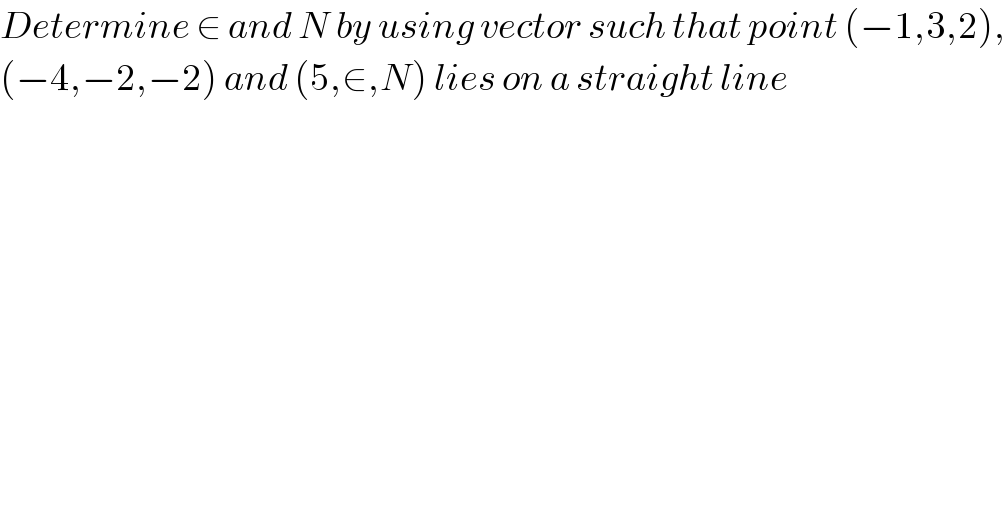
$${Determine}\:\in\:{and}\:{N}\:{by}\:{using}\:{vector}\:{such}\:{that}\:{point}\:\left(−\mathrm{1},\mathrm{3},\mathrm{2}\right), \\ $$$$\left(−\mathrm{4},−\mathrm{2},−\mathrm{2}\right)\:{and}\:\left(\mathrm{5},\in,{N}\right)\:{lies}\:{on}\:{a}\:{straight}\:{line} \\ $$$$ \\ $$
Answered by nburiburu last updated on 23/Jun/16
![let′s find the line: (x;y;z)=(−1;3;2)+λ.[(−4;−2;−2)−(−1;3;2)] now let be (x;y;z)=(5;ε;N) and you can solve it. the result should be λ=−2; ε=13; N=10.](https://www.tinkutara.com/question/Q6323.png)
$${let}'{s}\:{find}\:{the}\:{line}: \\ $$$$\left({x};{y};{z}\right)=\left(−\mathrm{1};\mathrm{3};\mathrm{2}\right)+\lambda.\left[\left(−\mathrm{4};−\mathrm{2};−\mathrm{2}\right)−\left(−\mathrm{1};\mathrm{3};\mathrm{2}\right)\right] \\ $$$${now}\:{let}\:{be}\:\left({x};{y};{z}\right)=\left(\mathrm{5};\epsilon;{N}\right)\:{and}\:{you}\:{can}\:{solve}\:{it}. \\ $$$${the}\:{result}\:{should}\:{be}\:\lambda=−\mathrm{2};\:\epsilon=\mathrm{13};\:{N}=\mathrm{10}. \\ $$$$ \\ $$