
Question Number 130523 by benjo_mathlover last updated on 26/Jan/21
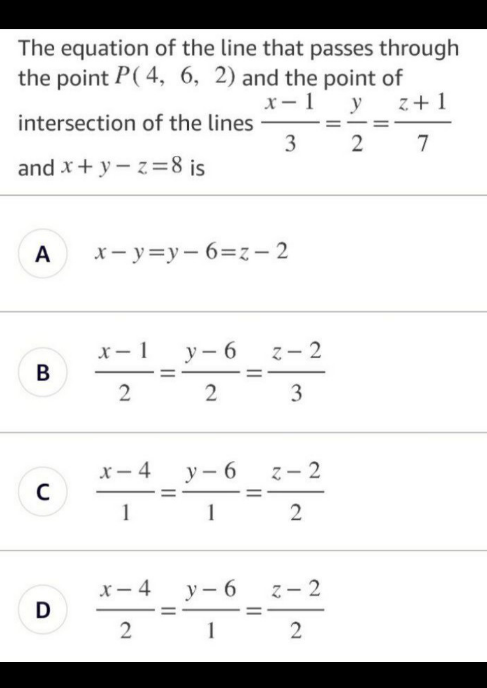
Answered by TheSupreme last updated on 26/Jan/21
![P(4,6,2) { ((2x−3y=2)),((7x−3z=10)),((x+y−z=8)) :} [(2,(−3),0),(7,0,(−3)),(1,1,(−1)) ] ((x),(y),(z) )= ((2),((10)),(8) ) n_1 −n_2 +3n_3 −2x=16→x=−8 z=22 y=−6 Q(−8,6,22) P(4,6,2) with sostitution A wrong B wrong C correct D wrong](https://www.tinkutara.com/question/Q130526.png)
$${P}\left(\mathrm{4},\mathrm{6},\mathrm{2}\right) \\ $$$$\begin{cases}{\mathrm{2}{x}−\mathrm{3}{y}=\mathrm{2}}\\{\mathrm{7}{x}−\mathrm{3}{z}=\mathrm{10}}\\{{x}+{y}−{z}=\mathrm{8}}\end{cases} \\ $$$$\begin{bmatrix}{\mathrm{2}}&{−\mathrm{3}}&{\mathrm{0}}\\{\mathrm{7}}&{\mathrm{0}}&{−\mathrm{3}}\\{\mathrm{1}}&{\mathrm{1}}&{−\mathrm{1}}\end{bmatrix}\begin{pmatrix}{{x}}\\{{y}}\\{{z}}\end{pmatrix}=\begin{pmatrix}{\mathrm{2}}\\{\mathrm{10}}\\{\mathrm{8}}\end{pmatrix} \\ $$$${n}_{\mathrm{1}} −{n}_{\mathrm{2}} +\mathrm{3}{n}_{\mathrm{3}} \\ $$$$−\mathrm{2}{x}=\mathrm{16}\rightarrow{x}=−\mathrm{8} \\ $$$${z}=\mathrm{22} \\ $$$${y}=−\mathrm{6} \\ $$$${Q}\left(−\mathrm{8},\mathrm{6},\mathrm{22}\right) \\ $$$${P}\left(\mathrm{4},\mathrm{6},\mathrm{2}\right) \\ $$$${with}\:{sostitution} \\ $$$${A}\:{wrong} \\ $$$${B}\:{wrong} \\ $$$${C}\:{correct} \\ $$$${D}\:{wrong} \\ $$