
Question Number 7524 by Little last updated on 02/Sep/16
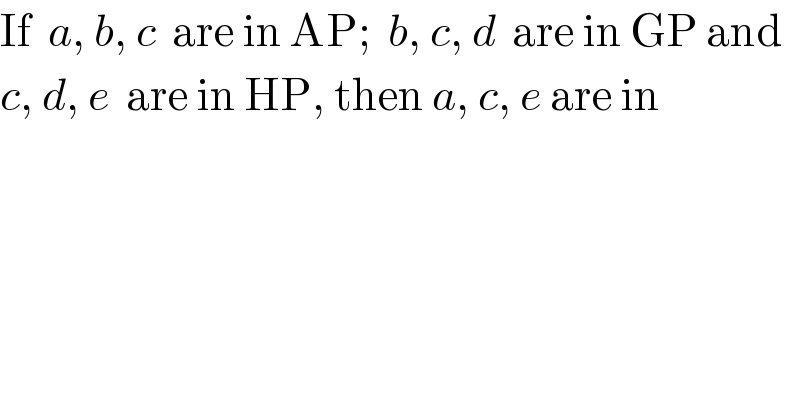
$$\mathrm{If}\:\:{a},\:{b},\:{c}\:\:\mathrm{are}\:\mathrm{in}\:\mathrm{AP};\:\:{b},\:{c},\:{d}\:\:\mathrm{are}\:\mathrm{in}\:\mathrm{GP}\:\mathrm{and} \\ $$$${c},\:{d},\:{e}\:\:\mathrm{are}\:\mathrm{in}\:\mathrm{HP},\:\mathrm{then}\:{a},\:{c},\:{e}\:\mathrm{are}\:\mathrm{in} \\ $$
Commented by Rasheed Soomro last updated on 02/Sep/16
![Complete Answer If a, b, c are in AP; b, c, d are in GP and c, d, e are in HP, then a, c, e are in −−−−−−−−−−−−−−−−−−− a,b,c are in AP : c=a+2d ′=a+2(b−a)=2b−a [d ′ is common difference] b,c,d are in GP : d=br^2 =b(c/b)^2 =c^2 /b =(((2b−a)^2 )/b) [r is common ratio] c,d,e are in HP ⇒d=((2ce)/(c+e))⇒e=(dc/(2c−d)) e=(dc/(2c−d))=(((((2b−a)^2 )/b)×(2b−a))/(2(2b−a)−(((2b−a)^2 )/b)))=((((2b−a)^3 )/b)/((2b(2b−a)−(2b−a)^2 )/b)) =(((2b−a)^3 )/((2b−a)[2b−2b+a]))=(((2b−a)^2 )/a) a,c,e a,2b−a, (((2b−a)^2 )/a) Let′s assume that this is GP Testing for common ratio ((2b−a)/a)=^(?) ((((2b−a)^2 )/a)/(2b−a)) ((2b−a)/a) =^(?) (((2b−a)^2 )/a)×(1/(2b−a)) ((2b−a)/a) =((2b−a)/a) Hence a,2b−a, (((2b−a)^2 )/a) is a GP,whose common ratio is ((2b−a)/a) Or a , c , e are in GP](https://www.tinkutara.com/question/Q7537.png)
$${Complete}\:{Answer} \\ $$$$\mathrm{If}\:\:{a},\:{b},\:{c}\:\:\mathrm{are}\:\mathrm{in}\:\mathrm{AP};\:\:{b},\:{c},\:{d}\:\:\mathrm{are}\:\mathrm{in}\:\mathrm{GP}\:\mathrm{and} \\ $$$${c},\:{d},\:{e}\:\:\mathrm{are}\:\mathrm{in}\:\mathrm{HP},\:\mathrm{then}\:{a},\:{c},\:{e}\:\mathrm{are}\:\mathrm{in} \\ $$$$−−−−−−−−−−−−−−−−−−− \\ $$$$\:{a},{b},{c}\:{are}\:{in}\:{AP}\:: \\ $$$${c}={a}+\mathrm{2}{d}\:'={a}+\mathrm{2}\left({b}−{a}\right)=\mathrm{2}{b}−{a}\:\left[{d}\:'\:{is}\:{common}\:{difference}\right] \\ $$$${b},{c},{d}\:{are}\:{in}\:{GP}\:: \\ $$$${d}={br}^{\mathrm{2}} ={b}\left({c}/{b}\right)^{\mathrm{2}} ={c}^{\mathrm{2}} /{b}\:=\frac{\left(\mathrm{2}{b}−{a}\right)^{\mathrm{2}} }{{b}}\:\left[{r}\:{is}\:{common}\:{ratio}\right] \\ $$$${c},{d},{e}\:{are}\:{in}\:{HP}\:\Rightarrow{d}=\frac{\mathrm{2}{ce}}{{c}+{e}}\Rightarrow{e}=\frac{{dc}}{\mathrm{2}{c}−{d}} \\ $$$${e}=\frac{{dc}}{\mathrm{2}{c}−{d}}=\frac{\frac{\left(\mathrm{2}{b}−{a}\right)^{\mathrm{2}} }{{b}}×\left(\mathrm{2}{b}−{a}\right)}{\mathrm{2}\left(\mathrm{2}{b}−{a}\right)−\frac{\left(\mathrm{2}{b}−{a}\right)^{\mathrm{2}} }{{b}}}=\frac{\frac{\left(\mathrm{2}{b}−{a}\right)^{\mathrm{3}} }{{b}}}{\frac{\mathrm{2}{b}\left(\mathrm{2}{b}−{a}\right)−\left(\mathrm{2}{b}−{a}\right)^{\mathrm{2}} }{{b}}} \\ $$$$\:\:\:\:\:\:\:\:\:\:\:\:\:\:\:\:\:\:\:\:\:\:\:\:\:\:\:\:\:\:\:\:\:\:\:\:\:\:\:\:\:\:\:\:\:\:\:\:\:\:\:\:\:\:\:\:\:\:=\frac{\left(\mathrm{2}{b}−{a}\right)^{\mathrm{3}} }{\left(\mathrm{2}{b}−{a}\right)\left[\mathrm{2}{b}−\mathrm{2}{b}+{a}\right]}=\frac{\left(\mathrm{2}{b}−{a}\right)^{\mathrm{2}} }{{a}} \\ $$$${a},{c},{e} \\ $$$${a},\mathrm{2}{b}−{a},\:\frac{\left(\mathrm{2}{b}−{a}\right)^{\mathrm{2}} }{{a}} \\ $$$${Let}'{s}\:\:{assume}\:{that}\:{this}\:{is}\:{GP} \\ $$$${Testing}\:{for}\:{common}\:{ratio} \\ $$$$\frac{\mathrm{2}{b}−{a}}{{a}}\overset{?} {=}\frac{\frac{\left(\mathrm{2}{b}−{a}\right)^{\mathrm{2}} }{{a}}}{\mathrm{2}{b}−{a}} \\ $$$$\frac{\mathrm{2}{b}−{a}}{{a}}\:\overset{?} {=}\frac{\left(\mathrm{2}{b}−{a}\right)^{\mathrm{2}} }{{a}}×\frac{\mathrm{1}}{\mathrm{2}{b}−{a}} \\ $$$$\frac{\mathrm{2}{b}−{a}}{{a}}\:=\frac{\mathrm{2}{b}−{a}}{{a}} \\ $$$${Hence}\:{a},\mathrm{2}{b}−{a},\:\frac{\left(\mathrm{2}{b}−{a}\right)^{\mathrm{2}} }{{a}}\:\:\:{is}\:\:{a}\:{GP},{whose}\:{common}\:{ratio} \\ $$$${is}\:\frac{\mathrm{2}{b}−{a}}{{a}} \\ $$$${Or}\:\:\:\:{a}\:,\:\:{c}\:\:,\:\:{e}\:\:\:{are}\:{in}\:{GP} \\ $$
Answered by Rasheed Soomro last updated on 07/Sep/16
$${Answer}\:{is}\:{in}\:{comment}. \\ $$