
Question Number 57822 by 1103264451 last updated on 12/Apr/19
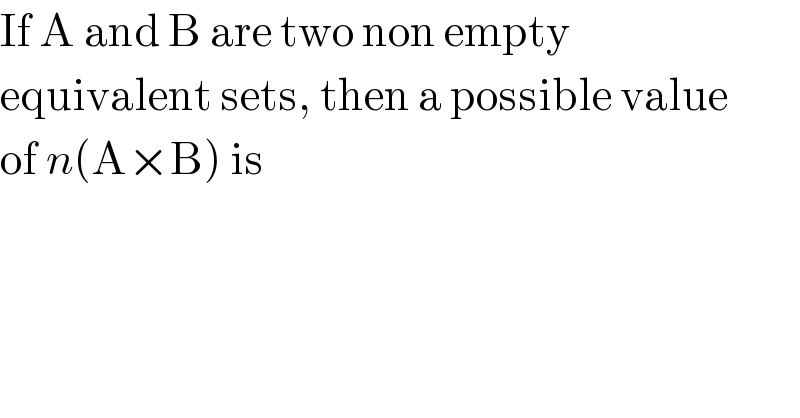
$$\mathrm{If}\:\mathrm{A}\:\mathrm{and}\:\mathrm{B}\:\mathrm{are}\:\mathrm{two}\:\mathrm{non}\:\mathrm{empty}\: \\ $$$$\mathrm{equivalent}\:\mathrm{sets},\:\mathrm{then}\:\mathrm{a}\:\mathrm{possible}\:\mathrm{value} \\ $$$$\mathrm{of}\:{n}\left(\mathrm{A}×\mathrm{B}\right)\:\mathrm{is} \\ $$
Commented by Rasheed.Sindhi last updated on 13/Apr/19
![n(A×B)=n(A)×n(B) ∵ n(A)=n(B) ∴ n(A×B)=n(A)×n(A)=[n(A)]^2](https://www.tinkutara.com/question/Q57828.png)
$${n}\left(\mathrm{A}×\mathrm{B}\right)={n}\left(\mathrm{A}\right)×{n}\left(\mathrm{B}\right) \\ $$$$\because\:{n}\left(\mathrm{A}\right)=\mathrm{n}\left(\mathrm{B}\right) \\ $$$$\therefore\:{n}\left(\mathrm{A}×\mathrm{B}\right)={n}\left(\mathrm{A}\right)×{n}\left(\mathrm{A}\right)=\left[{n}\left(\mathrm{A}\right)\right]^{\mathrm{2}} \\ $$